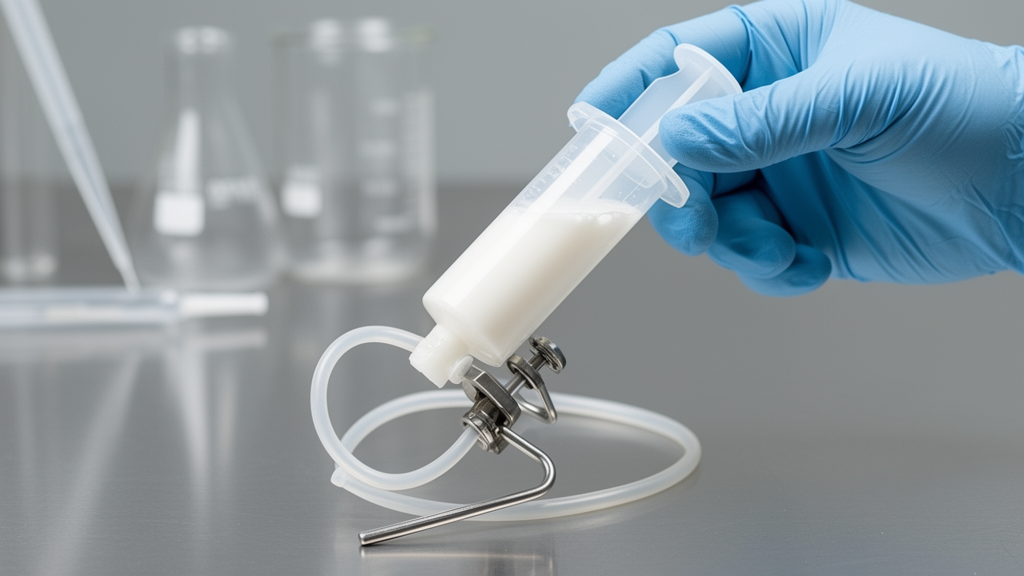
Administering oral medications through enteral feeding tubes is a daily challenge in hospitals, especially for patients who cannot swallow tablets or capsules. Most oral drugs were never designed to travel through a narrow, flexible tube, so pharmacists must convert solid dosage forms into liquids, a process that raises questions about viscosity, drug stability, particle dispersion, and whether drug residue will cling to the tube wall or clog it entirely. A new in vitro study published in AAPS Open reports that a self-emulsifying anhydrous suspension vehicle performed favorably across a battery of laboratory tests designed to answer exactly those questions.
The research team, led by Yi Liu and colleagues, compared a self-emulsifying anhydrous suspension vehicle against two commercially available non-self-emulsifying anhydrous vehicles, using metronidazole 50 mg/mL suspensions as the test case. Two consecutive 10 mL doses were administered through 6.5 French polyurethane feeding tubes, with 15 mL water flushes between and after doses. The 50 mL total challenge volume was deliberately rigorous and was not intended to represent a typical clinical administration volume. After air-drying, the tubes were examined visually for residual deposition.
No complete tube occlusion occurred with any of the three vehicles, but the differences in residue were striking. The self-emulsifying vehicle left minimal visible residue along the inner tube wall and at the tube exit, whereas both non-self-emulsifying vehicles showed visible deposition despite the water flushes, suggesting a potential for drug or vehicle accumulation with repeated administrations. Quantitative recovery testing of the first dose added a numerical dimension: the self-emulsifying vehicle achieved 96.3 ± 4.2 percent recovery with a coefficient of variation of 4.32 percent, while the two comparators showed greater variability, at 111.1 ± 15.5 percent (CV 13.97 percent) and 83.4 ± 30.7 percent (CV 36.80 percent) respectively. Based on these preliminary findings, only the self-emulsifying vehicle was advanced to further evaluation.
The team then prepared five representative formulations in the self-emulsifying vehicle: metronidazole 50 mg/mL, doxycycline 100 mg/mL, nifedipine 4 mg/mL, chloroquine phosphate equivalent to 10 mg/mL chloroquine, and valacyclovir 50 mg/mL. These were chosen from medications frequently compounded at a local pediatric hospital and were designed to span a range of clinically relevant characteristics, including different aqueous solubilities, aqueous stabilities, drug loadings, and drug sources, with some prepared from USP-grade API powder and others from crushed commercial tablets. Chloroquine powder was sifted through a 40-mesh strainer before mixing, while valacyclovir powder was not sifted, a deliberate contrast intended to reflect real-world compounding conditions.
All five formulations demonstrated acceptable potency and content uniformity when measured with validated UPLC methods prior to the tube studies. Drug recovery, tested in triplicate with tubes secured at a 30-degree angle to simulate the posture of bedridden patients, exceeded 90 percent across all formulations and tube types, with mean recovery ranging from 90.8 percent to 100.6 percent. The authors note that recovery values slightly above 100 percent occasionally appear in analytical recovery studies and are likely attributable to cumulative experimental variability in suspension withdrawal, volumetric collection, and assay measurement rather than any actual drug gain.
Tube occlusion risk proved to be both formulation-dependent and tube size-dependent. Formulations made from API powder or sifted tablets passed through all 6.5 French nasogastric tubes made of polyurethane and polyvinyl chloride. However, doxycycline 100 mg/mL and metronidazole 50 mg/mL caused clogging in 6.5 French silicone tubes, which have narrower inner diameters than polyurethane or PVC tubes of the same French size. Metronidazole passed successfully when retested in 8 French silicone tubes, while doxycycline, though never completely occluding tubes, left visible deposits in several 8 French silicone tubes and passed cleanly only in 12 French silicone tubes. The unsifted valacyclovir formulation, containing large excipient chunks, could not pass through 8 French tubes but flowed without occlusion or deposit through 10 French polyurethane and PVC tubes and 12 French silicone gastrostomy tubes.
Osmolality, an important safety consideration particularly for pediatric and jejunal administration, required an adapted approach. Because the vehicle is anhydrous, it has no measurable osmolality by conventional freezing-point depression osmometry, so samples were diluted 1:5 with water before measurement. The vehicle itself registered 116 ± 7 mOsm/kg after dilution, and all tested formulations showed values below or around 300 mOsm/kg, a range the authors cite as acceptable for both gastric and jejunal administration. The contrast with a published value for metronidazole 50 mg/mL in the aqueous Ora-Sweet/Ora-Plus vehicle, reported at 1217 mOsm/kg, is notable, indicating that the anhydrous vehicle contributes considerably less osmotic load after administration. Valacyclovir osmolality testing was excluded because its large insoluble excipient particles could interfere with reliable measurement.
Compatibility with feeding tube materials was assessed by immersing 2-inch segments of polyurethane, PVC, and silicone tubes in the vehicle for 5 days at 40 °C followed by 24 hours at 38 °C, with water-immersed segments serving as negative controls. Light microscopic examination found no discoloration, structural alteration, loss of flexibility, or other visible changes compared with the controls, suggesting compatibility under intended short-term use. Separately, stability studies using validated stability-indicating methods showed that all tested formulations maintained physical and chemical stability for up to 180 days in amber plastic bottles under both refrigerated and room temperature conditions, a finding the authors suggest could enable extended beyond-use dates without preservatives.
The authors propose, cautiously, that the improved performance may stem from the vehicle’s dispersion and rheological behavior. In previous work, the self-emulsifying vehicle formed a homogeneous emulsion rapidly upon contact with water, whereas the non-self-emulsifying comparators remained separated phases; it also showed higher apparent viscosity at rest (86.57 Pa·s versus 22.42 and 17.41 Pa·s) and pronounced thixotropy, thinning under shear and recovering afterward. The authors emphasize, however, that the present study was not designed to establish these mechanisms, and the extent of their contribution remains undetermined and should be regarded as plausible hypotheses rather than demonstrated causes.
The limitations deserve clear emphasis. This was an in vitro study, so clinical outcomes in real patients remain unverified. Not all feeding tube designs on the market were tested, so the observed suitability cannot be extrapolated to every tube. The head-to-head comparison against non-self-emulsifying vehicles used metronidazole as a single model drug, and the study was not designed to establish advantage over non-self-emulsifying or aqueous vehicles generally. Extractables and leachables were not investigated, cumulative effects of repeated dosing and long-term administration were not evaluated, and the study did not assess post-administration drug absorption or bioavailability, which the authors note may differ for lipid-based vehicles and would require particular care for narrow-therapeutic-window drugs. Within those boundaries, the findings support the self-emulsifying anhydrous suspension vehicle as a promising alternative dispersion medium for enteral administration of challenging oral medications, with further studies of additional formulations, multi-drug combinations, and clinical performance warranted.
Subject of Research: Laboratory evaluation of a self-emulsifying anhydrous suspension vehicle for delivering medications through enteral feeding tubes
Article Title: In vitro performance evaluation of a self-emulsifying anhydrous suspension vehicle for enteral drug administration
Article References: Liu, Y., Banov, D., Davis, C., Denison, J., Day, A. J., Shan, A., Song, G., Ip, K., Iqbal, Z., & Zdoryk, O. (2026). In vitro performance evaluation of a self-emulsifying anhydrous suspension vehicle for enteral drug administration. AAPS Open, 12(1), Article 57. https://doi.org/10.1186/s41120-026-00196-w
Image Credits: AI Generated
DOI: 10.1186/s41120-026-00196-w
Keywords: enteral feeding tubes, anhydrous suspension vehicle, self-emulsifying, drug recovery, tube occlusion, osmolality, compounding, pharmaceutics, in vitro testing, pediatric pharmacy, drug delivery, material compatibility
News Source: Ophelia Keating. (October 29, 2026). New Anhydrous Suspension Vehicle Shows Strong In Vitro Feeding Tube Performance. Scienmag.