• HOME
  • NEWS
  • EXPLORE
    • CAREER
      • Companies
      • Jobs
    • EVENTS
    • iGEM
      • News
      • Team
    • PHOTOS
    • VIDEO
    • WIKI
  • BLOG
  • COMMUNITY
    • FACEBOOK
    • INSTAGRAM
    • TWITTER
Saturday, May 23, 2026
BIOENGINEER.ORG
No Result
View All Result
  • Login
  • HOME
  • NEWS
  • EXPLORE
    • CAREER
      • Companies
      • Jobs
        • Lecturer
        • PhD Studentship
        • Postdoc
        • Research Assistant
    • EVENTS
    • iGEM
      • News
      • Team
    • PHOTOS
    • VIDEO
    • WIKI
  • BLOG
  • COMMUNITY
    • FACEBOOK
    • INSTAGRAM
    • TWITTER
  • HOME
  • NEWS
  • EXPLORE
    • CAREER
      • Companies
      • Jobs
        • Lecturer
        • PhD Studentship
        • Postdoc
        • Research Assistant
    • EVENTS
    • iGEM
      • News
      • Team
    • PHOTOS
    • VIDEO
    • WIKI
  • BLOG
  • COMMUNITY
    • FACEBOOK
    • INSTAGRAM
    • TWITTER
No Result
View All Result
Bioengineer.org
No Result
View All Result
Home NEWS Science News Chemistry

New algorithm predicts optimal materials among all possible compounds

Bioengineer by Bioengineer
May 14, 2020
in Chemistry
Reading Time: 2 mins read
0
IMAGE
Share on FacebookShare on TwitterShare on LinkedinShare on RedditShare on Telegram

IMAGE

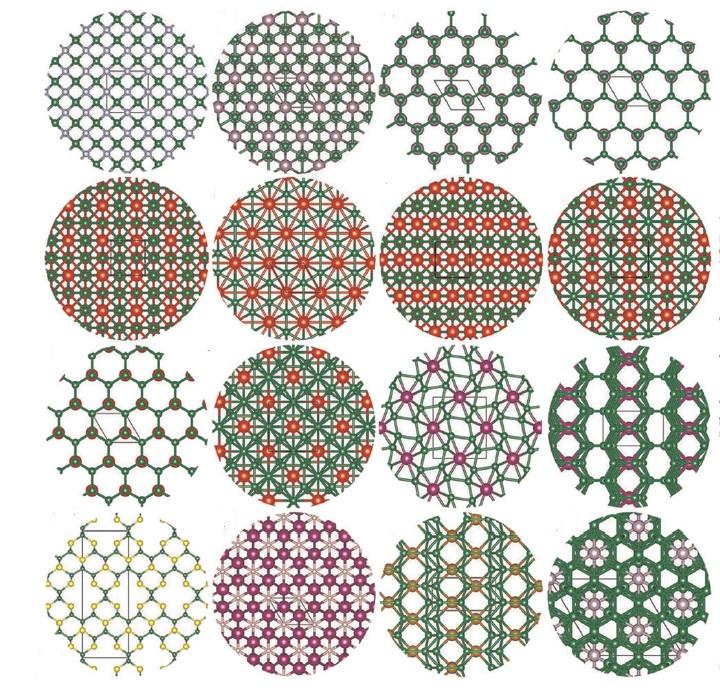
Credit: Zahed Allahyari and Artem R. Oganov / NPJ Computational Materials

Skoltech researchers have offered a solution to the problem of searching for materials with required properties among all possible combinations of chemical elements. These combinations are virtually endless, and each has an infinite multitude of possible crystal structures; it is not feasible to test them all and choose the best option (for instance, the hardest compound) either in an experiment or in silico. The computational method developed by Skoltech professor Artem R. Oganov and his PhD student Zahed Allahyari solves this major problem of theoretical materials science. Oganov and Allahyari presented their method in the MendS code (stands for Mendelevian Search) and tested it on superhard and magnetic materials.

“In 2006, we developed an algorithm that can predict the crystal structure of a given fixed combination of chemical elements. Then we increased its predictive powers by teaching it to work without a specific combination — so one calculation would give you all stable compounds of given elements and their respective crystal structures. The new method tackles a much more ambitious task: here, we pick neither a precise compound nor even specific chemical elements — rather, we search through all possible combinations of all chemical elements, taking into account all possible crystal structures, and find those that have the needed properties (e.g., highest hardness or highest magnetization)” says Artem Oganov, Skoltech and MIPT professor, Fellow of the Royal Society of Chemistry and a member of Academia Europaea.

The researchers first figured out that it was possible to build an abstract chemical space so that compounds that would be close to each other in this space would have similar properties. Thus, all materials with peculiar properties (for example, superhard materials) will be clustered in certain areas, and evolutionary algorithms will be particularly effective for finding the best material. The Mendelevian Search algorithm runs through a double evolutionary search: for each point in the chemical space, it looks for the best crystal structure, and at the same time these found compounds compete against each other, mate and mutate in a natural selection of the best one.

To test the efficacy of the new method, scientists gave their machine a task to find the composition and structure of the hardest material. Their algorithm returned diamond, which makes pursuits for materials harder than diamond a dead end. Moreover, the algorithm also predicted several dozen hard and superhard phases, including most of the already known materials and several completely new ones.

This method can speed up the search for record-breaking materials and usher in new technological breakthroughs. Equipped with these materials, scientists can create brand new technologies or increase the efficiency and availability of old ones.

###

Media Contact
Alina Chernova
[email protected]

Related Journal Article

http://dx.doi.org/10.1038/s41524-020-0322-9

Tags: Chemistry/Physics/Materials SciencesMaterials
Share12Tweet8Share2ShareShareShare2

Related Posts

Study Reveals How Valproate Affects Early Brain Development: Insights into the Antiepileptic Drug’s Impact — Chemistry

Study Reveals How Valproate Affects Early Brain Development: Insights into the Antiepileptic Drug’s Impact

May 22, 2026
Sustainable Chemistry: Iron Replaces Noble Metals in Catalytic Reactions — Chemistry

Sustainable Chemistry: Iron Replaces Noble Metals in Catalytic Reactions

May 22, 2026

Advancing Thin-Film Device Manufacturing with Imaging Ellipsometry for Enhanced Process Control

May 22, 2026

Simple Adjustment in 3D Printing Enhances Fit of Dental Crowns

May 22, 2026
Please login to join discussion

POPULAR NEWS

  • blank

    New Study Reveals Plants Can Detect the Sound of Rain

    734 shares
    Share 293 Tweet 183
  • ESMO 2025: mRNA COVID Vaccines Enhance Efficacy of Cancer Immunotherapy

    312 shares
    Share 125 Tweet 78
  • Research Indicates Potential Connection Between Prenatal Medication Exposure and Elevated Autism Risk

    847 shares
    Share 339 Tweet 212
  • Common Food Preservatives Associated with Elevated Blood Pressure and Increased Heart Disease Risk

    55 shares
    Share 22 Tweet 14

About

We bring you the latest biotechnology news from best research centers and universities around the world. Check our website.

Follow us

Recent News

Chewing, Nutrition, and Frailty in Elderly Patients

Fractional SIR Model Explores Vaccination Impact on Childhood Diseases

Fish Consumption and Mercury Exposure in Chicago Asians

Subscribe to Blog via Email

Enter your email address to subscribe to this blog and receive notifications of new posts by email.

Join 83 other subscribers
  • Contact Us

Bioengineer.org © Copyright 2023 All Rights Reserved.

Welcome Back!

Login to your account below

Forgotten Password?

Retrieve your password

Please enter your username or email address to reset your password.

Log In
No Result
View All Result
  • Homepages
    • Home Page 1
    • Home Page 2
  • News
  • National
  • Business
  • Health
  • Lifestyle
  • Science

Bioengineer.org © Copyright 2023 All Rights Reserved.