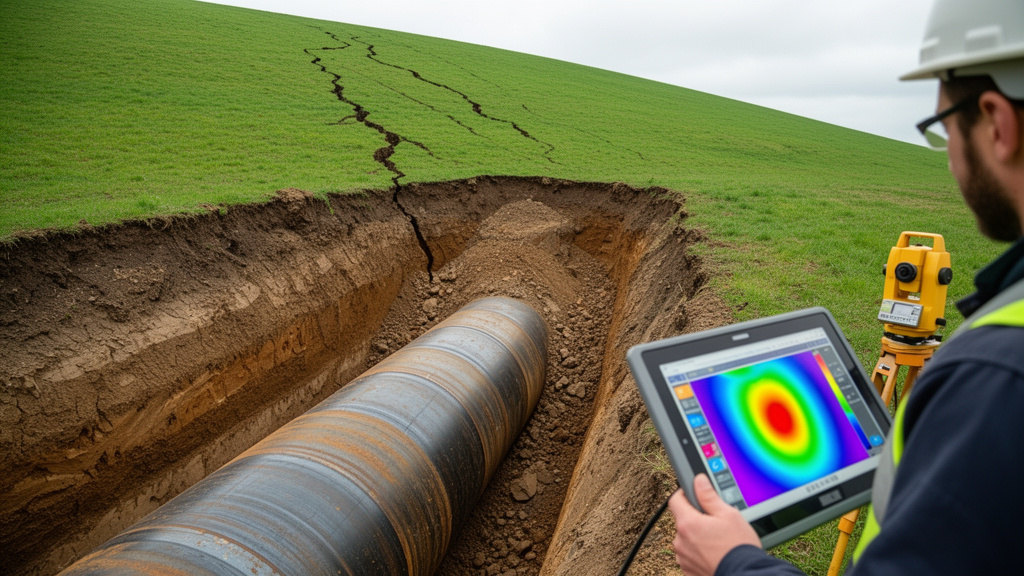
Buried oil and gas pipelines that cross mountainous terrain are routinely exposed to transverse landslide loading, and assessing how these loads deform and stress the pipe is a central task in structural safety evaluation. A new study published in Frontiers in Mechanical Engineering proposes a physics-informed neural network (PINN) framework that handles both forward mechanical prediction and inverse load identification for such pipelines in a single computational architecture.
Conventional finite element methods remain the standard tool for forward analysis of pipeline structures, but the authors note a key limitation: they cannot natively assimilate sparse field monitoring data, which is essential when the landslide-induced load itself is unknown and must be reconstructed from measurements. PINNs, which embed physical equations directly into neural network training, can in principle serve both forward and inverse problems, yet their practical use on large-scale pipeline models has been hampered by spectral bias, strict continuity requirements of strong-form formulations, and the computational overhead of automatic differentiation.
To overcome these obstacles, the research team—affiliated with Zhejiang Natural Resources Group Spatial Information, the PipeChina Institute of Science and Technology, and the Institute of Mechanics of the Chinese Academy of Sciences—built a domain-decomposed, energy-based PINN for Winkler-supported pipeline beams. The design uses single-hidden-layer networks combined with cubic Hermite interpolation, analytical differentiation instead of automatic differentiation, and a weak-form energy loss functional, choices intended to improve training stability and efficiency for large structural problems.
The framework supports two distinct inverse tasks. In the first, single-stage static load identification is formulated as a bilevel optimization problem with Tikhonov regularization to stabilize the ill-posed reconstruction of unknown loads. In the second, two-stage time-varying load evolution is tracked through dual-network temporal coupling, allowing the method to refine estimates of changing load amplitudes over successive monitoring stages.
A notable advantage of the unified PINN architecture is its flexibility in fusing heterogeneous monitoring data. Deflection, rotation, and strain measurements can all be incorporated across staged monitoring procedures, so operators are not restricted to a single sensor type when reconstructing the loads acting on a buried line.
Forward validation against ABAQUS benchmarks under both cosine-shaped and asymmetric ridge load distributions produced relative errors below 0.2% for deflection, rotation, bending moment, and strain, indicating that the neural approach reproduces the standard finite element solution to high precision for these test cases.
The inverse tests showed that deflection-based monitoring achieves high-accuracy load reconstruction, with a root-mean-square error below 80 kN/m when five or more sensors are deployed. For time-varying loads, the two-stage incremental monitoring procedure effectively refines the load amplitude estimate, although the authors emphasize that the achievable accuracy remains constrained by the baseline quality of the initial sparse inversion—meaning the first, data-poor stage sets a floor on how well the subsequent refinement can perform.
Robustness was examined by adding Gaussian noise at 5% of peak amplitude to the data. Under this perturbation, the load identification accuracy and the inherent sensitivity hierarchy of the structural responses were well preserved, which the authors interpret as evidence of favorable noise robustness and reliability for field conditions where measurements are never perfectly clean.
The study, received in August 2026 and accepted in September 2026, is presented as an accurate, robust, and efficient physics-informed paradigm for geohazard monitoring and safety assessment of buried pipeline infrastructure. By combining a weak-form energy formulation with domain decomposition and analytical differentiation, the method addresses the specific computational bottlenecks that have limited PINN deployment on large-scale structural problems, while retaining the unified forward-inverse capability that distinguishes it from conventional finite element workflows.
Subject of Research: A physics-informed neural network method for forward and inverse analysis of buried pipelines under landslide loading
Article Title: A physics-informed neural network-based computational method for forward and inverse analysis of buried pipelines subjected to lateral landslides
Article References: Xinxing, Z., Fuping, W., Liangliang, L., Tianping, L., & Xiaoyu, L. (2026). A physics-informed neural network-based computational method for forward and inverse analysis of buried pipelines subjected to lateral landslides. Frontiers in Mechanical Engineering, 12, 1974386. https://doi.org/10.3389/fmech.2026.1974386
Image Credits: AI Generated
DOI: 10.3389/fmech.2026.1974386
Keywords: buried pipelines, landslides, physics-informed neural networks, load identification, domain decomposition, Winkler foundation, structural health monitoring, inverse problems, geohazards, pipeline safety, physics-informed, neural
News Source: Cassandra Pierce. (October 28, 2026). Neural Network Method Pinpoints Landslide Loads on Buried Pipelines. Scienmag.