• HOME
  • NEWS
  • EXPLORE
    • CAREER
      • Companies
      • Jobs
    • EVENTS
    • iGEM
      • News
      • Team
    • PHOTOS
    • VIDEO
    • WIKI
  • BLOG
  • COMMUNITY
    • FACEBOOK
    • INSTAGRAM
    • TWITTER
Saturday, May 16, 2026
BIOENGINEER.ORG
No Result
View All Result
  • Login
  • HOME
  • NEWS
  • EXPLORE
    • CAREER
      • Companies
      • Jobs
        • Lecturer
        • PhD Studentship
        • Postdoc
        • Research Assistant
    • EVENTS
    • iGEM
      • News
      • Team
    • PHOTOS
    • VIDEO
    • WIKI
  • BLOG
  • COMMUNITY
    • FACEBOOK
    • INSTAGRAM
    • TWITTER
  • HOME
  • NEWS
  • EXPLORE
    • CAREER
      • Companies
      • Jobs
        • Lecturer
        • PhD Studentship
        • Postdoc
        • Research Assistant
    • EVENTS
    • iGEM
      • News
      • Team
    • PHOTOS
    • VIDEO
    • WIKI
  • BLOG
  • COMMUNITY
    • FACEBOOK
    • INSTAGRAM
    • TWITTER
No Result
View All Result
Bioengineer.org
No Result
View All Result
Home NEWS Science News

NASA sees Tropical Storm Blake’s center off Australia’s Kimberley Coast

Bioengineer by Bioengineer
January 7, 2020
in Science News
Reading Time: 2 mins read
0
IMAGE
Share on FacebookShare on TwitterShare on LinkedinShare on RedditShare on Telegram

IMAGE

Credit: NASA Worldview, Earth Observing System Data and Information System (EOSDIS)


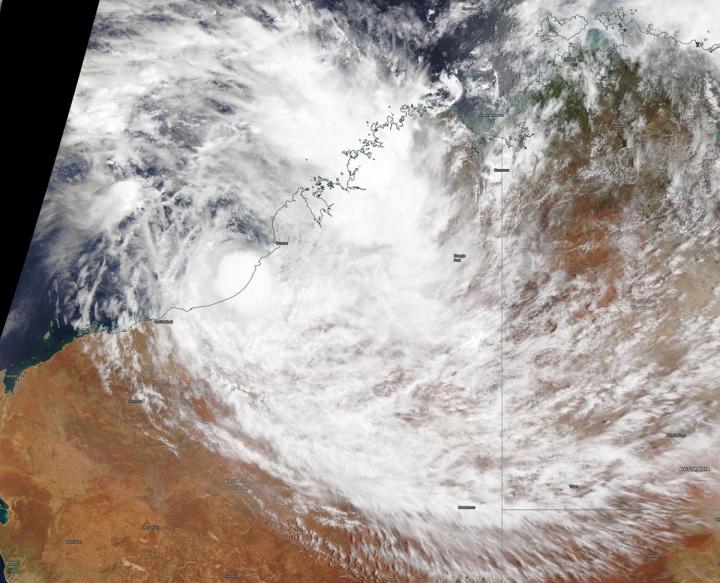
NASA’s Terra satellite passed over the Southern Indian Ocean on January 7 and found the center of Tropical Storm Blake just of the Kimberley coast of Western Australia.

The Australian Bureau of Meteorology or ABM noted that the Warning Zone for the storm stretches from Bidyadanga to De Grey, extending inland to Shay Gap.

On January 7, the Moderate Imaging Spectroradiometer or MODIS instrument that flies aboard NASA’s Terra satellite provided a visible image of Blake that showed a rounded center of circulation surrounded by strong thunderstorms. A rounded shape of a tropical cyclone indicates an organized storm. That center was located just off shore from Bidyadanga. Bidyadanga is also known as La Grange and has the largest Aboriginal community in Western Australia.

The MODIS image showed the extent of the southern quadrant of Blake’s clouds stretching inland into the northwestern part of Western Australia.

At 7 a.m. EST (1200 UTC/8 p.m. AWST local time), Blake had maximum sustained winds near 75 kph (47 mph). Blake is centered near latitude 19.1 degrees south and longitude 121.0 degrees east, about 85 kilometers (km) (53 miles) north northeast of Wallal Downs and 95 km (59 miles) west southwest of Bidyadanga. Blake is moving to the south.

ABM forecasters said that Blake is likely to track close to the west Kimberley coast this evening and cross the coast along Eighty Mile Beach near Wallal Downs early Wednesday morning, January 8. “There is a chance the system may take a more southwest track early Wednesday morning close to the coast. If this occurs, it may stay just far enough off the coast to intensify slightly further before making landfall later Wednesday morning between Wallal Downs and Pardoo Roadhouse,” according to ABM.

Tropical Cyclone Blake is moving south and is expected to make landfall near Wallal Downs early Wednesday morning, January 8.

NASA’s Terra satellite is one in a fleet of NASA satellites that provide data for hurricane research.

###

Tropical cyclones and hurricanes are the most powerful weather events on Earth. NASA’s expertise in space and scientific exploration contributes to essential services provided to the American people by other federal agencies, such as hurricane weather forecasting.

For updated forecasts from ABM, visit: http://www.bom.gov.au/

By Rob Gutro

NASA’s Goddard Space Flight Center

Media Contact
Rob Gutro
[email protected]

Original Source

https://blogs.nasa.gov/hurricanes/2020/01/07/blake-southern-indian-ocean-2/

Tags: Atmospheric ChemistryAtmospheric ScienceClimate ChangeClimate ScienceEarth ScienceMeteorologyTechnology/Engineering/Computer ScienceTemperature-Dependent PhenomenaWeather/Storms
Share12Tweet8Share2ShareShareShare2

Related Posts

New Actinomycin Derivatives Target Malaria More Selectively

May 16, 2026

Mobile App Enhances Exercise for Older Adults’ Cognition

May 16, 2026

Botulinum Toxin Reduces Urinary Retention Post-Hemorrhoidopexy

May 16, 2026

Blood Metal Exposure Linked to Puberty Timing

May 16, 2026
Please login to join discussion

POPULAR NEWS

  • Research Indicates Potential Connection Between Prenatal Medication Exposure and Elevated Autism Risk

    843 shares
    Share 337 Tweet 211
  • New Study Reveals Plants Can Detect the Sound of Rain

    730 shares
    Share 291 Tweet 182
  • Salmonella Haem Blocks Macrophages, Boosts Infection

    62 shares
    Share 25 Tweet 16
  • Breastmilk Balances E. coli and Beneficial Bacteria in Infant Gut Microbiomes

    58 shares
    Share 23 Tweet 15

About

We bring you the latest biotechnology news from best research centers and universities around the world. Check our website.

Follow us

Recent News

New Actinomycin Derivatives Target Malaria More Selectively

Mobile App Enhances Exercise for Older Adults’ Cognition

Botulinum Toxin Reduces Urinary Retention Post-Hemorrhoidopexy

Subscribe to Blog via Email

Enter your email address to subscribe to this blog and receive notifications of new posts by email.

Join 82 other subscribers
  • Contact Us

Bioengineer.org © Copyright 2023 All Rights Reserved.

Welcome Back!

Login to your account below

Forgotten Password?

Retrieve your password

Please enter your username or email address to reset your password.

Log In
No Result
View All Result
  • Homepages
    • Home Page 1
    • Home Page 2
  • News
  • National
  • Business
  • Health
  • Lifestyle
  • Science

Bioengineer.org © Copyright 2023 All Rights Reserved.