• HOME
  • NEWS
  • EXPLORE
    • CAREER
      • Companies
      • Jobs
    • EVENTS
    • iGEM
      • News
      • Team
    • PHOTOS
    • VIDEO
    • WIKI
  • BLOG
  • COMMUNITY
    • FACEBOOK
    • INSTAGRAM
    • TWITTER
Thursday, May 14, 2026
BIOENGINEER.ORG
No Result
View All Result
  • Login
  • HOME
  • NEWS
  • EXPLORE
    • CAREER
      • Companies
      • Jobs
        • Lecturer
        • PhD Studentship
        • Postdoc
        • Research Assistant
    • EVENTS
    • iGEM
      • News
      • Team
    • PHOTOS
    • VIDEO
    • WIKI
  • BLOG
  • COMMUNITY
    • FACEBOOK
    • INSTAGRAM
    • TWITTER
  • HOME
  • NEWS
  • EXPLORE
    • CAREER
      • Companies
      • Jobs
        • Lecturer
        • PhD Studentship
        • Postdoc
        • Research Assistant
    • EVENTS
    • iGEM
      • News
      • Team
    • PHOTOS
    • VIDEO
    • WIKI
  • BLOG
  • COMMUNITY
    • FACEBOOK
    • INSTAGRAM
    • TWITTER
No Result
View All Result
Bioengineer.org
No Result
View All Result
Home NEWS Science News

NASA-NOAA satellite finds Tropical Storm Mario more out of shape

Bioengineer by Bioengineer
September 19, 2019
in Science News
Reading Time: 3 mins read
0
IMAGE
Share on FacebookShare on TwitterShare on LinkedinShare on RedditShare on Telegram

IMAGE

Credit: NASA Worldview, Earth Observing System Data and Information System (EOSDIS)

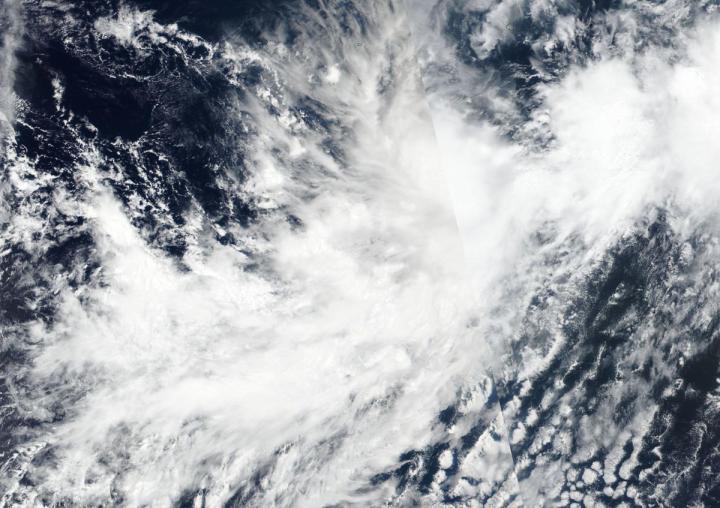
NASA-NOAA’s Suomi NPP satellite imagery revealed Tropical Storm Mario appeared to be losing its rounded shape in the Eastern Pacific Ocean.

When tropical cyclones begin to lose their shape and appear less circular, it is generally an indication of a storm that is weakening. Circular storms can spin faster, just like a tire on a car. Once the tire loses its circular shape it can’t rotate as fast.

The Visible Infrared Imaging Radiometer Suite (VIIRS) instrument aboard Suomi NPP provided a visible image of Mario on Sept. 18 at 5:36 p.m. EDT (2136 UTC) that indicated wind shear was affecting the storm as it did not appear circular as a result of wind shear. NPP data is used by forecasters at NOAA’s National Hurricane Center to assess factors of the storm that include structure and strength.

NASA’s Aqua satellite also passed over Mario and provided cloud top temperature data. Aqua showed Mario contained some powerful thunderstorms stretching high into the troposphere with cloud top temperatures as cold as or colder than 220 Kelvin (minus 63 degrees Fahrenheit / minus 53 degrees Celsius). NASA research has shown that storms with cloud top temperatures that cold can produce heavy rainfall.

NHC forecasters also utilized data to determine moderate easterly wind shear, associated at least in part with outflow from Mario’s larger sibling (Lorena) to the east, has prevented the tropical storm from strengthening at a faster rate.

In general, wind shear is a measure of how the speed and direction of winds change with altitude. Tropical cyclones are like rotating cylinders of winds. Each level needs to be stacked on top each other vertically in order for the storm to maintain strength or intensify. Wind shear occurs when winds at different levels of the atmosphere push against the rotating cylinder of winds, weakening the rotation by pushing it apart at different levels.

During the morning of Sept. 19, microwave and first-light visible imagery suggest that the low-level center of Mario may be displaced to the east of most of its strongest thunderstorms, indicating a weakening storm.

NOAA’s National Hurricane Center or NHC said, “At 11 a.m. EDT (1500 UTC), the center of Tropical Storm Mario was located near latitude 16.5 degrees north and longitude 111.5  degrees west. Mario is moving toward the north near 7 mph (11 kph). Maximum sustained winds are near 65 mph (100 kph) with higher gusts.  Little change in strength is forecast during the next several days.

Mario is currently embedded within low- to mid-layer southwesterly flow and this should cause the cyclone to move generally northeastward or north-northeastward for the next day or two. What happens after that depends largely on Lorena.

###

Hurricanes are the most powerful weather event on Earth. NASA’s expertise in space and scientific exploration contributes to essential services provided to the American people by other federal agencies, such as hurricane weather forecasting.

For updated forecasts. visit: http://www.nhc.noaa.gov

By Rob Gutro 

NASA’s Goddard Space Flight Center

Media Contact
Rob Gutro
[email protected]

Original Source

https://blogs.nasa.gov/hurricanes/2019/09/19/mario-eastern-pacific-ocean-2/

Tags: Atmospheric ChemistryAtmospheric ScienceClimate ChangeClimate ScienceEarth ScienceMeteorologyTechnology/Engineering/Computer ScienceTemperature-Dependent PhenomenaWeather/Storms
Share13Tweet8Share2ShareShareShare2

Related Posts

Why Emus Can’t Fly: Unlocking the Mystery Hidden in Bird Embryos — Biology

Why Emus Can’t Fly: Unlocking the Mystery Hidden in Bird Embryos

May 14, 2026
IgG Fucosylation Associated with Severe COVID-19 Progression and its Modulation by Traditional Chinese Medicine Therapy — Technology and Engineering

IgG Fucosylation Associated with Severe COVID-19 Progression and its Modulation by Traditional Chinese Medicine Therapy

May 14, 2026

Link Between Air Pollution Exposure and Increased Risk of Lewy Body and Parkinson’s Disease-Related Dementias

May 14, 2026

Innovating an Affordable and Sustainable Marimba #ASA190

May 14, 2026
Please login to join discussion

POPULAR NEWS

  • Research Indicates Potential Connection Between Prenatal Medication Exposure and Elevated Autism Risk

    842 shares
    Share 337 Tweet 211
  • New Study Reveals Plants Can Detect the Sound of Rain

    729 shares
    Share 291 Tweet 182
  • Salmonella Haem Blocks Macrophages, Boosts Infection

    62 shares
    Share 25 Tweet 16
  • Breastmilk Balances E. coli and Beneficial Bacteria in Infant Gut Microbiomes

    57 shares
    Share 23 Tweet 14

About

We bring you the latest biotechnology news from best research centers and universities around the world. Check our website.

Follow us

Recent News

Why Emus Can’t Fly: Unlocking the Mystery Hidden in Bird Embryos

IgG Fucosylation Associated with Severe COVID-19 Progression and its Modulation by Traditional Chinese Medicine Therapy

Link Between Air Pollution Exposure and Increased Risk of Lewy Body and Parkinson’s Disease-Related Dementias

Subscribe to Blog via Email

Enter your email address to subscribe to this blog and receive notifications of new posts by email.

Join 82 other subscribers
  • Contact Us

Bioengineer.org © Copyright 2023 All Rights Reserved.

Welcome Back!

Login to your account below

Forgotten Password?

Retrieve your password

Please enter your username or email address to reset your password.

Log In
No Result
View All Result
  • Homepages
    • Home Page 1
    • Home Page 2
  • News
  • National
  • Business
  • Health
  • Lifestyle
  • Science

Bioengineer.org © Copyright 2023 All Rights Reserved.