For patients diagnosed with a small kidney tumor, the traditional options have long been surgery or careful watching. But a new five-year study from France suggests there may be a third path that is just as effective, and far gentler on the body: freezing the tumor from the inside out. In research published in CVIR Oncology, a team of interventional radiologists and urologists reports that percutaneous cryoablation, a minimally invasive technique that destroys tumors with extreme cold delivered through needle-like probes, achieved remarkable results in patients with papillary renal cell carcinoma, one of the less common and more indolent forms of kidney cancer. Over a median follow-up extending to five years, not a single patient in the study died of their cancer, and not one developed metastatic disease.
The study, conducted at a single center between May 2008 and February 2020, followed 48 consecutive patients who were treated for a total of 53 biopsy-confirmed papillary renal cell carcinoma tumors. These were not healthy surgical candidates: the patients had been deemed unfit for partial nephrectomy, the current gold-standard operation for localized kidney cancer, because of advanced age, impaired kidney function, or poor overall condition, while some had simply declined surgery. Every case was reviewed by a multidisciplinary tumor board that included urologists, oncologists, radiologists, pathologists, and radiation oncologists before cryoablation was chosen. The cohort was predominantly male, with 39 men and 9 women, and the median age was 69.5 years, with patients ranging from 36 to 88 years old.
Papillary renal cell carcinoma is a distinct entity within the family of kidney cancers. While clear cell renal cell carcinoma is the most common histological type, papillary tumors account for roughly 10 to 15 percent of all renal cell carcinomas and are generally associated with better outcomes. The World Health Organization formally listed the entity in its 2016 classification of renal tumors, and pathologists further divide papillary tumors into two subtypes: type 1, which tends to be slower growing and more indolent, and type 2, which carries more aggressive features such as higher tumor grade, necrosis, and lymphovascular invasion. In the French series, type 1 tumors dominated the cohort, making up 46 of the 53 lesions, or 88.8 percent, while type 2 tumors accounted for the remaining 11.2 percent.
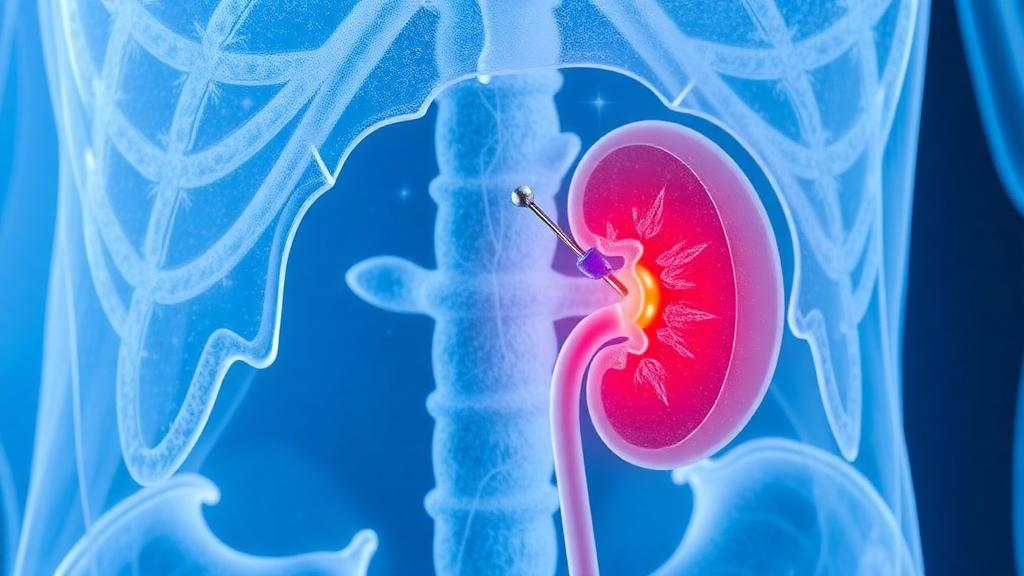
The technical execution of the procedure reveals why cryoablation has become such a powerful tool in interventional oncology. All treatments were performed by experienced interventional radiologists under general anesthesia or sedation, with the patient staying in hospital. Using computed tomography or magnetic resonance imaging for guidance, the radiologists inserted between two and four thin cryoprobes, typically 15 to 17 gauge, directly through the skin and into the tumor. The number, type, and positioning of the probes were tailored to each tumor’s size, location, and morphology, with the goal of enveloping the entire tumor in a lethal ice ball that extended 5 to 10 millimeters beyond its visible margins. For MRI-guided procedures, the team used MRI-compatible probes and near real-time multiplanar MRI fluoroscopy, allowing them to watch the ice ball grow in three dimensions as it formed.
Each ablation followed a standardized freeze-thaw protocol: two freezing cycles of 10 minutes each, separated by a 10-minute passive thawing period. This repetition is critical to the biology of cryodestruction. Rapid freezing causes ice crystals to form inside and around cells, rupturing their membranes, while the thawing and refreezing cycles amplify vascular damage, cutting off the tumor’s blood supply and ensuring that cells at the margin of the ice ball, where temperatures are less extreme, are still lethally injured. When tumors sat close to vulnerable structures such as the bowel or the abdominal wall, the team performed hydro-dissection or pneumo-dissection, injecting fluid or gas to physically push those organs out of harm’s way. In one striking example described in the study, sterile gloves filled with warm saline were placed over the skin at the probe entry sites to prevent frostbite, because MRI-compatible cryoprobes are not insulated along their shafts.
The results were striking on nearly every measure. Technical efficacy, defined as the absence of contrast enhancement and tumor enlargement on imaging within three months of the procedure, was achieved in all 53 tumors, a 100 percent success rate in destroying the treated lesion. The overall complication rate was just 11 percent, and every single complication was minor, classified as grade 2 or lower on the standard Clavien-Dindo scale. No patient required hemodialysis after treatment, a crucial finding given that many of these patients already had compromised kidney function, and a quarter of the cohort had only a single kidney. The median hospital stay was three days, and the median procedure took 127 minutes.
Oncologic outcomes were equally impressive. Only three of the 53 tumors, or 5.7 percent, recurred locally during follow-up, with a mean time to recurrence of 36 months. Two of the recurrences occurred in type 1 tumors and one in a type 2 tumor, a difference that was not statistically significant but is consistent with the known biology of the more aggressive type 2 subtype, which in this study also carried higher International Society of Urologic Pathologists grade scores. Two of the three recurrences were successfully treated with a second cryoablation. When these salvage treatments were factored in, the five-year estimates for local recurrence-free survival reached 95.9 percent for primary treatment and 97.8 percent for secondary effectiveness. Most remarkably, cancer-specific survival and metastasis-free survival were both 100 percent: no patient died of papillary renal cell carcinoma, and no patient ever developed distant metastases. Overall survival at five years was 90.3 percent, with the deaths that did occur attributable to unrelated cancers such as gastric, lung, and duodenal malignancies.
Perhaps the most provocative comparison in the study is with surgery itself. The authors point to a large surgical series of 626 patients with papillary renal cell carcinoma treated with partial nephrectomy, in which five-year cancer-specific survival was 83 percent, local recurrence-free survival was 91 percent, and overall survival was 82 percent, all figures lower than those reported in the cryoablation cohort. The authors are careful to caution against overinterpreting this comparison: there was no direct head-to-head analysis, the surgical series involved larger tumors averaging 4 to 5 centimeters compared with 2 to 3 centimeters in the ablation studies, and the sample sizes differ dramatically. Still, the findings add to a growing body of evidence that thermal ablation can match surgical outcomes for early-stage kidney tumors while avoiding the risks of major surgery, with prior studies showing fewer complications and shorter hospital stays for ablated patients.
The study does carry limitations that the authors acknowledge candidly. Its retrospective design and relatively small sample size, a consequence of the rarity of papillary renal cell carcinoma compared with the clear cell type, mean that larger multicenter studies will be needed to confirm the results. The effect of operator experience was not formally evaluated, although the authors note that their center performs more than 60 renal cryoablations per year, suggesting a consistently high standard of practice. The potential for inter- and intra-observer variability in imaging assessments was also not eliminated. And because the cohort was dominated by type 1 tumors, the findings for the more aggressive type 2 subtype rest on only seven lesions, a reminder that subtype-specific evidence remains thin.
Even with those caveats, the message for clinical practice is clear. For patients with biopsy-confirmed, localized papillary renal cell carcinoma who cannot undergo or decline surgery, percutaneous cryoablation delivered under image guidance offers a treatment that is safe, kidney-preserving, and, on the evidence of five years of follow-up, extraordinarily effective. The authors suggest that when treating type 2 tumors, radiologists should aim for larger ablation safety margins to account for their more aggressive biology. As interventional oncology continues to mature, they argue, cryoablation for renal cell carcinoma, particularly for indolent histologic subtypes like papillary tumors, deserves increased consideration in clinical practice and in future guideline development. For a disease increasingly caught early by incidental imaging, the freezer may prove to be as mighty as the scalpel.
Subject of Research: Percutaneous cryoablation as a treatment for papillary renal cell carcinoma
Article Title: Safety and oncologic efficacy of percutaneous cryoablation of papillary renal cell carcinoma: a 5-year single-center follow-up study
Article References: Mulot, B.-M., de Marini, P., Tan, A. S. M., Orkut, S., Garnon, J., Weiss, J., Autrusseau, P. A., Tricard, T., Lang, H., Cazzato, R. L., & GANGI, A. (2025). Safety and oncologic efficacy of percutaneous cryoablation of papillary renal cell carcinoma: a 5-year single-center follow-up study. CVIR Oncology, 1(1), Article 4. https://doi.org/10.1007/s44343-025-00003-5
Image Credits: AI Generated
DOI: 10.1007/s44343-025-00003-5
Keywords: cryoablation, papillary renal cell carcinoma, kidney cancer, interventional radiology, renal tumors, minimally invasive treatment, oncology, MRI guidance, CT guidance, cancer survival, thermal ablation, nephron-sparing
News Source: Nathaniel Bowman. (October 4, 2026). Freezing Kidney Tumors With Needles Shows Five-Year Success Against Papillary Renal Cancer. Scienmag.