When missiles struck cities across the Gulf in early 2026, patients undergoing cancer treatment in Bahrain faced a psychological collision that few clinical frameworks had anticipated: the terror of a life-threatening illness compounded by the terror of war itself. A new study published in Supportive Care in Cancer offers one of the first real-time portraits of how oncology patients respond when geopolitical crisis and serious disease unfold simultaneously. Drawing on frontline psycho-oncology practice at a tertiary cancer center in Bahrain, the research presents a typology of five distinct response patterns observed among adult patients during a period of acute and ongoing regional tension, providing clinicians with a practical framework for recognizing and addressing distress that standard screening tools were never designed to capture.
The study’s author, Subathra Jeyaram of the Department of Patient Well-Being at the Bahrain Oncology Centre within the Royal Medical Services, grounds the work in direct clinical observation rather than retrospective surveys. This real-time approach matters because the psychological landscape of a crisis is fluid: patients’ fears, coping strategies, and emotional states shift as the security situation evolves, and a snapshot taken months later would inevitably smooth out the very variability the research seeks to document. By describing response patterns as they emerged in clinical interactions, the study captures the heterogeneity of patient experience in a way that conventional distress measurement, which typically treats anxiety and depression as endpoints on a scale, does not.
The first and arguably most striking pattern is the defiant or adaptive response. Patients in this group appeared to absorb the external threat and, in a sense, metabolize it into resolve. Rather than collapsing under the combined weight of illness and insecurity, they continued treatment adherence and maintained engagement with care, sometimes framing their fight against cancer as a battle that no missile could interrupt. This pattern resonates with long-standing theoretical work on coping, particularly Susan Folkman’s influential 1997 model of positive psychological states and coping with severe stress, which demonstrated that even under extreme adversity, people can generate meaning, hope, and positive affect that sustain adaptive functioning. The Bahrain observations suggest that geopolitical crisis can, for some patients, activate rather than suppress these positive coping resources.
At the opposite end of the spectrum sits the overwhelmed pattern, in which the dual burden of cancer and crisis exceeds the patient’s regulatory capacity. These patients experienced the convergence of two existential threats as fundamentally destabilizing, with the uncertainty of the security situation amplifying the already profound uncertainty of a cancer diagnosis. The study situates this pattern within a well-documented research tradition on uncertainty in illness: recent work published in the Journal of Health Psychology in 2025 examined the relationship between illness-related uncertainty and psychological adjustment to chronic disease, finding that prolonged uncertainty is a potent driver of maladjustment. When national events inject a second, uncontrollable source of uncertainty into a patient’s life, the additive effect can push coping systems past their limits, producing acute distress that demands immediate clinical attention.
A third pattern, described as reassuring or other-focused, reveals a subtler psychological dynamic. Patients exhibiting this response directed their emotional energy toward calming family members, fellow patients, or caregivers, presenting themselves as composed even while internally struggling. This other-oriented coping style raises important questions about the accuracy of routine distress screening, because a patient who appears calm and who reassures others may score below clinical thresholds on standard instruments while carrying substantial hidden burden. The National Comprehensive Cancer Network’s Distress Management guidelines, updated in 2026, emphasize systematic screening as the cornerstone of psychosocial oncology care, and this Bahraini typology suggests that screening protocols may need to account for patients whose coping style is to mask their own distress behind caretaking of others.
The fourth pattern, anticipatory anxiety, captures patients whose distress was oriented toward feared future scenarios rather than present circumstances. These individuals experienced intrusive worry about what might happen next: further escalation, disruption of treatment supply chains, evacuation, or personal harm. Cognitive theory offers a lens for understanding this pattern. Research on catastrophic thinking, including a 2016 analysis by Gellatly and Beck published in Cognitive Therapy and Research, identifies catastrophizing as a transdiagnostic process that fuels anxiety across psychiatric conditions. In the oncology setting, where patients already face an uncertain prognosis, the geopolitical crisis supplied fresh material for catastrophic cognitions, effectively doubling the imagined futures over which the mind could ruminate.
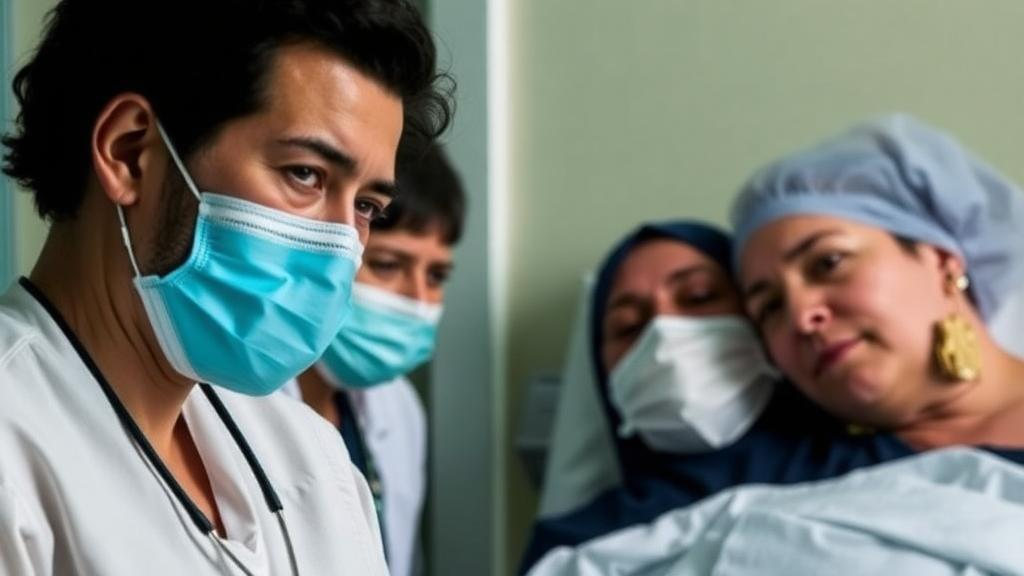
Perhaps the most clinically novel contribution is the fifth pattern: caregiver-patient dyadic anxiety. This pattern recognizes that distress in oncology is rarely an individual phenomenon. The crisis did not stop at the patient’s bedside; it swept up spouses, children, and parents, whose fears about both the war and the illness fed back into the patient’s emotional state. Recent dyadic research in psycho-oncology, including a 2024 study in Psycho-Oncology examining patients’ and caregivers’ attachment orientations and mutually supportive care, underscores that patient and caregiver psychological states are intertwined systems. The Bahrain observations extend this insight into crisis conditions, suggesting that during geopolitical emergencies, the dyad, not the individual, should be the unit of assessment and intervention.
The theoretical significance of the typology lies in how it extends existing models of distress and coping. Classic frameworks such as Miller’s 1987 work on monitoring and blunting describe stable individual styles of information seeking under threat, and Folkman’s model describes how positive states can coexist with severe stress. The Bahrain typology adds a contextual layer: it shows that the same external crisis can evoke qualitatively different response configurations across patients, and that these configurations are observable in real time by trained clinicians. Rather than replacing established theory, the framework functions as an experience-informed bridge between abstract coping constructs and the practical decisions a psycho-oncologist must make during a crisis, such as which patients need urgent intervention, which need family-centered support, and which may benefit most from reinforcement of their existing adaptive strengths.
The context in which these patterns emerged was extraordinary even by the standards of a volatile region. According to reporting cited in the study, Iranian missiles reached Gulf cities in late February 2026 following strikes on Iran, causing casualties in the United Arab Emirates and sending shockwaves of fear through populations across the Arabian Peninsula. Bahrain, a small island nation hosting significant international presence, found itself within the psychological blast radius of a conflict that no one in the oncology ward had chosen. The study also situates the crisis within broader indicators of regional stability and human development, referencing the United Nations Development Programme’s 2023/2024 Human Development Report and comparative crime index data, underscoring that patients’ perceptions of safety are shaped by both objective conditions and the information environment surrounding them.
The practical implications reach far beyond Bahrain. Oncology centers worldwide operate in regions exposed to conflict, natural disaster, and political instability, and even centers in stable countries treat patients who carry trauma from crises elsewhere. The typology offers a vocabulary that clinicians can use to recognize response patterns quickly: the defiant patient who may need help sustaining rather than building coping; the overwhelmed patient who needs immediate stabilization; the reassuring patient who needs permission to disclose hidden fear; the catastrophizing patient who may respond to cognitive techniques targeting anticipatory anxiety; and the anxious dyad that benefits from family-inclusive care. The study also carries a quiet warning about clinician burden, referencing the literature on physician burnout, since frontline staff managing crisis-era oncology care must absorb not only their patients’ distress but the same ambient fear that patients experience.
Published as a conceptual contribution with no datasets generated or analyzed, the study is transparent about its nature: it is a practice-derived typology, not a statistical classification. Its strength is ecological validity, grounded in real interactions at a single tertiary center during an actual crisis; its limitation is the need for empirical validation across settings, cultures, and future emergencies. Yet the framework arrives at a moment when health systems are increasingly asked to plan for the psychosocial consequences of large-scale disruptions, from war to pandemic to climate-driven displacement. By naming five recognizable faces of patient response, the research transforms an amorphous crisis into something clinicians can see, discuss, and act upon, and it makes a compelling case that supportive cancer care must be designed not only for the disease inside the patient but for the world outside the hospital window.
Subject of Research: Psychological response patterns of cancer patients during geopolitical crisis
Article Title: Uncertainty, adaptation, and distress: Understanding cancer patient responses in a time of geopolitical crisis in Bahrain
Article References: Jeyaram, S. (2026). Uncertainty, adaptation, and distress: Understanding cancer patient responses in a time of geopolitical crisis in Bahrain. Supportive Care in Cancer, 34(10), Article 1026. https://doi.org/10.1007/s00520-026-11281-x
Image Credits: AI Generated
DOI: 10.1007/s00520-026-11281-x
Keywords: psycho-oncology, cancer distress, geopolitical crisis, coping, uncertainty in illness, Bahrain, caregiver dyad, anticipatory anxiety, distress screening, resilience, supportive care, mental health
News Source: Nathaniel Bowman. (October 4, 2026). Five Faces of Fear: How Cancer Patients Cope When War Comes to the Hospital Door. Scienmag.