• HOME
  • NEWS
  • EXPLORE
    • CAREER
      • Companies
      • Jobs
    • EVENTS
    • iGEM
      • News
      • Team
    • PHOTOS
    • VIDEO
    • WIKI
  • BLOG
  • COMMUNITY
    • FACEBOOK
    • INSTAGRAM
    • TWITTER
Tuesday, May 12, 2026
BIOENGINEER.ORG
No Result
View All Result
  • Login
  • HOME
  • NEWS
  • EXPLORE
    • CAREER
      • Companies
      • Jobs
        • Lecturer
        • PhD Studentship
        • Postdoc
        • Research Assistant
    • EVENTS
    • iGEM
      • News
      • Team
    • PHOTOS
    • VIDEO
    • WIKI
  • BLOG
  • COMMUNITY
    • FACEBOOK
    • INSTAGRAM
    • TWITTER
  • HOME
  • NEWS
  • EXPLORE
    • CAREER
      • Companies
      • Jobs
        • Lecturer
        • PhD Studentship
        • Postdoc
        • Research Assistant
    • EVENTS
    • iGEM
      • News
      • Team
    • PHOTOS
    • VIDEO
    • WIKI
  • BLOG
  • COMMUNITY
    • FACEBOOK
    • INSTAGRAM
    • TWITTER
No Result
View All Result
Bioengineer.org
No Result
View All Result
Home NEWS Science News Chemistry

Nanocatalysts that remotely control chemical reactions inside living cells

Bioengineer by Bioengineer
August 10, 2020
in Chemistry
Reading Time: 2 mins read
0
IMAGE
Share on FacebookShare on TwitterShare on LinkedinShare on RedditShare on Telegram

IMAGE

Credit: In su Lee (POSTECH)

The enzymes responsible for catalytic reactions in our body’s biological reactions are difficult to use for diagnosis or treatment as they react only to certain molecules or have low stability. Many researchers anticipate that if these issues are ameliorated or if artificial catalysts are developed to create a synergetic effect by meeting the enzymes in the body, there will be new ways to diagnose and treat diseases. In particular, if artificial catalysts that respond to external stimuli such as magnetic fields are developed, new treatment methods that remotely control bioreactions from outside the body can become a reality.

The research team led by Professor In Su Lee of the Department of Chemistry at POSTECH has developed a remote magnetic-sensitive artificial catalyst called MAG-NER, which shows high catalytic efficiency within living cells. The study was published as the supplementary cover paper for Nano Letters, an international journal on nanotechnology.

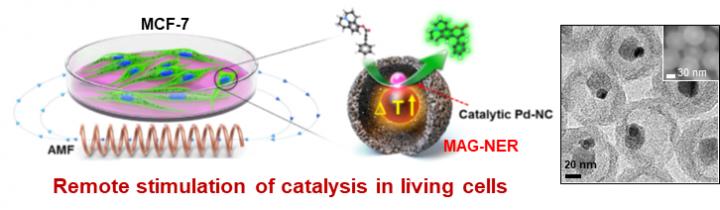
The research team mimicked the structure of vesicles, an organelle within a cell, and synthesized a magnetic-catalyst-combined nanoreactor with iron-oxide nanoparticles and palladium catalysts inside a hollow silica nanoshell.

When MAG-NER encounters an alternating magnetic field, iron-oxide nanoparticles inside cause magnetic field-induced heat and activate only the palladium catalyst without raising the exterior temperature. The research team succeeded in implementing the catalytic reaction with high efficiency, which transforms non-fluorescent reactants into fluorescent products through implanting MAG-NER into living cells then applying alternating magnetic fields. The research team also confirmed that the catalyst of MAG-NER can remain active for long periods of time without being contaminated by biomolecules in cells and does not affect the cells’ survival.

Using MAG-NER, it is anticipated that diagnosis and treatment methods, that can artificially remote control the cell’s functions, can be developed as artificial molecules can be synthesized or chemical reactions can be induced within cells using magnetic fields that are harmless to the body.

Professor In Su Lee who led the research explained, “This research is a result of utilizing the hallow nanoreactor materials that our lab has been developing over the years and is valued as an innovative chemical tool that will advance biomedical and biological research.”

###

This research was conducted with the support from the National Research Foundation’s Research Leader Program (Creative Research).

Media Contact
Jinyoung Huh
[email protected]

Original Source

http://postech.ac.kr/eng/nanocatalysts-that-remotely-control-chemical-reactions-inside-living-cells/

Related Journal Article

http://dx.doi.org/10.1021/acs.nanolett.0c01507

Tags: BiochemistryBiologyBiomedical/Environmental/Chemical EngineeringBiotechnologyCell BiologyChemistry/Physics/Materials SciencesElectromagneticsMedicine/HealthNanotechnology/Micromachines
Share12Tweet8Share2ShareShareShare2

Related Posts

Humans and Zebra Finches Share Similar Speech Learning Techniques #ASA190 — Chemistry

Humans and Zebra Finches Share Similar Speech Learning Techniques #ASA190

May 11, 2026
Unveiling Dark Matter Through Molecular Insights — Chemistry

Unveiling Dark Matter Through Molecular Insights

May 11, 2026

From Touch to Sight: A Bioinspired Multisensory Framework Endows Robots with Human-Like Perception

May 11, 2026

Announcing the 2026 Carbon Future Young Investigator Award Winners

May 11, 2026
Please login to join discussion

POPULAR NEWS

  • Research Indicates Potential Connection Between Prenatal Medication Exposure and Elevated Autism Risk

    841 shares
    Share 336 Tweet 210
  • New Study Reveals Plants Can Detect the Sound of Rain

    728 shares
    Share 290 Tweet 182
  • Salmonella Haem Blocks Macrophages, Boosts Infection

    62 shares
    Share 25 Tweet 16
  • Breastmilk Balances E. coli and Beneficial Bacteria in Infant Gut Microbiomes

    57 shares
    Share 23 Tweet 14

About

We bring you the latest biotechnology news from best research centers and universities around the world. Check our website.

Follow us

Recent News

Humans and Zebra Finches Share Similar Speech Learning Techniques #ASA190

New Study Uncovers How Fungal Parasites Attack Strawberries and Raspberries

City of Hope Researchers to Present Groundbreaking Immunotherapy and Precision Medicine Advances Across Multiple Cancer Types at ASCO 2026

Subscribe to Blog via Email

Enter your email address to subscribe to this blog and receive notifications of new posts by email.

Join 82 other subscribers
  • Contact Us

Bioengineer.org © Copyright 2023 All Rights Reserved.

Welcome Back!

Login to your account below

Forgotten Password?

Retrieve your password

Please enter your username or email address to reset your password.

Log In
No Result
View All Result
  • Homepages
    • Home Page 1
    • Home Page 2
  • News
  • National
  • Business
  • Health
  • Lifestyle
  • Science

Bioengineer.org © Copyright 2023 All Rights Reserved.