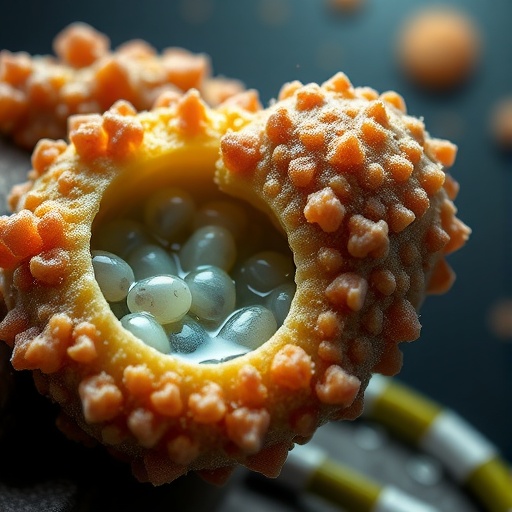
Pancreatic cancer remains among the deadliest malignancies, largely because it is detected late and is shielded by a dense tissue environment that makes efficient drug delivery difficult. Even when chemotherapy is administered intravenously, many drugs fail to reach tumors at therapeutic levels. A new study from POSTECH proposes a strategy to solve both problems at once: hiding the carrier in the bloodstream until it arrives at cancer tissue.
The platform centers on “smart” bioadhesive protein nanoparticles loaded with gemcitabine, a standard chemotherapy agent for pancreatic cancer. In conventional formulations, gemcitabine can degrade rapidly and distributes broadly, contributing to systemic side effects. Here, the researchers designed nanoparticles that remain stealthy in normal tissues while enabling targeted retention and sustained release at the tumor site.
To achieve invisibility, the team mass-produced a mussel-inspired adhesive protein and converted it into nanoparticles. They then encapsulated gemcitabine within the particle core and applied a biocompatible polyethylene glycol (PEG) coating. PEG suppresses the adhesive functionality and helps the particles evade immune recognition, allowing stable circulation through the body.
The decisive component is a spatially controlled stimulus–response mechanism. The PEG layer is not removed everywhere; it is engineered to be cleaved by MMP2, an enzyme secreted at high levels in pancreatic tumor microenvironments. This creates a lock-and-key behavior: stealth persists during systemic transit, but the protective layer is shed upon encountering tumor tissue.
Once the PEG is removed, the underlying mussel-like bioadhesive protein becomes active again. The nanoparticles then bind strongly to the tumor microenvironment, improving local accumulation. That adhesion supports deeper penetration toward cancer cells and enables continuous drug release directly where it is needed most.
In an animal model of pancreatic cancer, intravenously administered stealth nanoparticles significantly outperformed conventional free drug and standard nanoparticle controls. Tumor accumulation and retention increased by more than 60%, without detectable systemic toxicity.
Importantly, treatment efficacy improved dramatically: tumor volume and weight were reduced by more than half compared with animals receiving conventional chemotherapy alone. Histological examination further confirmed widespread cancer cell death, consistent with sustained and localized dosing.
The researchers also emphasize the broader potential of this approach for other difficult solid tumors that share the relevant enzyme-rich microenvironments. With further development, the platform could become a next-generation targeted delivery system that improves benefit-to-risk ratios in systemic cancer therapy.
Subject of Research: Drug delivery nanoparticles for pancreatic cancer chemotherapy
Article Title: Stealthy systemic circulation of spatially controlled tumor microenvironment-activated bioadhesive proteinic nanoparticles for pancreatic cancer chemotherapy
News Publication Date: 18-Jun-2026
Web References: http://dx.doi.org/10.1016/j.biomaterials.2026.124384
References: 10.1016/j.biomaterials.2026.124384
Image Credits: POSTECH
Keywords: pancreatic cancer; gemcitabine; stealth nanoparticles; PEG; MMP2; tumor microenvironment; bioadhesive protein; controlled drug release; targeted chemotherapy; nanomedicine
Tags: bioadhesive mussel-inspired protein nanoparticlesdense stromal tissue in pancreatic tumorsenabling targeted drug releaseenzyme-triggered nanoparticle disassemblygemcitabine-loaded nanocarriersnanoparticle-based chemotherapy enhancementovercoming drug delivery barriers in pancreatic cancerpancreatic cancer tissuepolyethylene glycol (PEG) coating for immune evasionstealth drug delivery systemstargeted therapy for pancreatic malignanciestumor-specific stimulus response