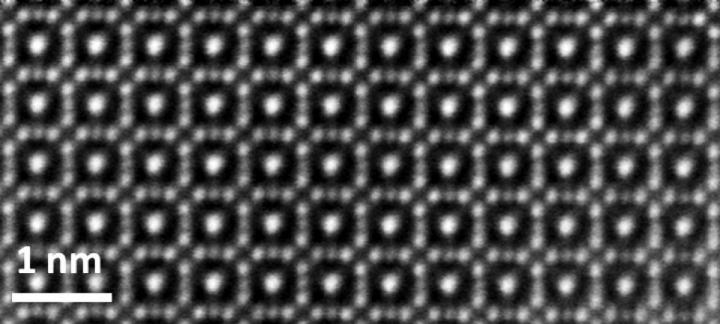
Credit: Miguel Levy/Michigan Tech
Optical signals produced by laser sources are extensively used in fiber-optic communications, which work by pulsing information packaged as light through cables, even at great distances, from a transmitter to a receiver. Through this technology it is possible to transmit telephone conversations, internet messages and cable television images. The great advantage of this technology over electrical signal transmission is its bandwidth — namely, the amount of information that can be broadcast.
New research from a collaboration between Michigan Technological University and Argonne National Laboratory further improves optical signal processing, which could lead to the fabrication of even smaller fiber-optic devices.
The article, unveiling an unexpected mechanism in optical nonreciprocity — developed by the research group of Miguel Levy, professor of physics at Michigan Tech — has been published in the journal Optica. “Boosting Optical Nonreciprocity: Surface Reconstruction in Iron Garnets” explains the quantum and crystallographic origins of a novel surface effect in nonreciprocal optics that improves the processing of optical signals.
An optical component called the magneto-optic isolator appears ubiquitously in these optical circuits. Its function is to protect the laser source — the place where light is generated before transmission — from unwanted light that might be reflected back from downstream. Any such light entering the laser cavity endangers the transmitted signal because it creates the optical equivalent of noise.
“Optical isolators work on a very simple principle: light going in the forward direction is allowed through; light going in the backwards direction is stopped,” Levy said. “This appears to violate a physical principle called time-reversal symmetry. The laws of physics say that if you reverse the direction of time — if you travel backwards in time — you end up exactly where you started. Therefore, the light going back should end up inside the laser.”
But the light doesn’t. Isolators achieve this feat by being magnetized. North and south magnetic poles in the device do not switch places for light coming back.
“So forward and backward directions actually look different to the traveling light. This phenomenon is called optical nonreciprocity,” Levy said.
Optical isolators need to be miniaturized for on-chip integration into optical circuits, a process similar to the integration of transistors into computer chips. But that integration requires the development of materials technologies that can produce more efficient optical isolators than presently available.
Recent work by Levy’s research group has demonstrated an order-of-magnitude improvement in the physical effect responsible for isolator operation. This finding, observable in nanoscale iron garnet films, opens up the possibility of much tinier devices. New materials technology development of this effect hinges on understanding its quantum basis.
The research group’s findings provide precisely this type of understanding. This work was done in collaboration with physics graduate student Sushree Dash, Applied Chemical and Morphological Analysis Laboratory staff engineer Pinaki Mukherjee and Argonne National Laboratory staff scientists Daniel Haskel and Richard Rosenberg.
The Optica article explains the role of the surface in the electronic transitions responsible for the observed enhanced magneto-optic response. These were observed with the help of Argonne’s Advanced Photon Source. Mapping the surface reconstruction underlying these effects was made possible through the state-of-the-art scanning transmission electron microscope acquired by Michigan Tech two years ago.
The new understanding of magneto-optic response provides a powerful tool for the further development of improved materials technologies to advance the integration of nonreciprocal devices in optical circuits.
###
Media Contact
Allison Mills
[email protected]
Original Source
https:/
Related Journal Article
http://dx.