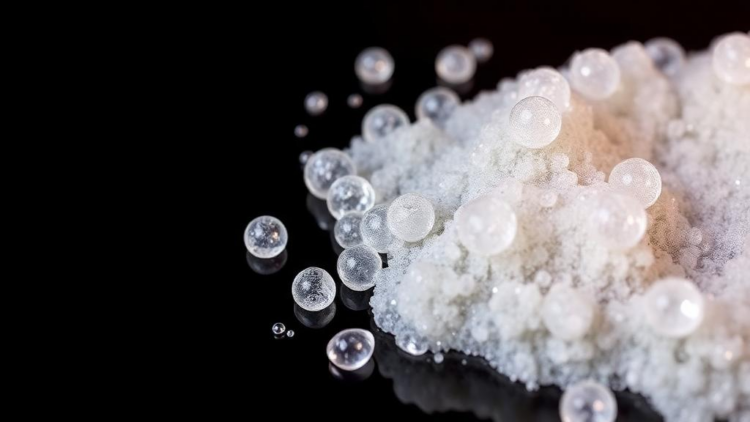
A drop of water landing on a lotus leaf does not spread. It beads up, gleams like mercury, and rolls away, picking up dust as it goes. Materials scientists have chased that trick for decades, and a new review in Polymer Bulletin by Parth Patel, Prasad Pichare and Aarti P. More of the Institute of Chemical Technology in Mumbai takes stock of how far one particular class of water-hating materials has come: superhydrophobic polymeric foams. These are not flat coatings but spongy, three-dimensional networks whose internal surfaces repel water so completely that droplets sit on them with contact angles above 150 degrees and slide off at the slightest tilt. The review, published as volume 83, article 663 of the journal, maps the physics, chemistry, fabrication routes and stubborn practical problems that define the field today.
The secret of superhydrophobicity lies in a partnership between chemistry and geometry. A surface made of low-surface-energy material, such as a silicone or fluorinated compound, naturally resists wetting. But chemistry alone cannot push a flat surface past the superhydrophobic threshold. Roughness is the second ingredient, and it must exist on multiple length scales, with microstructures decorated by even smaller nanostructures. When water meets such a hierarchically rough, low-energy surface, it cannot penetrate the valleys between the peaks. Instead it rests on the tips, with air trapped underneath, a configuration known as the Cassie-Baxter state. The alternative, in which water fully saturates the roughness, is the Wenzel state, and the difference between the two is everything. A droplet in the Cassie-Baxter state rolls off easily; a droplet in the Wenzel state can become pinned so firmly that it behaves more like glue than liquid.
What makes foams special, the authors argue, is that the roughness is not confined to a skin. An open-cell foam is a continuous skeleton of polymer struts surrounding a labyrinth of connected pores, giving the material an enormous internal surface area relative to its weight. That architecture delivers properties a flat film never could: mechanical toughness, compressibility, rapid uptake of liquids into the pore network, and the ability to be squeezed dry and reused again and again. The physics of that uptake is governed by capillary action, described classically by the Lucas-Washburn equation, which relates how fast a wetting liquid penetrates a pore to the pore radius and the liquid’s surface tension. The review emphasizes that connected pores, capillary-driven infiltration and even deliberate wettability gradients inside the foam determine how efficiently oil can be absorbed, a point of direct consequence for the field’s flagship application.
That application is oil spill cleanup. When a foam is both superhydrophobic and superoleophilic, it drinks oil and refuses water, making it a selective sponge for petroleum slicks. Polyurethane foam, cheap, elastic and commercially ubiquitous, has been the workhorse substrate. Researchers have modified it with silica nanoparticles, polysiloxane-modified clay nanotubes, zinc oxide microrods wrapped in carbon cloth, silanized nanoclay and magnetite particles that let a magnetic field steer the saturated sponge. More recent work has added photothermal coatings, layers that convert sunlight into heat, so that viscous crude oil, which barely flows at ambient temperature, warms up and wicks into the foam faster. One 2025 study described a fire-extinguishing polyurethane foam for solar-assisted recovery of viscous crude oil, combining absorption with an intrinsic safety feature.
Polyurethane is only the beginning of the materials list the review assembles. Polystyrene foams, including those made by high internal phase emulsion templating, a technique that produces well-defined, highly connected pore structures, have been engineered with carbon black or graphene for photothermal oil capture and continuous separation of even emulsified oil-water mixtures. Polypropylene and polyethylene foams, often fabricated by supercritical carbon dioxide foaming, a solventless process in which pressurized gas expands the polymer into a microcellular structure, have shown robust superhydrophobicity, self-cleaning behavior, anti-icing performance and selective oil absorption. Ethylene propylene diene monomer rubber, polyethylene terephthalate and even biodegradable polylactic acid have all been converted into water-repellent sponges, the latter sometimes by a simple skin-peeling method that exposes a naturally rough interior.
A quieter revolution in the field concerns where the chemistry comes from. Fluoroalkyl silanes and other fluorinated modifiers are superb at lowering surface energy, but their toxicity and environmental persistence are increasingly unacceptable. The review highlights a shift toward fluorine-free systems: silicone-based chemistries, hydrophobic silica, stearic acid, and, strikingly, lignin, the aromatic polymer that woody plants use to waterproof their own cell walls. Lignin-based polyurethane foams, lignin nanosphere coatings and biomass-derived porous carbon combined with carbon nanotubes in melamine foam all demonstrate that nature’s own hydrophobic building blocks can do the job. Bioinspired design runs through the whole field, from lotus-leaf mimicry to a 2025 foam modeled on dragonfly wings, and even to self-healing surfaces that repair mechanical damage the way living tissue does.
The applications extend well beyond mopping up oil. Because water cannot adhere to these surfaces, they resist icing, and superhydrophobic polyethylene and polyurethane foams have been demonstrated for anti-icing and photothermal deicing, melting frost off their own surfaces using embedded light-absorbing fillers such as graphene or carbon nanotubes. The trapped air and low density of polymer foams make them excellent thermal insulators, and some formulations add flame retardants, producing foams that repel water and resist fire simultaneously, in one case with a built-in fire alarm response. Conductive fillers such as carbon nanotubes, MXene nanosheets and graphene turn the foams into pressure sensors and electromagnetic interference shields, so the same sponge that cleans an oil slick might also monitor compression or block radio-frequency noise in damp environments.
Yet the review is candid about why these materials are not already everywhere. Coatings of nanoparticles bonded weakly to a foam surface wear away under abrasion, and once the delicate micro-nano texture is destroyed, the Cassie-Baxter state collapses and the foam wets permanently. Fluorinated chemistry raises regulatory and toxicological concerns. Most laboratory syntheses involve dip-coating, chemical vapor deposition, sol-gel processing, electrospinning or freeze-drying, none of which scale gracefully or cheaply to industrial volumes, and the authors point to persistent discrepancies between laboratory results and real-world performance. Durability, scalability and cost form a triangle of constraints that the field has not yet fully escaped, a theme echoed in broader assessments of superhydrophobic surface commercialization.
The path forward, the authors suggest, lies in fluorine-free chemistries, self-repairing structures borrowed from biology, and fabrication processes that are scalable at reasonable cost. Some of those pieces already exist in prototype form: mechanochemically durable self-healing coatings, water-based nonfluorinated dispersions for large-area application, extrusion plus supercritical foaming routes that use commodity processing equipment, and even three-dimensional printable self-foaming silicone inks that produce bulk superhydrophobic objects rather than fragile surfaces. If durability and manufacturing can be solved together, superhydrophobic foams could move from demonstration papers to deployed products, cleaning spills, shedding ice, insulating buildings and sensing pressure, all while refusing, like the lotus leaf, to let water stick.
Subject of Research: Superhydrophobic polymeric foams: wetting theory, fabrication methods and applications in oil-water separation and multifunctional materials
Article Title: Superhydrophobic polymeric foam: A review
Article References: Patel, P., Pichare, P., & More, A. P. (2026). Superhydrophobic polymeric foam: A review. Polymer Bulletin, 83(12), Article 663. https://doi.org/10.1007/s00289-026-06713-x
Image Credits: AI Generated
DOI: 10.1007/s00289-026-06713-x
Keywords: superhydrophobic foams, Cassie-Baxter state, Wenzel state, oil spill cleanup, polyurethane foam, supercritical CO2 foaming, lignin, fluorine-free coatings, photothermal conversion, anti-icing, electromagnetic shielding, self-healing surfaces
Cite Scienmag News
APA MLA Chicago
Neil Sanderson. (October 1, 2026). Water-Repellent Polymer Foams Move From Lab Curiosity to Oil-Spill Workhorse. Scienmag. https://scienmag.com/water-repellent-polymer-foams-move-from-lab-curiosity-to-oil-spill-workhorse/
Neil Sanderson. “Water-Repellent Polymer Foams Move From Lab Curiosity to Oil-Spill Workhorse.” Scienmag, 1 October 2026, https://scienmag.com/water-repellent-polymer-foams-move-from-lab-curiosity-to-oil-spill-workhorse/. Accessed 1 October 2026.
Neil Sanderson. “Water-Repellent Polymer Foams Move From Lab Curiosity to Oil-Spill Workhorse.” Scienmag. October 1, 2026. https://scienmag.com/water-repellent-polymer-foams-move-from-lab-curiosity-to-oil-spill-workhorse/
Copy citation Download RIS
Tags: anti-icingapplications in environmental remediationCassie-Baxter statechallenges in superhydrophobic material developmentelectromagnetic shieldingfluorinated compounds in water repellencyfluorine-free coatingshierarchical surface roughnessligninnature-inspired water-repellent surfacesoil spill cleanupoil-spill cleanup technologiesphotothermal conversionphysics of water droplet behavior on superhydrophobic surfacespolymer foam fabrication methodspolyurethane foamself-healing surfacessupercritical CO2 foamingsuperhydrophobic foamsSuperhydrophobic polymeric foamssuperhydrophobic surface chemistrywater contact angle measurementwater-repellent materialsWenzel state