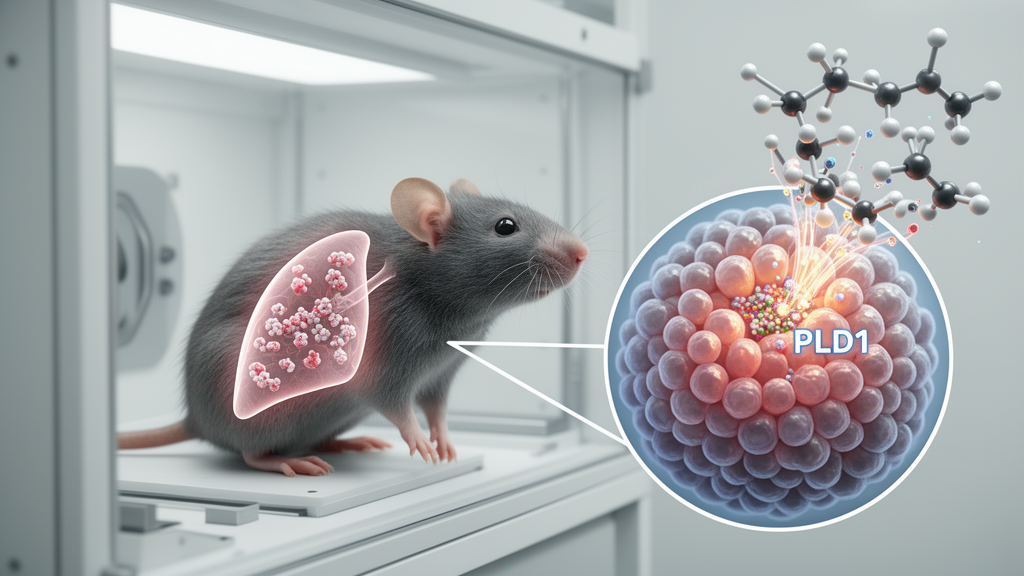
A UTHealth Houston-led team identified a molecular dependency in a subtype of non-small cell lung cancer and showed in mouse models that a drug delivered directly to cancer cells could reduce their reliance on phospholipase D1, significantly slowing tumor growth without other reported negative health effects. The peer-reviewed study, led by Xiaochao Tan, PhD, of the Department of Integrative Biology and Pharmacology at McGovern Medical School, was published in the Proceedings of the National Academy of Sciences. The findings describe a preclinical treatment strategy and do not establish clinical benefit in people with lung or other cancers.
The research centers on lung cancer cells with extra copies of an abnormal segment of chromosome 3q. Tan’s previous work found that these extra DNA copies encode several proteins associated with the Golgi apparatus, which modifies, sorts and packages proteins for delivery within cells or secretion outside them. In the current study, the team identified a chromosome 3q region containing the gene encoding phospholipase D1, or PLD1. The researchers found that lung cancer cells produced unusually high levels of PLD1 and used the Golgi apparatus to send cancer-promoting materials out of the cells, allowing tumors to grow and survive.
The team tested the approach in mouse models using a drug delivered directly to cancer cells that curbs their reliance on PLD1. This intervention significantly slowed tumor growth in the mice, and the investigators reported that it caused no other negative health effects in the experimental animals. The university’s news release did not identify the drug or provide the number of animals, effect size, dose, treatment schedule or measurements used to assess health effects, so the result cannot establish the magnitude, durability or general applicability of the benefit. It remains an experimental observation from mouse tumor models rather than evidence that an available therapy works in patients.
Extra copies of chromosome 3q are common in head and neck cancer and esophageal cancer, leading the researchers to propose that patients with those cancers may also benefit from targeting the same pathway. That application remains untested in the reported research: the experiments described involved lung cancer models, and the release did not present treatment results for head and neck or esophageal tumors. The study also does not establish how many patients with non-small cell lung cancer carry the relevant chromosome 3q changes, or whether elevated PLD1 and Golgi activity are sufficiently distinctive to identify candidates for this strategy. Direct delivery is also part of the experimental finding; the release does not show how the method might work after systemic administration in people or whether it can reach and selectively affect tumor cells in a clinical setting.
Non-small cell lung cancer is the most common type of lung cancer and is often diagnosed after it has spread to other parts of the body, while therapeutic options for the subtype examined in the research remain limited. The study identifies a specific weakness in this setting: cancer cells with extra copies of chromosome 3q appear to depend on PLD1 and Golgi-mediated secretion to promote tumor growth and survival. By delivering a drug directly to the affected cells, the team interrupted that dependency and reduced tumor growth in mice, with no additional negative health effects reported. The work provides a technically defined target for further testing, but its scope is limited to cellular findings and mouse models; it does not demonstrate safety, efficacy or patient selection in humans.
Subject of Research: Preclinical targeting of PLD1-dependent Golgi secretion in non-small cell lung cancer
Article Title: Researchers unlock promising lung cancer treatment option
Article References: Researchers unlock promising lung cancer treatment option. Original publication (Bibliographic details unavailable.)
Image Credits: AI Generated
DOI: Not provided
Keywords: lung cancer, non-small cell lung cancer, phospholipase D1, PLD1, Golgi apparatus, chromosome 3q, tumor growth, drug delivery, mouse models, cancer secretion, Researchers, unlock
News Source: Nathaniel Bowman. (October 21, 2026). Mouse study identifies PLD1 target in non-small cell lung cancer. Scienmag.