• HOME
  • NEWS
  • EXPLORE
    • CAREER
      • Companies
      • Jobs
    • EVENTS
    • iGEM
      • News
      • Team
    • PHOTOS
    • VIDEO
    • WIKI
  • BLOG
  • COMMUNITY
    • FACEBOOK
    • INSTAGRAM
    • TWITTER
Friday, May 15, 2026
BIOENGINEER.ORG
No Result
View All Result
  • Login
  • HOME
  • NEWS
  • EXPLORE
    • CAREER
      • Companies
      • Jobs
        • Lecturer
        • PhD Studentship
        • Postdoc
        • Research Assistant
    • EVENTS
    • iGEM
      • News
      • Team
    • PHOTOS
    • VIDEO
    • WIKI
  • BLOG
  • COMMUNITY
    • FACEBOOK
    • INSTAGRAM
    • TWITTER
  • HOME
  • NEWS
  • EXPLORE
    • CAREER
      • Companies
      • Jobs
        • Lecturer
        • PhD Studentship
        • Postdoc
        • Research Assistant
    • EVENTS
    • iGEM
      • News
      • Team
    • PHOTOS
    • VIDEO
    • WIKI
  • BLOG
  • COMMUNITY
    • FACEBOOK
    • INSTAGRAM
    • TWITTER
No Result
View All Result
Bioengineer.org
No Result
View All Result
Home NEWS Science News Biology

Mouse sperm generated in rats

Bioengineer by Bioengineer
March 2, 2021
in Biology
Reading Time: 2 mins read
0
IMAGE
Share on FacebookShare on TwitterShare on LinkedinShare on RedditShare on Telegram

Researchers from the National Institute for Physiological Sciences in Japan successfully grow mouse stem cells into sperm in the body of the rat
IMAGE

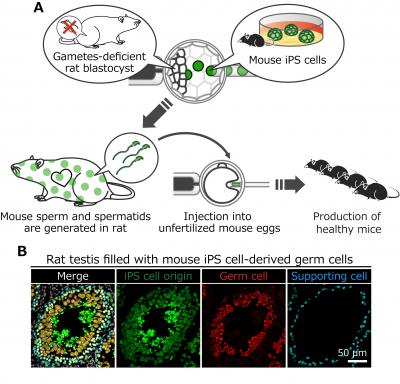
A. Schematics for the generation of rats with mouse gametes. Mouse spermatids isolated from the rat testis are injected into unfertilized mouse eggs to produce viable mice.

Okazaki, Japan – Making gametes such as sperm and eggs from pluripotent stem cells, primitive cells that can make all the tissues, greatly contributes to efficient reproduction of livestock animals and future assisted reproductive medicine. Researchers pave the way to achieve this goal using a body of xenogenic animals.

The researchers previously developed a method to grow stem cells into an entire organ in the body, so-called blastocyst complementation. The blastocyst is a structure of early embryos. If stem cells are transplanted into the blastocyst obtained from animals that cannot make a certain organ, the stem cells compensate the missing organ in the developing body, and make the entire organ. “We expected this method is also applicable to the efficient production of gametes,” explains an author who led the study, Dr. Toshihiro Kobayashi.

A year ago, the researchers created a genetically modified rat that completely lacks sperm and eggs. They hypothesized that the rat can be used as an excellent host to grow exogenous stem cells into gametes.

The researchers firstly transplanted allogenic rat stem cells into blastocyst obtained from rats that are unable to make gametes, and confirmed all the gametes were derived from the stem cells. The generated gametes deliver the genetic information from the stem cells to the next generation, which enables efficient production of genetically modified rats.

Then, researchers tested whether xenogenic mouse stem cells can make mouse gametes in the body of rats. Remarkably, mouse germ cells including sperm and spermatids were observed in the testis of the rats, and the spermatids could fertilize with mouse eggs to produce healthy pups (see figures).

“Making gametes from stem cells even in the xenogenic environment is quite important for the application of this strategy,” says another author led the study, Dr. Masumi Hirabayashi. “In the future, we may be able to use the method to preserve endangered species, since their stem cells are available due to iPS cell technology.”

###

Media Contact
Toshihiro Kobayashi
[email protected]

Original Source

https://doi.org/10.1038/s41467-021-21557-x

Related Journal Article

http://dx.doi.org/10.1038/s41467-021-21557-x

Tags: BiotechnologyDevelopmental/Reproductive BiologyGeneticsMedicine/HealthPhysiology
Share13Tweet8Share2ShareShareShare2

Related Posts

Supercomputer Simulations Uncover How Bacterial Enzyme Pumps Sodium Ions, Opening Doors to Novel Antibiotics — Biology

Supercomputer Simulations Uncover How Bacterial Enzyme Pumps Sodium Ions, Opening Doors to Novel Antibiotics

May 15, 2026
New Astrobiology Special Collection Highlights Emerging Evidence Supporting Land-Based Origins of Life — Biology

New Astrobiology Special Collection Highlights Emerging Evidence Supporting Land-Based Origins of Life

May 14, 2026

Revolutionizing Textiles: Engineered Protein Fibers Pave the Way for Sustainable, Recyclable Fabrics

May 14, 2026

URI Master’s Student Emilio Pedroza Lopez Awarded Prestigious NSF Graduate Research Fellowship

May 14, 2026
Please login to join discussion

POPULAR NEWS

  • Research Indicates Potential Connection Between Prenatal Medication Exposure and Elevated Autism Risk

    843 shares
    Share 337 Tweet 211
  • New Study Reveals Plants Can Detect the Sound of Rain

    729 shares
    Share 291 Tweet 182
  • Salmonella Haem Blocks Macrophages, Boosts Infection

    62 shares
    Share 25 Tweet 16
  • Breastmilk Balances E. coli and Beneficial Bacteria in Infant Gut Microbiomes

    58 shares
    Share 23 Tweet 15

About

We bring you the latest biotechnology news from best research centers and universities around the world. Check our website.

Follow us

Recent News

Paraprobiotics Mitigate BPA-Induced Damage to Male Fertility Linked to Plastic Exposure

Digital Health Fear Patterns in Older Cancer Patients

A*STAR Scientists Unveil Novel Technique to Decipher RNA Structure’s Impact on Health and Disease

Subscribe to Blog via Email

Enter your email address to subscribe to this blog and receive notifications of new posts by email.

Join 82 other subscribers
  • Contact Us

Bioengineer.org © Copyright 2023 All Rights Reserved.

Welcome Back!

Login to your account below

Forgotten Password?

Retrieve your password

Please enter your username or email address to reset your password.

Log In
No Result
View All Result
  • Homepages
    • Home Page 1
    • Home Page 2
  • News
  • National
  • Business
  • Health
  • Lifestyle
  • Science

Bioengineer.org © Copyright 2023 All Rights Reserved.