


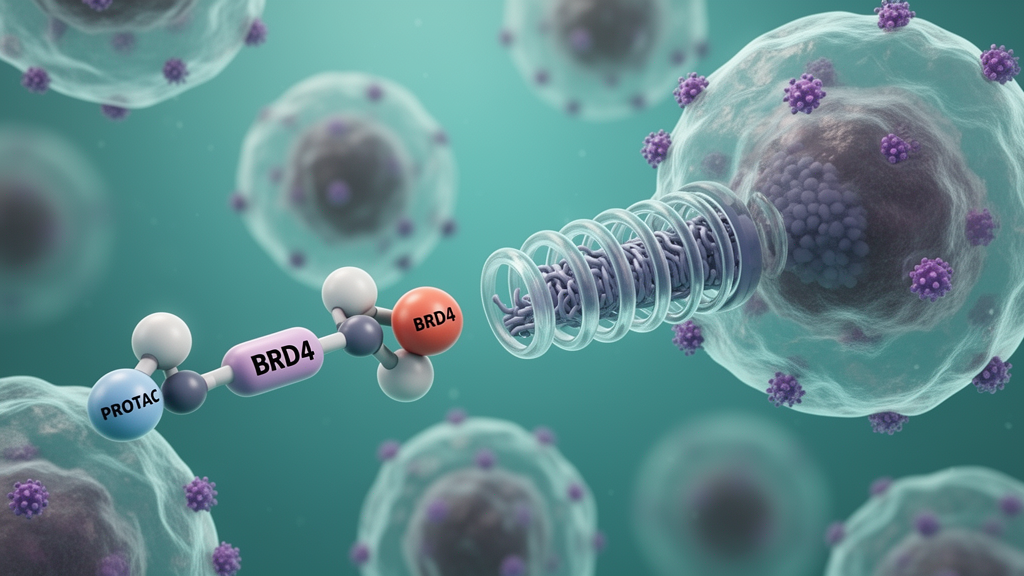
Researchers have engineered two experimental degrader molecules, MZ-1-ME and SIM-1-ME, that show enhanced degradation of the BRD4 protein and stronger growth-inhibitory activity in a cellular model of Kaposi’s Sarcoma, according to a study published in Biological Procedures Online on 14 August 2026.
Kaposi’s Sarcoma-associated Herpesvirus (KSHV) is the etiologic agent of several human cancers, including Kaposi’s Sarcoma (KS), for which treatment options remain limited. Members of the bromodomain and extra-terminal domain (BET) family, particularly bromodomain-containing protein 4 (BRD4), play important roles in RNA polymerase II–mediated transcriptional regulation and are required for the expression of many tumor-driving oncogenes in various cancer cells. This has made BET proteins attractive targets for anticancer drug development.
The researchers' recent studies showed that KSHV-infected immortalized endothelial cells displayed strong resistance to BET inhibitors such as (+)-JQ1; in contrast, they identified MZ-1 and SIM-1, two BRD4-targeting PROTAC degraders, as effective inhibitors of cell growth in these cells.
To develop PROTAC molecules with enhanced BRD4 degradation potency, the researchers introduced an (S)-methyl group at the benzylic position of the VHL ligand within the VHL-based BRD4 PROTACs MZ-1 and SIM-1. This chemical modification yielded the new analogues MZ-1-ME and SIM-1-ME, respectively.
In the KS cellular model, the modified compounds exhibited enhanced BRD4 degradation and enhanced anticancer activities compared with their parental compounds, MZ-1 and SIM-1. The authors suggest that these next-generation degraders may represent promising PROTACs for the development of BRD4-targeted therapies against Kaposi’s Sarcoma.
The findings are limited to work in immortalized endothelial cell models infected with KSHV, and the compounds remain preclinical research tools rather than approved therapies. The study was published as open access research, with the accepted, peer-reviewed version shared early and subject to further edits before the final Version of Record. The work was conducted by Jungang Chen, Zhengyu Wang, Jarna Karmoker, Jiaojiao Fan, Hongfei Zhou, Lu Dai, Hong-Yu Li and Zhiqiang Qin, among others.
Subject of Research: Engineering of BRD4-targeting PROTAC degraders with enhanced activity against KSHV-infected endothelial cells
Article Title: Engineering SIM-1 and MZ-1 PROTACs for enhanced target degradation in KSHV-infected immortalized endothelial cells
Article References: Chen, J., Wang, Z., Karmoker, J., Fan, J., Zhou, H., Dai, L., Li, H.-Y., & Qin, Z. (2026). Engineering SIM-1 and MZ-1 PROTACs for enhanced target degradation in KSHV-infected immortalized endothelial cells. Biological Procedures Online. https://doi.org/10.1186/s12575-026-00360-2
Image Credits: AI Generated
DOI: 10.1186/s12575-026-00360-2
Keywords: PROTAC, BRD4, BET proteins, KSHV, Kaposi's Sarcoma, VHL ligand, targeted protein degradation, endothelial cells, anticancer drug development, (+)-JQ1 resistance, Biological Procedures Online, Engineering
News Source: Nathaniel Bowman. (October 29, 2026). Modified PROTACs Show Stronger BRD4 Degradation in KSHV-Infected Cells. Scienmag.



