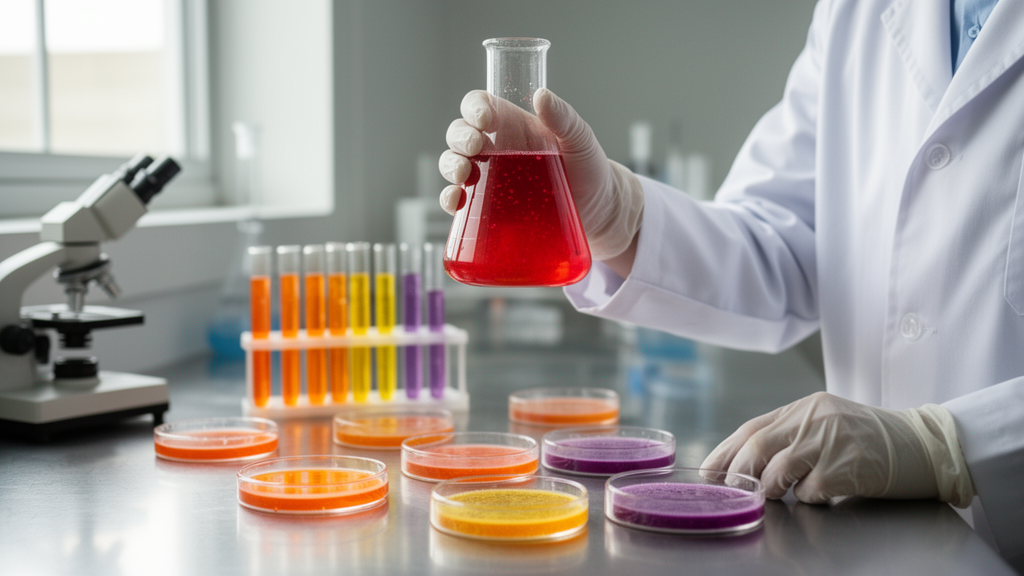
Color sells food before taste ever gets a chance. A review published on 1 October 2026 in Food Production, Processing and Nutrition argues that pigments made by fungi, bacteria and microalgae are positioned to take a much larger share of the colorant market, as food manufacturers move away from synthetic dyes such as tartrazine, sunset yellow and quinoline yellow amid consumer concerns about their health effects. The authors, led by Aisha Halliru Duwan, survey the diversity of microbial pigments, the biosynthetic pathways that produce them, and the biotechnological tools now being used to boost yields and stability.
The core argument is practical rather than aesthetic. Plant-derived pigments such as anthocyanins and betalains face seasonal variability, extraction inefficiencies and stability problems, while animal-derived colorants raise sustainability concerns. Microbial production, by contrast, can run year-round, is independent of weather and rainfall, scales through strain improvement, and uses inexpensive raw materials. According to the review, microbial pigments already represent more than one-third of the food colors used worldwide, with carotenoids such as beta-carotene and astaxanthin produced from multiple microorganisms making up a significant portion of that market.
The pigment catalog is broad. Carotenoids, lipid-soluble tetraterpenoids ranging from yellow to red, are produced by organisms including Xanthophyllomyces dendrorhous, Blakeslea trispora, Dunaliella salina and Rhodotorula species, with more than 500 known members spanning lycopene, lutein, zeaxanthin and astaxanthin. Monascus fungi generate azaphilone pigments through polyketide pathways initiated by acetyl-CoA condensation; transesterification with medium-chain fatty acids such as octanoic acid shifts orange monascorubrin and rubropunctatin toward the yellow monascin and ankaflavin. Betalains, water-soluble pigments best known from plants in the order Caryophyllales, also occur in basidiomycete fungi and the bacterium Gluconacetobacter diazotrophicus, and betanin production has recently been achieved in Saccharomyces cerevisiae grown on glucose. Melanins, dark polymeric pigments divided into five classes by precursor chemistry, come from organisms as varied as Aspergillus fumigatus and Vibrio cholerae, while riboflavin, vitamin B2, is manufactured industrially by Bacillus subtilis, Candida famata and Ashbya gossypii.
The biosynthetic details matter because they are the levers for engineering. Carotenoid synthesis begins when phytoene synthase condenses two geranyl pyrophosphate molecules into phytoene, which is then desaturated and isomerized into lycopene; cyclases, hydroxylases and ketolases then build the cyclic and oxygenated derivatives. Riboflavin biosynthesis draws on GTP and ribulose-5-phosphate from the pentose phosphate pathway, with a final dismutation step catalyzed by riboflavin synthase. Understanding these routes, the review notes, is what allows metabolic engineers to identify bottlenecks and redirect metabolic flux toward the desired pigment.
Production technology is split between submerged and solid-state fermentation. Submerged fermentation in liquid substrates such as molasses offers high mycelial output, lower contamination risk and faster processing, while solid-state fermentation suits fungi particularly well, reduces waste and can yield a product usable directly as a dye. Optimal conditions differ sharply by organism: Monascus species ferment best at 25 to 28 degrees Celsius, whereas Pseudomonas species prefer 35 to 36 degrees, and reported peak carotenoid production in Sarcina species occurs after 72 hours of incubation. Carbon source, nitrogen source, pH and mineral availability all influence pigment formation, and the authors highlight agro-industrial wastes, from molasses and whey to soybean and sugarcane residues, as low-cost substrates, while cautioning that their availability varies by geography and season.
The most technically ambitious section covers genetic and genomic toolkits. CRISPR-Cas9 genome editing, with its Cas9 protein and guide RNA enabling precise knockouts, knock-ins and regulatory changes, can be applied across yeasts, fungi and bacteria to turn them into cell factories for natural colorants. Engineered Escherichia coli has been made to produce the xanthophyll violaxanthin by modifying carotenoid biosynthesis pathways, and yeast strains have been manipulated to generate both natural pigments such as carotenoids and flavonoids and synthetic ones. Omics technologies, including genomics, proteomics and metabolomics, are used to map how cellular processes govern pigment formation and to guide the design of higher-yielding strains. The review is careful to note, however, that pigments produced by engineered microorganisms still require comprehensive safety and toxicity evaluation, with regulatory approval status varying by pigment type, production strategy and region.
Extraction and purification are evolving in parallel. Traditional solvent-based methods such as maceration, Soxhlet extraction and distillation consume large solvent volumes, run slowly and can degrade pigments through heat exposure. Newer alternatives include ultrasound-assisted, microwave-assisted, enzyme-assisted, pulsed electric field and supercritical fluid extraction, alongside pressurized liquid extraction. For analysis and purification, the combination of high-performance liquid chromatography with Raman spectroscopy offers separation, quantification and non-destructive structural information, while polymeric and non-ionic adsorption resins simplify pigment isolation and cut solvent use and operating costs.
Applications extend well beyond simple coloring. The review describes microbial pigments in intelligent packaging, where pH-sensitive, time-temperature and freshness indicators change color to signal food quality; a deep blue pigment from Pantoea agglomerans, produced at temperatures of 10 degrees Celsius or above, has been explored as a low-temperature storage indicator, and betalain-based sensors are under development for real-time freshness monitoring in dairy products, sauces and soups. Monascus species have a long history in Asian rice fermentation, yielding red mold rice valued for color, flavor and shelf life. Microbial pigments are also being positioned for plant-based food formulations, and precision fermentation is being used to produce ingredients such as vitamin B12 and heme proteins to improve meat analogs. Reported bioactivities include antioxidant, antimicrobial and anti-inflammatory effects, with Monascus ruber pigment showing strong antimicrobial activity against foodborne pathogens and Halomonas carotenoids showing activity against several bacterial species.
The obstacles are equally concrete. Natural pigments degrade under heat, light, pH shifts and oxidative conditions, with carotenoids particularly vulnerable, so microencapsulation, nanoemulsions and nanoencapsulation are being investigated to protect pigments during processing and storage; scanning electron microscopy images of optimized astaxanthin microcapsules show spherical, smooth-surfaced particles consistent with effective encapsulation. Extraction costs make mass production difficult, and citrinin contamination remains a safety concern limiting industrial use of Monascus pigments. Microalgal pigments such as phycocyanin face scale-up, processing efficiency and thermal stability problems, and few studies have assessed pigment stability in complex food matrices over the long term. Every microbial pigment intended as a food additive must also clear rigorous regulatory and safety assessments to ensure no toxic or allergenic metabolites enter the final product.
The review’s conclusion is measured: microbial pigments offer scalability, consistency and multifunctionality that synthetic and plant-derived colorants cannot match, and advances in CRISPR-based editing, pathway optimization, omics-driven strain development and encapsulation have substantially improved yield and stability. But widespread commercialization, the authors write, still depends on solving production costs, scale-up limitations, comprehensive toxicological evaluation and regulatory compliance. Future work, they suggest, should combine metabolic engineering with machine learning-assisted fermentation optimization and sustainable bioprocessing to build production platforms capable of delivering safe, multifunctional and sustainable coloring solutions to the food industry.
Subject of Research: A review of microbial pigments as natural food colorants, their biosynthesis, production technologies and applications.
Article Title: Microbial pigments as next generation food colorants: unraveling structure, function relationships and biotechnological innovations
Article References: Duwan, A. H., Christabel, A. R. S., Raja, A., Veerapandi, S., Selvakumar, K., Koduru, S. K., Chandrakala, V., & Bukke, S. P. N. (2026). Microbial pigments as next generation food colorants: unraveling structure, function relationships and biotechnological innovations. Food Production, Processing and Nutrition, 8(1), Article 71. https://doi.org/10.1186/s43014-026-00418-4
Image Credits: AI Generated
DOI: 10.1186/s43014-026-00418-4
Keywords: microbial pigments, food colorants, natural dyes, Monascus, carotenoids, fermentation, metabolic engineering, synthetic biology, nanoencapsulation, smart packaging, food safety, betalains
News Source: Morgan Morrow. (October 29, 2026). Microbial Pigments Emerge as Next-Generation Natural Food Colorants. Scienmag.