• HOME
  • NEWS
  • EXPLORE
    • CAREER
      • Companies
      • Jobs
    • EVENTS
    • iGEM
      • News
      • Team
    • PHOTOS
    • VIDEO
    • WIKI
  • BLOG
  • COMMUNITY
    • FACEBOOK
    • INSTAGRAM
    • TWITTER
Thursday, May 14, 2026
BIOENGINEER.ORG
No Result
View All Result
  • Login
  • HOME
  • NEWS
  • EXPLORE
    • CAREER
      • Companies
      • Jobs
        • Lecturer
        • PhD Studentship
        • Postdoc
        • Research Assistant
    • EVENTS
    • iGEM
      • News
      • Team
    • PHOTOS
    • VIDEO
    • WIKI
  • BLOG
  • COMMUNITY
    • FACEBOOK
    • INSTAGRAM
    • TWITTER
  • HOME
  • NEWS
  • EXPLORE
    • CAREER
      • Companies
      • Jobs
        • Lecturer
        • PhD Studentship
        • Postdoc
        • Research Assistant
    • EVENTS
    • iGEM
      • News
      • Team
    • PHOTOS
    • VIDEO
    • WIKI
  • BLOG
  • COMMUNITY
    • FACEBOOK
    • INSTAGRAM
    • TWITTER
No Result
View All Result
Bioengineer.org
No Result
View All Result
Home NEWS Science News Chemistry

Mechanical force as a new way of starting chemical reactions

Bioengineer by Bioengineer
December 19, 2019
in Chemistry
Reading Time: 2 mins read
0
IMAGE
Share on FacebookShare on TwitterShare on LinkedinShare on RedditShare on Telegram

IMAGE

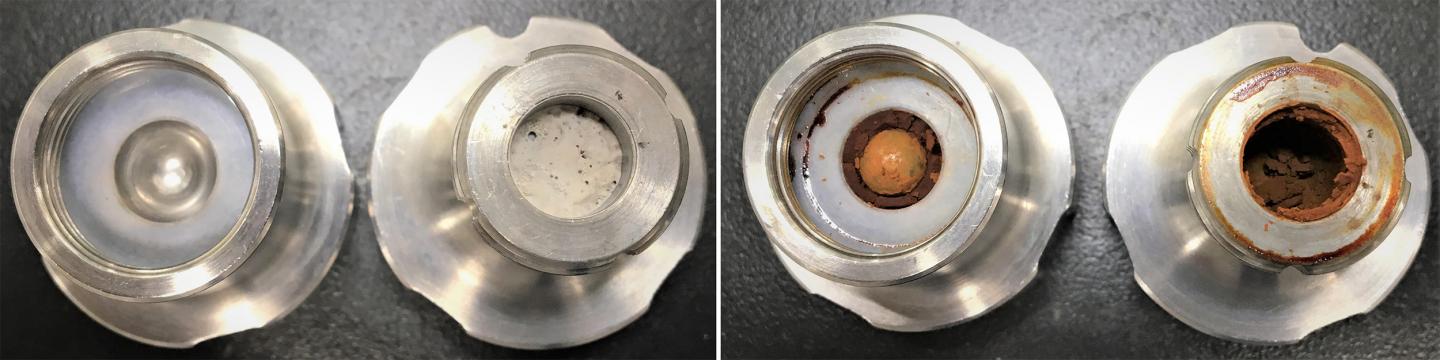
Credit: Kubota K. et al. Science, December 19, 2019


Researchers have shown mechanical force can start chemical reactions, making them cheaper, more broadly applicable, and more environmentally friendly than conventional methods.

Chemical reactions are most conventionally prompted by heating up the reaction mixtures. Within the last ten years, there has been extensive research on “photoredox catalysts” that can be activated by visible light and enable highly specific and efficient chemical reactions. However, these reactions often require a large amount of harmful organic solvents, making them applicable only to soluble reactants.

“Piezoelectric materials” such as barium titanate are known to generate electric potentials when a mechanical pressure is applied to them, which is why they are used in microphones and lighters. In the current study published in Science, the research team led by Hajime Ito and Koji Kubota of the Institute for Chemical Reaction Design and Discovery (WPI-ICReDD) at Hokkaido University proved this electric potential can also be used to activate chemical reactions. “In our system, we use the mechanical force provided by a ball mill to activate a piezoelectric material for redox reactions, while eliminating the use of organic solvent,” says Koji Kubota. They call it a mechanoredox reaction as opposed to a photoredox reaction.

The team demonstrated that electric potentials derived from piezoelectric material (BaTiO3) activate a compound called aryl diazonium salts generating highly reactive radicals. The radicals undergo bond-forming reactions such as arylation and borylation reactions — both of which are important in synthetic chemistry — with high efficiency. The team also showed that the borylation reaction could occur by striking the mixture in a plastic bag with a hammer.

“This is the first example of arylation and borylation reactions using mechanically induced piezoelectricity,” says Koji Kubota. “Our solvent-free system using a ball mill has enabled us to eliminate organic solvents, making the reactions easier to handle, more environmentally friendly, and applicable even to reactants that cannot be dissolved in the reaction solvent.” They could also recycle the barium titanate and achieve better yields than photoredox reactions, even further increasing the attractiveness of this approach.

“We are now exploring the tunability of the mechanically generated electric potential. Together with computational predictions, we aim to extend the applicability of this technique,” says Hajime Ito. “Our goal is to complement or at least partly replace existing photoredox approaches and provide an environmentally friendly and cost-efficient alternative to be used in industrial organic synthesis.”

###

Media Contact
Naoki Namba
[email protected]
81-117-062-185

Original Source

https://www.global.hokudai.ac.jp/blog/mechanical-force-as-a-new-way-of-starting-chemical-reactions/

Related Journal Article

http://dx.doi.org/10.1126/science.aay8224

Tags: Atomic/Molecular/Particle PhysicsChemistry/Physics/Materials SciencesIndustrial Engineering/ChemistryMolecular Physics
Share12Tweet8Share2ShareShareShare2

Related Posts

Scientists Overcome Longstanding Challenge in Measuring Semiconductor Defects — Chemistry

Scientists Overcome Longstanding Challenge in Measuring Semiconductor Defects

May 14, 2026
Wall Design Highlights Deaf and Hard-of-Hearing Experience at #ASA190 — Chemistry

Wall Design Highlights Deaf and Hard-of-Hearing Experience at #ASA190

May 14, 2026

New Method Finds More Efficient Route Between Earth and Moon Than Ever Before

May 14, 2026

Unveiling the Unseen: Exploring the Boundaries of Two-Photon Vision

May 14, 2026
Please login to join discussion

POPULAR NEWS

  • Research Indicates Potential Connection Between Prenatal Medication Exposure and Elevated Autism Risk

    842 shares
    Share 337 Tweet 211
  • New Study Reveals Plants Can Detect the Sound of Rain

    729 shares
    Share 291 Tweet 182
  • Salmonella Haem Blocks Macrophages, Boosts Infection

    62 shares
    Share 25 Tweet 16
  • Breastmilk Balances E. coli and Beneficial Bacteria in Infant Gut Microbiomes

    58 shares
    Share 23 Tweet 15

About

We bring you the latest biotechnology news from best research centers and universities around the world. Check our website.

Follow us

Recent News

Leading Obesity and Dietitian Societies Jointly Release Consensus Guidelines on Incretin Drug Use for Obesity Treatment

Nationwide Study Reveals Decreased Triptan Use for Migraine in Women One Year After Starting Semaglutide for Weight Loss

CU Anschutz School of Medicine Launches Innovative 3-Year MD Program to Combat Physician Shortages and Reduce Training Costs

Subscribe to Blog via Email

Enter your email address to subscribe to this blog and receive notifications of new posts by email.

Join 82 other subscribers
  • Contact Us

Bioengineer.org © Copyright 2023 All Rights Reserved.

Welcome Back!

Login to your account below

Forgotten Password?

Retrieve your password

Please enter your username or email address to reset your password.

Log In
No Result
View All Result
  • Homepages
    • Home Page 1
    • Home Page 2
  • News
  • National
  • Business
  • Health
  • Lifestyle
  • Science

Bioengineer.org © Copyright 2023 All Rights Reserved.