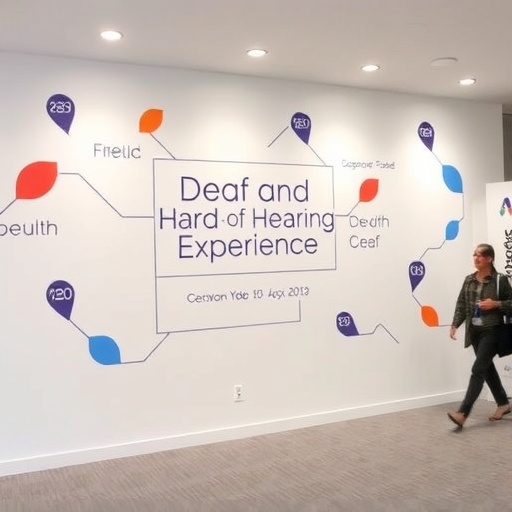
In an era where the design of physical spaces increasingly demands attention not only for aesthetics but also for their functional impact on human experience, recent advancements have shed light on an innovative approach to acoustic accessibility. A research team led by Po-Chun Chou from the University of Michigan has unveiled a pioneering method to enhance speech clarity for individuals who are deaf or hard of hearing. Their groundbreaking work dissects the complex interaction between sound waves and architectural surfaces, presenting a modular wall system constructed from 3D-printed building blocks designed to transform how sound propagates within enclosed spaces.
The fundamental challenge addressed by Chou and his colleagues stems from the prevalent issue of sound reflection in typical room environments. Multiple reflective surfaces scatter speech sounds, causing reverberations that obscure the fine acoustic cues critical for understanding spoken language. While the average listener might dismiss these reflections as mere background noise, for those with hearing impairments, these distortions pose a severe obstacle. They interfere disproportionately with the perception of consonant sounds, which are essential for distinguishing words and comprehending rapid conversational exchanges.
Traditional solutions to acoustic problems often rely on reducing volume or carpeting large areas with absorptive materials to dampen reflections. However, Chou’s research shifts the focus toward controlling the geometry of sound scattering rather than merely quelling overall sound intensity. By leveraging computational simulations, the team meticulously modeled how diverse surface microstructures influence the diffusion and absorption of speech frequencies. These insights paved the way for an adaptive architectural element—a wall comprised of interlocking tiles with distinctive geometric patterns that can be arranged to tailor the acoustic environment according to specific spatial requirements.
Rather than fabricating entire walls, the researchers introduced a modular concept wherein individual tiles connect seamlessly, akin to a tactile puzzle. This modularity empowers room designers and occupants to customize the wall configuration, optimizing sound dynamics for a vast array of room sizes and shapes. Importantly, these tiles are produced using advanced 3D printing technologies, which afford precision and repeatability previously unattainable by conventional manufacturing. This precision in fabrication ensures that subtle modifications to tile geometry can yield predictable, tunable acoustic responses.
One of the study’s pivotal revelations was that acoustic performance can be manipulated through the interplay of geometry and fabrication parameters alone, without dependence on traditional materials like foam or heavy curtains. This finding challenges prevailing assumptions in architectural acoustics and opens avenues for lightweight, visually striking elements that fulfill both aesthetic and acoustic functions. The research elucidates how varying design features each selectively influence specific frequency bands, enabling bespoke solutions that address diverse user needs and auditory environments.
Crucially, the design flexibility afforded by these 3D-printed tiles offers personalized acoustic experiences. Since hearing impairments affect individuals differently, the capacity to tailor sound reflections and clarity at a granular level allows for environments that prioritize accessibility. These adaptive walls are not merely noise-controlling surfaces; they represent a new paradigm in inclusive architectural design where clarity of communication is prioritized alongside comfort.
The inspiration for this work emanates directly from lived experiences within the deaf and hard-of-hearing communities, underscoring the significance of environmental factors in auditory accessibility. Chou emphasizes that the integration of scientific rigor with user-centered design can produce spaces that are not only comfortable for all occupants but also empower those who depend heavily on clarity to engage fully with their surroundings. This fusion of digital fabrication techniques and acoustic science exemplifies how multidisciplinary approaches can yield transformative improvements in quality of life.
The broader implications of Chou’s research extend well beyond private residences or medical facilities serving the hearing impaired. Public spaces such as classrooms, conference halls, theaters, and transportation hubs stand to benefit immensely from adoption of geometry-based acoustic control. By embedding such intelligent design features into everyday environments, architects and engineers can facilitate clearer communication, reduce listening fatigue, and promote inclusivity on a societal scale.
As the anticipation builds towards the formal presentation of these findings at the 190th Meeting of the Acoustical Society of America, the scientific community eagerly awaits further validation and exploration of this technology’s potential. Beyond its immediate application for hearing accessibility, this research heralds a shift in how built environments can leverage computational modeling and additive manufacturing to optimize human interaction with sound.
In summary, Po-Chun Chou’s work exemplifies cutting-edge innovation at the intersection of acoustics, material science, and digital manufacturing. The introduction of modular, 3D-printed wall tiles capable of finely tuning speech clarity represents a milestone in the quest to create more accessible and communicative spaces. By prioritizing the control of sound wave geometry rather than volume alone, this approach promises to revolutionize architectural acoustics for diverse user populations, affirming that thoughtful design can bridge gaps in sensory experience and inclusion.
Subject of Research: Acoustic optimization of built environments for deaf and hard-of-hearing individuals through digitally fabricated modular wall tiles.
Article Title: Modular 3D-Printed Walls Redefine Architectural Acoustics for Enhanced Hearing Accessibility
News Publication Date: May 14, 2026
Web References:
Acoustical Society of America Press Room: https://acoustics.org/asa-press-room/
Lay Language Papers on Acoustics: https://acoustics.org/lay-language-papers/
Acoustical Society of America Official Site: https://acousticalsociety.org/
Image Credits: Po-Chun Chou
Keywords
Acoustics, speech clarity, architectural acoustics, 3D printing, modular wall, hearing accessibility, sound reflection, digital fabrication, applied acoustics, noise control, hearing loss, acoustic simulation
Tags: 3D-printed acoustic wall panelsacoustic accessibility designarchitectural acoustics for hearing impaireddesigning spaces for hard of hearingfunctional acoustic architectureimproving consonant perception in speechinnovative hearing aid environmentsmodular sound-reflective surfacesreverberation reduction techniquessound wave interaction in architecturespeech clarity for deaf individualsUniversity of Michigan acoustic research