• HOME
  • NEWS
  • EXPLORE
    • CAREER
      • Companies
      • Jobs
    • EVENTS
    • iGEM
      • News
      • Team
    • PHOTOS
    • VIDEO
    • WIKI
  • BLOG
  • COMMUNITY
    • FACEBOOK
    • INSTAGRAM
    • TWITTER
Thursday, May 21, 2026
BIOENGINEER.ORG
No Result
View All Result
  • Login
  • HOME
  • NEWS
  • EXPLORE
    • CAREER
      • Companies
      • Jobs
        • Lecturer
        • PhD Studentship
        • Postdoc
        • Research Assistant
    • EVENTS
    • iGEM
      • News
      • Team
    • PHOTOS
    • VIDEO
    • WIKI
  • BLOG
  • COMMUNITY
    • FACEBOOK
    • INSTAGRAM
    • TWITTER
  • HOME
  • NEWS
  • EXPLORE
    • CAREER
      • Companies
      • Jobs
        • Lecturer
        • PhD Studentship
        • Postdoc
        • Research Assistant
    • EVENTS
    • iGEM
      • News
      • Team
    • PHOTOS
    • VIDEO
    • WIKI
  • BLOG
  • COMMUNITY
    • FACEBOOK
    • INSTAGRAM
    • TWITTER
No Result
View All Result
Bioengineer.org
No Result
View All Result
Home NEWS Science News Chemistry

Maryland engineers open door to big new library of tiny nanoparticles

Bioengineer by Bioengineer
April 24, 2020
in Chemistry
Reading Time: 3 mins read
0
IMAGE
Share on FacebookShare on TwitterShare on LinkedinShare on RedditShare on Telegram

A new study expands the landscape of nanomaterials — and what we can do with them
IMAGE

Credit: Yang et al.

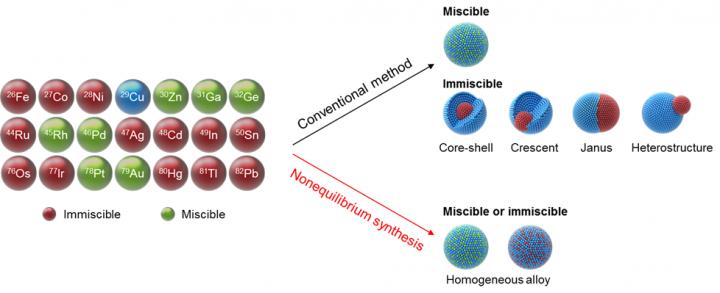
The development of bimetallic nanoparticles (i.e., tiny particles composed of two different metals that exhibit several new and improved properties) represents a novel area of research with a wide range of potential applications. Now, a research team in the University of Maryland (UMD)’s A. James Clark School of Engineering has developed a new method for mixing metals generally known to be immiscible, or unmixable, at the nanoscale to create a new range of bimetallic materials. Such a library will be useful for studying the role of these bimetallic particles in various reaction scenarios such as the transformation of carbon dioxide to fuel and chemicals.

The study, led by Professor Liangbing Hu, was published in Science Advances on April 24, 2020. Research Associate Chunpeng Yang served as first author on the study.

“With this method, we can quickly develop different bimetallics using various elements, but with the same structure and morphology,” said Hu. “Then we can use them to screen catalytic materials for a reaction; such materials will not be limited by synthesizing difficulties.”

The complex nature of nanostructured bimetallic particles makes mixing such particles using conventional methods difficult, for a variety of reasons – including the chemical makeup of the metals, particle size, and how metals arrange themselves at the nanoscale.

This new non-equilibrium synthesis method exposes copper-based mixes to a thermal shock of approximately 1300 degrees Celsius for .02 seconds and then rapidly cools them to room temperature. The goal of using such a short interval of thermal heat is to quickly trap, or ‘freeze,’ the high-temperature metal atoms at room temperature while maintaining their mixing state. In doing so, the research team was able to prepare a collection of homogeneous copper-based alloys. Typically, copper only mixes with a few other metals, such as zinc and palladium – but by using this new method, the team broadened the miscible range to include copper with nickel, iron, and silver, as well.

“Using a scanning electron microscope and transmission electron microscope, we were able to confirm the morphology – how the materials formed – and size of the resulting Cu-Ag [copper-silver] bimetallic nanoparticles,” Yang said.

This method will enable scientists to create more diverse nanoparticle systems, structures, and materials having applications in catalysis, biological applications, optical applications, and magnetic materials.

As a model system for rapid catalyst development, the team investigated copper-based alloys as catalysts for carbon monoxide reduction reactions, in collaboration with Feng Jiao, professor at the University of Delaware. The electro-catalysis of carbon monoxide reduction (COR) is an attractive platform, allowing scientists to use greenhouse gas and renewable electrical energy to produce fuels and chemicals.

“Copper is, thus far, the most promising monometallic electrocatalyst that drives carbon monoxide reduction to value-added chemicals,” said Jiao. “The ability to rapidly synthesize a wide variety of copper-based bimetallic nanoalloys with a uniform structure enables us to conduct fundamental studies on the structure-property relationship in COR and other catalyst systems.”

The non-equilibrium synthetic strategy can be extended to other bimetallic or metal oxide systems, too. Utilizing artificial intelligence-based machine learning, the new synthetic method will make rapid catalyst screening and rational design possible.

###

Media Contact
Melissa L. Andreychek
[email protected]

Tags: Chemistry/Physics/Materials SciencesMaterialsNanotechnology/MicromachinesTechnology/Engineering/Computer Science
Share12Tweet8Share2ShareShareShare2

Related Posts

Advancing In Vivo and In Situ Monitoring: Science Bulletin Highlights Host-Based Antifouling Gold Nanotube Sensor for Selective Detection of Mechanically Sensitive Serotonin Release in Intestinal Mucosa — Chemistry

Advancing In Vivo and In Situ Monitoring: Science Bulletin Highlights Host-Based Antifouling Gold Nanotube Sensor for Selective Detection of Mechanically Sensitive Serotonin Release in Intestinal Mucosa

May 20, 2026
How Magnetic Orientation Could Influence the Building Blocks of Life — Chemistry

How Magnetic Orientation Could Influence the Building Blocks of Life

May 20, 2026

Breaking a 200-Year-Old Belief: Novel Surface Design Achieves Two Distinct Wetting States on One Substrate

May 20, 2026

Unveiling Sound Waves: Scientists Discover Hidden Behaviors in Acoustic Phenomena

May 20, 2026
Please login to join discussion

POPULAR NEWS

  • blank

    New Study Reveals Plants Can Detect the Sound of Rain

    733 shares
    Share 292 Tweet 183
  • ESMO 2025: mRNA COVID Vaccines Enhance Efficacy of Cancer Immunotherapy

    303 shares
    Share 121 Tweet 76
  • Research Indicates Potential Connection Between Prenatal Medication Exposure and Elevated Autism Risk

    846 shares
    Share 338 Tweet 212
  • Breastmilk Balances E. coli and Beneficial Bacteria in Infant Gut Microbiomes

    58 shares
    Share 23 Tweet 15

About

We bring you the latest biotechnology news from best research centers and universities around the world. Check our website.

Follow us

Recent News

Electrographic Seizures in Tuberous Sclerosis Neonates

Cusp Singularity Boosts Chip-Scale Gyroscope Sensitivity

NutriGrow Delphi Sets Standards for Preterm Nutrition Reporting

Subscribe to Blog via Email

Enter your email address to subscribe to this blog and receive notifications of new posts by email.

Join 82 other subscribers
  • Contact Us

Bioengineer.org © Copyright 2023 All Rights Reserved.

Welcome Back!

Login to your account below

Forgotten Password?

Retrieve your password

Please enter your username or email address to reset your password.

Log In
No Result
View All Result
  • Homepages
    • Home Page 1
    • Home Page 2
  • News
  • National
  • Business
  • Health
  • Lifestyle
  • Science

Bioengineer.org © Copyright 2023 All Rights Reserved.