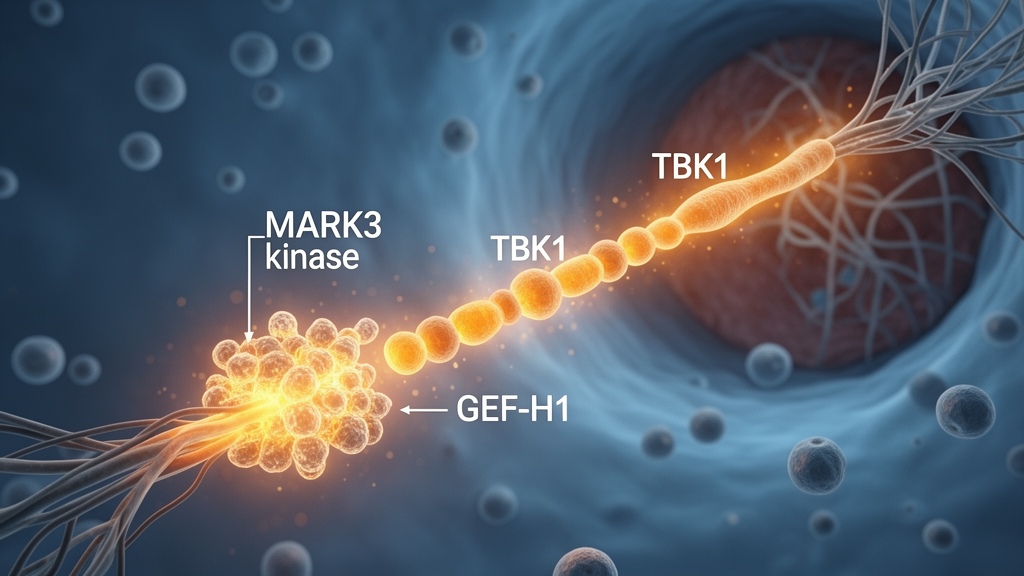
Researchers have identified MARK3, a serine/threonine protein kinase of the conserved MARK family, as a crucial regulator of innate antiviral immunity. The study shows that MARK3 promotes the production of type I interferon (IFN-I), a key early defense signal against viral infection, and that this activity depends on the kinase function of MARK3.
Using both in vitro and in vivo models, the team demonstrated that MARK3 exerts broad-spectrum antiviral activity through a signaling axis involving GEF-H1 and TBK1. According to the findings, MARK3 directly interacts with GEF-H1 and phosphorylates it at the amino acid position Ser645. This phosphorylation event potentiates the activation of TBK1, a central kinase in innate immune signaling, which in turn leads to enhanced phosphorylation of the transcription factor IRF3.
Once activated, IRF3 translocates to the nucleus, where it triggers potent IFN-I induction and the downstream expression of interferon-stimulated genes (ISGs).
The authors frame innate immunity as the body’s first line of defense against pathogenic challenge, serving both as a rapid bulwark that curbs microbial proliferation and as a rheostat that orchestrates downstream adaptive immunity. Within this framework, their results position MARK3 as an important antiviral kinase and define the MARK3–GEF-H1–TBK1 axis as a novel signaling pathway driving interferon-mediated antiviral defense.
The work, published in PLOS Pathogens, was authored by Xingmei Qi, Xue Zhu, Wenbiao Peng, Luoxue Hua, Xinru Xie, Chuncan Si, Meimei Lan, Zifan Zhuang, Siyi Ding, Ting Xu, Junjie Li, Yundi Zhang, Yifan Song, Yiping Yang, Yixue Cheng, Tao Guo, Linchao Li and Kezhen Wang. By mapping the molecular steps from MARK3-mediated GEF-H1 phosphorylation to TBK1 activation and IRF3-driven gene expression, the study provides a mechanistic account of how this kinase pathway supports the host’s early response to viral infection.
Subject of Research: The role of the MARK3 kinase in regulating innate antiviral immunity through the GEF-H1–TBK1 signaling axis.
Article Title: MARK3 promotes host antiviral defense by driving GEF-H1–mediated TBK1 activation
Article References: Qi, X., Zhu, X., Peng, W., Hua, L., Xie, X., Si, C., Lan, M., Zhuang, Z., Ding, S., Xu, T., Li, J., Zhang, Y., Song, Y., Yang, Y., Cheng, Y., Guo, T., Li, L., & Wang, K. (2026). MARK3 promotes host antiviral defense by driving GEF-H1–mediated TBK1 activation. PLOS Pathogens, 22(10), e1014701. https://doi.org/10.1371/journal.ppat.1014701
Image Credits: AI Generated
DOI: 10.1371/journal.ppat.1014701
Keywords: MARK3, GEF-H1, TBK1, IRF3, type I interferon, innate immunity, antiviral defense, interferon-stimulated genes, kinase signaling, PLOS Pathogens, promotes, host
News Source: Kristina Jarvis. (October 27, 2026). MARK3 kinase drives antiviral defense through GEF-H1 and TBK1 signaling. Scienmag.