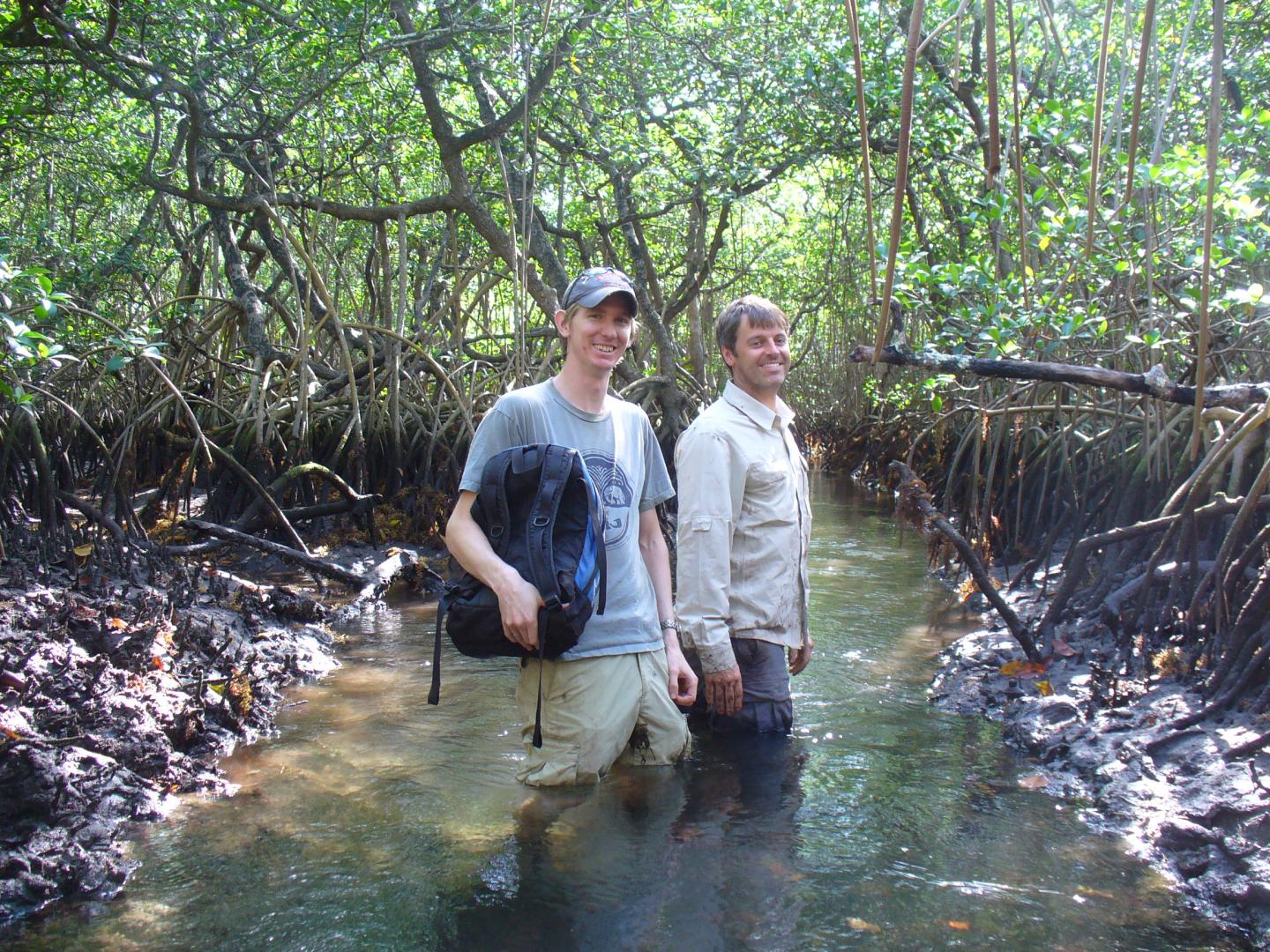
Credit: NTU Singapore/Benjamin Horton
Scientists from Nanyang Technological University, Singapore (NTU Singapore), and an international research team have predicted that by 2050, mangroves will not be able to survive rising sea-levels if global carbon emissions are not reduced.
Using sedimentary archives from when the Earth underwent deglaciation up to 10,000 years ago, the researchers estimated the probability of mangrove survival under rates of sea-level rise corresponding to two climate scenarios – low and high carbon emissions.
When rates of sea-level rise exceeded 6 mm per year, corresponding to what is estimated to result under high emissions scenarios for 2050, the researchers found that mangroves very likely (more than 90% probability) stopped growing at the pace required.
In contrast, mangroves can survive by building themselves up vertically when the sea-level rise remains under 5 mm per year, which corresponds to that projected under low emissions scenarios during the 21st century.
The threshold of a 6 mm sea level rise is one that will be “easily surpassed” on tropical coastlines if society does not make concerted efforts to cut carbon emissions, said lead investigator of the study, Professor Neil Saintilan from the Department of Earth and Environmental Sciences at Macquarie University.
Prof Saintilan said, “We know that sea-level rise is inevitable due to climate change, but not much is known about how different rates of sea-level rise affect the growth of mangroves, which is an important ecosystem for the health of the earth.”
The team comprising scientists from NTU Singapore, Macquarie University, University of Hong Kong, Rutgers University, and University of Wollongong published their findings on 5 June 2020 in the top academic journal Science.
Co-author Professor Benjamin Horton, who is Chair of the Asian School of the Environment at NTU Singapore said, “In 30 years, if we continue on a high-emissions trajectory, essentially all mangroves, including those in Singapore, will face a high risk of loss.”
“This research therefore highlights yet another compelling reason why countries must take urgent action to reduce carbon emissions. Mangroves are amongst the most valuable of natural ecosystems, supporting coastal fisheries and biodiversity, while protecting shorelines from wave and storm attack across the tropics,” Prof Horton added.
Why mangroves matter
With roots that rise from under the mud, mangrove stands grow in a process called vertical accretion. This feature is important to their ecosystem as it helps to soak up greenhouse gas emissions (carbon sequestration) at densities far greater than other forests, and provides a buffer between the land and sea – helping protect people from flooding on land.
The study, which covered 78 locations, explored how mangroves responded as the rate of sea-level rise slowed from over 10 mm per year 10,000 years ago to nearly stable conditions 4,000 years later. The drawdown of carbon as mangrove forests expanded over this time contributed to lower greenhouse gas concentrations.
The study found that mangroves will naturally encroach inland if their ability to vertically accrete is hindered. In doing so, mangroves will have to compete with other land-uses and may become squeezed behind coastal protections.
Co-author Assistant Professor Nicole Khan, who is from The University of Hong Kong said, “Most of what we know about the response of mangroves to rising sea level comes from observations over the past several years to decades when rates of rise are slower than projected for later this century. This research offers new insights because we looked deeper into the past when rates of sea-level rise were rapid, reaching those projected under high emissions scenarios.
“Our results underscore the importance of reducing emissions and adopting coastal management and adaptation measures that allow mangroves to naturally expand into low-lying coastal areas to protect these valuable ecosystems.”
###
Note to Editors:
Paper titled “Thresholds of mangrove survival under rapid sea-level rise”, published in Science, 5 June 2020.
Media contact:
Ms Junn Loh
Manager, Media Relations
Corporate Communications Office
Nanyang Technological University, Singapore
DID: (65) 6592-3557
Mobile: (65) 9339-9639
Email: [email protected]
About Nanyang Technological University, Singapore
A research-intensive public university, Nanyang Technological University, Singapore (NTU Singapore) has 33,000 undergraduate and postgraduate students in the Engineering, Business, Science, Humanities, Arts, & Social Sciences, and Graduate colleges. It also has a medical school, the Lee Kong Chian School of Medicine, set up jointly with Imperial College London.
NTU is also home to world-class autonomous institutes – the National Institute of Education, S Rajaratnam School of International Studies, Earth Observatory of Singapore, and Singapore Centre for Environmental Life Sciences Engineering – and various leading research centres such as the Nanyang Environment & Water Research Institute (NEWRI) and Energy Research Institute @ NTU (ERI@N).
Ranked 11th in the world, NTU has been placed the world’s top young university for the past six years. The University’s main campus is frequently listed among the Top 15 most beautiful university campuses in the world and it has 57 Green Mark-certified (equivalent to LEED-certified) building projects, of which 95% are certified Green Mark Platinum. Apart from its main campus, NTU also has a campus in Novena, Singapore’s healthcare district.
For more information, visit http://www.
Media Contact
Junn Loh
[email protected]
Related Journal Article
http://dx.