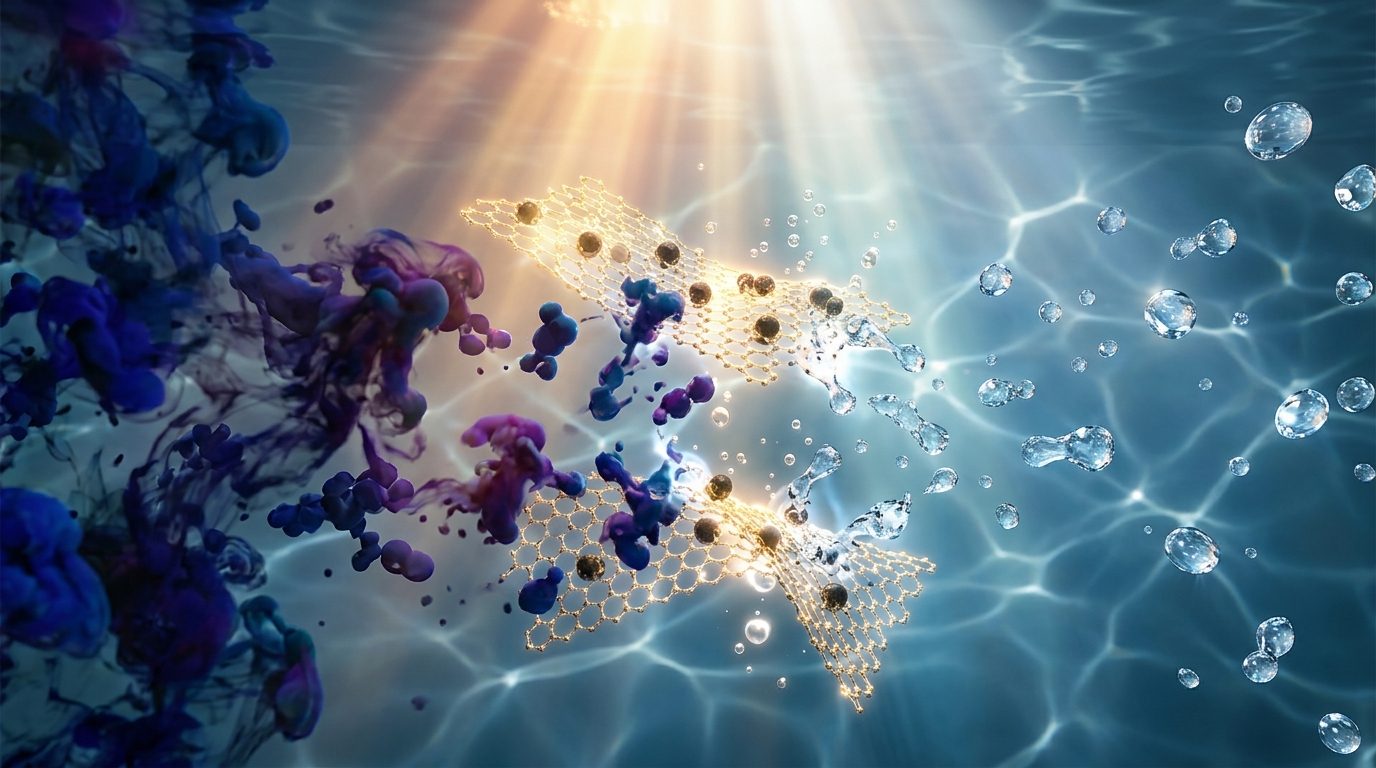
Chemists have built a magnetically recoverable photocatalyst that breaks down the stubborn dye rhodamine B under visible light, and they have traced exactly why it works: the carbon nitride scaffold they grow the magnetic component on shrinks its crystals to less than half the size they would otherwise reach. The composite, pairing graphitic carbon nitride with iron oxide nanoparticles, removed 91.25 percent of the dye within 150 minutes at near-neutral pH, according to a study published in Results in Chemistry. Because the particles can be pulled out of treated water with an ordinary magnet, the design sidesteps the filtration and centrifugation steps that often make catalyst recycling impractical.
The team, led by Hourieh Mirzaei of the underlying research group alongside Mohammad Hossein Ehsani, Alireza Shakeri and Ali Ramazani, did not invent the iron oxide–carbon nitride pairing. Earlier work had already established such binary composites as visible-light photocatalysts for dyes and chlorinated phenols. What is new here is the systematic link between structure and performance. The researchers showed that exfoliated carbon nitride nanosheets act as a dispersive matrix that governs how iron oxide nucleates and grows, and they quantified how that structural control propagates through surface area, optical response, charge separation and, ultimately, dye degradation kinetics.
Synthesis began with bulk carbon nitride, produced by heating melamine to 500 and then 520 degrees Celsius, followed by a second heating step in open air that exfoliated the material into pale-yellow nanosheets. Iron oxide nanoparticles were then grown directly on those sheets through in situ co-precipitation: iron chloride precursors were mixed into a methanol-dispersed nanosheet suspension under nitrogen, ammonia was added dropwise until the pH reached about 10, and the mixture was held at 80 degrees Celsius for two hours before a gentle 150-degree thermal treatment locked in interfacial stability. X-ray diffraction confirmed that the composite retained the characteristic reflections of cubic magnetite and graphitic carbon nitride, with no extra crystalline phases detected.
The structural payoff was striking. Pristine iron oxide particles prepared the same way, but without the carbon nitride scaffold, had a mean crystallite size of roughly 10.45 nanometers. In the composite, that figure dropped to about 4.8 nanometers, a reduction the authors attribute to the nanosheets restricting crystal growth during precipitation. Electron microscopy backed this up, showing near-spherical iron oxide particles uniformly anchored across the surfaces and edges of the wrinkled nanosheets, with some particles embedded between exfoliated layers, indicating intimate interfacial contact. Elemental mapping confirmed an even spread of carbon, nitrogen, iron and oxygen across the material.
Texture measurements revealed a second benefit. The specific surface area of the composite reached 22.6 square meters per gram, an increase of roughly 59 percent over pristine carbon nitride at 14.20 square meters per gram. The researchers suggest the iron oxide nanoparticles act as spacers between carbon nitride layers, partially preventing the sheets from restacking and exposing more surface and edge sites. Pore volume rose slightly, and the average pore diameter shifted from about 10.3 to 20.0 nanometers, changes that plausibly ease the transport of dye molecules toward reactive surfaces. The authors are careful to frame these textural gains as contributing factors rather than the sole origin of the performance boost.
Optical and photophysical measurements pointed to improved charge behavior. Diffuse reflectance spectroscopy showed the composite’s apparent optical transition energy falling from 2.63 electronvolts for pristine carbon nitride to 2.38 electronvolts, with the absorption edge shifting toward longer wavelengths, a sign of enhanced visible-light harvesting. Photoluminescence spectra told a complementary story: pristine carbon nitride emitted intensely near 465 nanometers, reflecting substantial radiative recombination of photogenerated electrons and holes, while the composite showed a markedly weaker signal, indicating suppressed recombination. The authors note that steady-state photoluminescence quenching alone cannot establish the direction of interfacial charge transfer, and they flag transient photocurrent, impedance and time-resolved measurements as the tools needed to pin down the pathway.
Magnetic testing confirmed the practical hook. Both pristine iron oxide and the composite behaved superparamagnetically at room temperature, with essentially no coercivity or remanence. Saturation magnetization fell from 61.7 to 21.01 electromagnetic units per gram when the iron oxide was embedded in the diamagnetic carbon nitride matrix, yet that residual response remained within the range reported for magnetically separable photocatalysts. In a demonstration shown in the study, the catalyst was retrieved quickly from an aqueous suspension with an external magnet, and the negligible hysteresis reduces the chance of magnetic aggregation during use.
Performance testing under three 50-watt halogen lamps with ultraviolet light filtered out revealed a clear optimum. Degradation efficiency climbed from 55 to 91 percent as catalyst loading rose from 10 to 25 milligrams per 100 milliliters of dye solution, then dropped to about 80 percent at 40 milligrams, a decline ascribed to light shielding, scattering and particle aggregation. Raising the initial dye concentration from 10 to 70 milligrams per liter pushed efficiency down from roughly 95 to 65 percent, as excess dye intercepted incoming light and competed for reactive sites. The pH sweep proved decisive: efficiency followed a bell-shaped curve across pH 3.5 to 10.8, peaking at 91.25 percent at pH 7.2 and falling under both acidic and alkaline conditions. Fitting the decay to a pseudo-first-order model yielded a rate constant of 0.0161 per minute at that optimum, about 2.3 times the value at pH 3.5 and 2.9 times the value at pH 10.8, with all fits showing correlation coefficients above 0.98.
Control experiments separated the contributions. Under identical visible-light conditions at pH 7.2, pristine carbon nitride managed 65.04 percent removal and pristine iron oxide 33.05 percent, while a catalyst-free blank reached only 15 percent and dark adsorption just 8.3 percent, confirming that photocatalytic oxidation drove the removal. Scavenger tests identified hydroxyl radicals as the dominant reactive species, with photogenerated holes contributing secondarily and superoxide playing a minor role. The authors stress that because dye concentration was tracked by ultraviolet-visible absorbance at 562 nanometers, the results demonstrate disappearance of the rhodamine B chromophore, not complete mineralization; confirming full breakdown would require total organic carbon or chemical oxygen demand measurements, and the degradation intermediates were not identified.
Reusability held up well over the tested window. Across five consecutive 150-minute cycles, removal efficiency slipped from 91.25 to 84.70 percent, an absolute drop of 6.55 percentage points, which the authors tentatively link to partial surface deactivation or minor catalyst loss during magnetic separation and washing. Post-cycling X-ray diffraction showed the major crystalline phases preserved with no detectable new phases or appreciable peak shifts, though the researchers caution that without post-cycling infrared, microscopy or quantitative iron-leaching data, the diffraction results should not be read as comprehensive evidence of chemical or compositional stability. The proposed mechanism itself remains provisional: electron transfer from carbon nitride toward iron oxide and a Fenton-like hydroxyl route involving the iron redox couple are presented as plausible interpretations rather than experimentally verified steps, since band positions and hydrogen peroxide formation were not directly measured. The team recommends future work on directly probing reactive oxygen generation and testing the material in complex wastewater matrices, where the combination of visible-light operation, near-neutral pH tolerance and magnetic recovery could prove most valuable.
Subject of Research: Magnetically recoverable g-C3N4/Fe3O4 photocatalysis for visible-light degradation of rhodamine B dye
Article Title: Crystallite-size-engineered g-C₃N₄/Fe₃O₄ heterojunction as a magnetically recoverable photocatalyst for pH-dependent visible-light-driven rhodamine B degradation
Article References: Mirzaei, H., Ehsani, M. H., Shakeri, A., & Ramazani, A. (2026). Crystallite-size-engineered g-C₃N₄/Fe₃O₄ heterojunction as a magnetically recoverable photocatalyst for pH-dependent visible-light-driven rhodamine B degradation. Results in Chemistry, 32, Article 103993. https://doi.org/10.1016/j.rechem.2026.103993
Image Credits: AI Generated
DOI: 10.1016/j.rechem.2026.103993
Keywords: photocatalysis, graphitic carbon nitride, iron oxide, rhodamine B, magnetic recovery, visible light, wastewater treatment, heterojunction, crystallite size, hydroxyl radicals, dye degradation, reusability
News Source: Bethany Barker. (November 4, 2026). Magnetic carbon nitride photocatalyst strips dye from water under visible light. Scienmag.