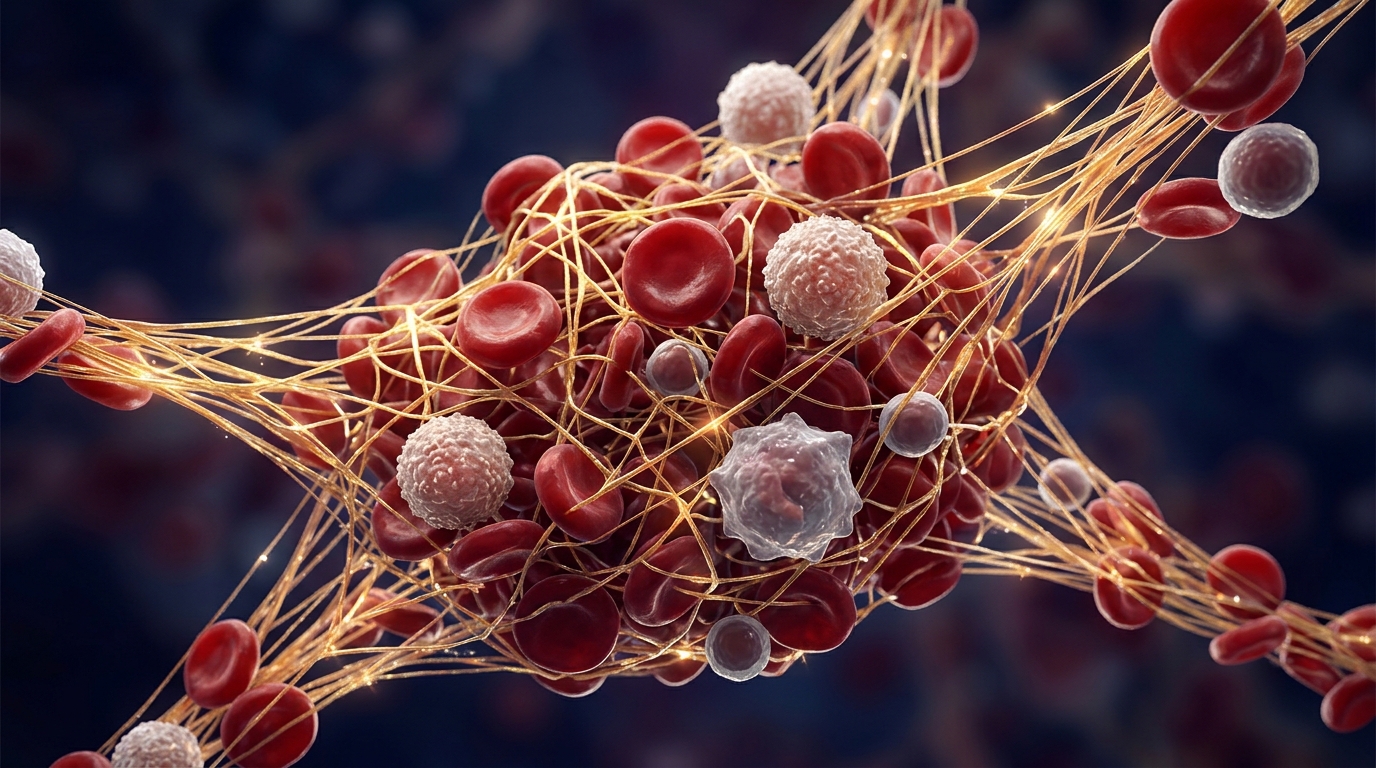
Blood clots are not all built the same way, and the differences may be written in the blood itself. In a new study published in Annals of Biomedical Engineering, researchers report that the mechanical behavior of clots formed from human blood in the laboratory is strongly tied to the blood’s composition, with fibrinogen emerging as the single most powerful explanatory variable. Across a group of healthy young adults, fibrinogen levels accounted for 70 percent of the variance in clot stiffness and 78 percent of the variance in fracture toughness, a measure of how resistant a clot is to cracking apart. The work also uncovered roles for specific white blood cell subtypes, with neutrophils positively correlated with clot strength and eosinophils showing a negative association, adding new biological detail to a picture that had previously been drawn mostly in broad strokes.
The study, led by Grace N. Bechtel, Nandini Senthilkumar, and colleagues at The University of Texas at Austin, builds on earlier work by the same team showing that sex and standard blood count measures explain some, but far from all, of the variability in clot mechanics. In that prior research, which spanned ages 19 to 46, sex had a strong effect on clot properties, blood composition measures had a moderate impact, and age showed no significant effect. Notably, hematocrit, the fraction of blood volume occupied by red blood cells and long considered a primary driver of clot mechanics, did not account for a large share of the observed variation. That gap suggested other contributing factors were missing from the analysis, and the new study was designed to find them.
To narrow the field, the researchers restricted their new study population to healthy adults in their twenties, drawing venous blood from six female subjects aged 22 to 25 and six male subjects aged 20 to 27 under institutional review board approval. Blood was collected into acid citrate dextrose anticoagulant, and clot samples were prepared and tested within three hours of collection. Additional tubes of blood were sent to a clinical laboratory for a complete blood count with differential and a fibrinogen assay, providing standard red blood cell measures, detailed white blood cell counts, and fibrinogen levels for each subject.
From each volunteer, the team prepared six clot samples, casting the re-calcified blood into Velcro-lined, 3D-printed molds measuring 40 by 10 by 3 millimeters and incubating them for 60 minutes at 37 degrees Celsius. The samples were then pulled to failure on a uniaxial tensile tester in two geometries: pure shear tests, which yielded clot stiffness, strength, and work to rupture, and mode-I fracture tests, in which a 13-millimeter lateral notch was cut into the sample so the researchers could identify the stretch at which crack propagation begins. Fracture toughness was computed from the strain energy density of the corresponding pure shear sample at that critical stretch. Stiffness was quantified as the tangent modulus at a stretch ratio of 1.35, a reference point chosen to capture the clot’s material response before damage sets in.
The results confirmed the expected sex differences with striking effect sizes. Clots from male subjects were significantly less stiff than those from female subjects, at 4.78 plus or minus 0.43 kilopascals versus 6.28 plus or minus 0.91 kilopascals, and had lower fracture toughness, at 1.46 plus or minus 0.08 versus 2.19 plus or minus 0.33 joules per square meter. Strength and work to rupture did not differ significantly between the sexes. On the blood side, male subjects had higher hematocrit, red blood cell counts, and hemoglobin, while platelet counts, fibrinogen levels, total white blood cell counts, and every white blood cell subtype measured showed no significant sex differences. Practically, the authors note, these data suggest clots from female subjects are less deformable and more resistant to rupture than those from male subjects, differences that likely influence how clots embolize and obstruct vessels, though whether they account for sex differences in thromboembolic disease remains to be determined.
When the team turned to correlations between blood composition and clot mechanics, the red blood cell measures and fibrinogen dominated. Higher hematocrit, hemoglobin, and red blood cell counts were associated with decreased stiffness, fracture toughness, strength, and work to rupture, while higher fibrinogen concentrations were associated with increases in all four properties. Hematocrit alone was correlated with stiffness, fracture toughness, strength, and work to rupture, with R-squared values of 0.72, 0.63, 0.59, and 0.52 respectively. Fibrinogen matched or exceeded those figures, with R-squared values of 0.70 for stiffness, 0.78 for fracture toughness, 0.64 for strength, and 0.50 for work to rupture, making it the strongest average correlate across all four metrics. The correlation analyses were explicitly exploratory and univariate, intended to identify associations rather than infer causality, and the researchers applied the Benjamini-Hochberg procedure to control the false discovery rate given the large number of tests performed.
A key question was whether fibrinogen’s apparent influence was simply a stand-in for sex, since the two variables travel together in the data; fibrinogen and hematocrit were inversely correlated in this cohort. Multivariable models comparing a sex-only baseline against models that added fibrinogen or hematocrit answered that concern for some metrics. Fibrinogen was associated with significant additional variance beyond sex for stiffness, adding an R-squared of 0.212, and for fracture toughness, adding 0.194. Hematocrit added significant variance beyond sex only for stiffness. Neither fibrinogen nor hematocrit improved the fit for strength or work to rupture once sex was accounted for. The authors write that fibrinogen’s association with stiffness and fracture toughness remained significant in models accounting for sex, indicating these associations are not solely a proxy for sex-related differences in fibrinogen levels.
The white blood cell findings add a new layer to the story. Prior work by the team had hinted that total white blood cell count influenced clot mechanics, but without differential counts the contributions of individual subtypes were unclear. In the new data, neutrophils were moderately correlated with strength and work to rupture, with R-squared values of 0.54 and 0.55, while eosinophils were weakly and negatively correlated with strength, with an R-squared of 0.45. Total white blood cell count, platelets, lymphocytes, monocytes, and basophils showed no significant associations. The neutrophil result aligns with prior in vitro studies showing that neutrophils interact with fibrin networks and enhance clot stability, in part by forming neutrophil extracellular traps that structurally reinforce the fibrin mesh. The authors are careful to note, however, that they did not directly confirm trap formation in their clots, so that mechanism remains speculative in this system. The eosinophil effect is even less well characterized; in vivo, eosinophils release toxic granule proteins that can disrupt extracellular matrix architecture, and a similar interference with the fibrin network may weaken clots, though future work is needed to test the mechanisms directly.
To probe whether the composition-mechanics relationships held beyond normal physiology, the researchers ran a series of supplemental experiments on modified whole blood. Varying hematocrit from 0 to 80 percent in blood from four donors, they found hematocrit significantly associated with all four mechanical properties, with marginal R-squared values ranging from 0.57 to 0.75. Spiking blood with reconstituted human fibrinogen to levels 0 to 400 milligrams per deciliter above each donor’s baseline produced even stronger associations, with marginal R-squared values between 0.86 and 0.91 across the four metrics. These extended-range results are consistent with the clinical use of fibrinogen supplementation to improve clot strength and stability in trauma and surgical patients. A third experiment comparing paired clots from eight donors coagulated with calcium chloride alone versus calcium chloride plus thrombin found no significant mechanical differences, suggesting that thrombin-driven platelet activation did not measurably alter clot mechanics under these conditions, though the authors caution that the limited sample size does not rule out a smaller contribution.
The authors are candid about the limits of the model. Their in vitro clots are homogeneous, rich in red blood cells, formed without flow, and lack the collagen deposits of aged thrombi, making them most representative of fresh venous clots. The team assumed clot composition reflected each subject’s blood composition, but did not perform histology or imaging to confirm it, and the study population was small and relatively homogeneous, raising questions about whether the findings hold across more diverse groups. Because many findings rest on correlations in a limited sample, definitive mechanistic conclusions are not possible. Still, the study is, to the authors’ knowledge, the first to demonstrate that physiological variations in fibrinogen and individual white blood cell subtypes are associated with whole blood clot mechanics in healthy subjects. The team says future studies should connect these findings to in vivo clot behavior and clinical outcomes, extending the work to larger, more heterogeneous populations and additional physiological variables, so that the mechanical fingerprint of a clot can one day be read directly from the blood that formed it.
Subject of Research: Associations between blood composition, including fibrinogen and white blood cell subtypes, and the mechanical properties of in vitro blood clots
Article Title: In Vitro Blood Clot Mechanical Properties are Associated with Fibrinogen and White Blood Cell Subtypes in Addition to Hematocrit and Sex
Article References: Bechtel, G. N., Senthilkumar, N., Noyer, J., Eades, T., Fuhg, J., Tamir, J. I., Saber, H., Parekh, S. H., & Rausch, M. K. (2026). In Vitro Blood Clot Mechanical Properties are Associated with Fibrinogen and White Blood Cell Subtypes in Addition to Hematocrit and Sex. Annals of Biomedical Engineering. https://doi.org/10.1007/s10439-026-04423-z
Image Credits: AI Generated
DOI: 10.1007/s10439-026-04423-z
Keywords: blood clots, fibrinogen, hematocrit, neutrophils, eosinophils, fracture toughness, clot stiffness, thromboembolic disease, white blood cells, biomechanics, in vitro model, sex differences
News Source: Gregory Coleman. (November 4, 2026). Fibrinogen and White Blood Cell Subtypes Shape Blood Clot Mechanics Beyond Hematocrit and Sex. Scienmag.