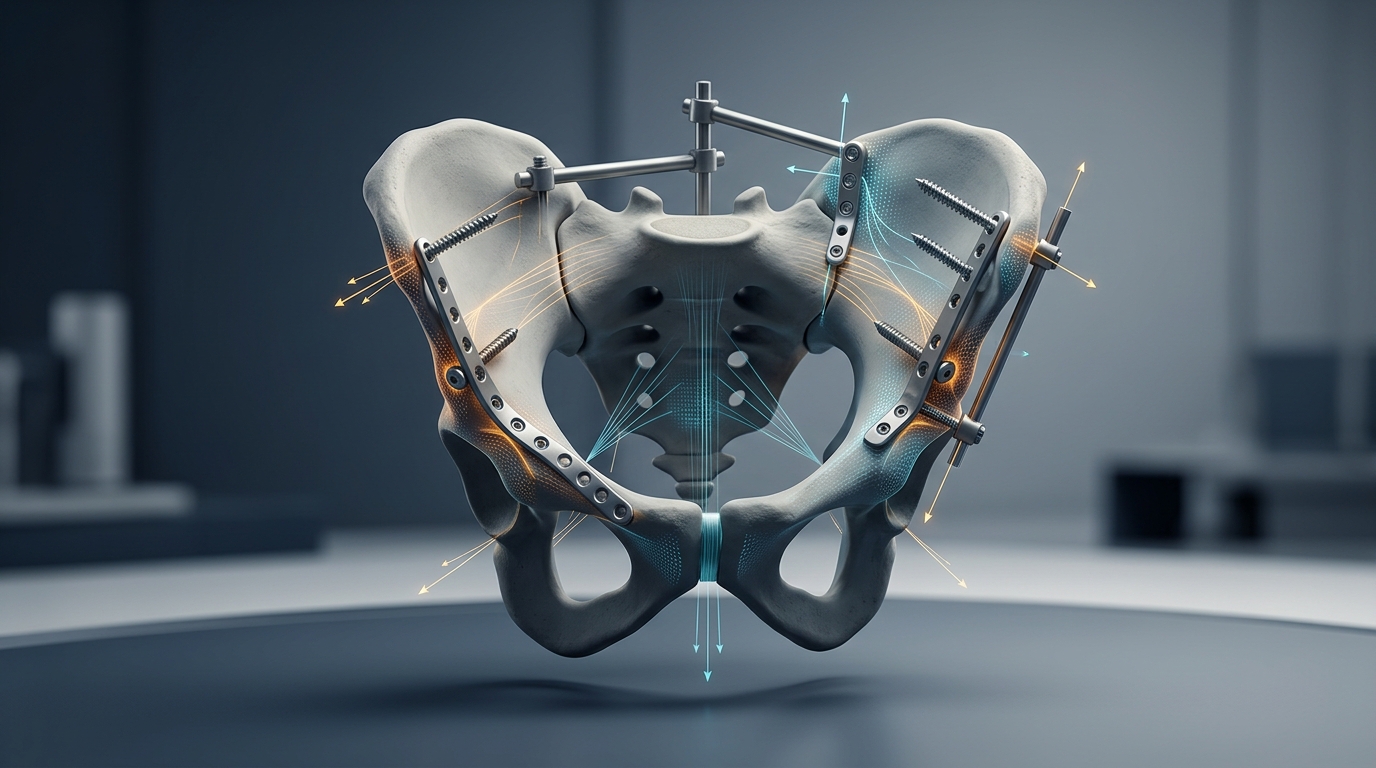
Traumatic pubic symphysis diastasis, a pelvic injury in which the joint at the front of the pelvis is torn apart, is associated with high fixation failure rates. Yet the laboratory studies used to decide how best to fix it are so varied in design that their results can barely be compared with one another. That is the central conclusion of a systematic review published in Annals of Biomedical Engineering, which mapped the methodological choices across 64 biomechanical studies of pubic symphysis diastasis fixation and found a field operating without consensus on almost any aspect of its testing.
The review, led by Suzanne van Wees of the University of Groningen with colleagues including Frank F. A. IJpma, Mirka L. Buist, Nick Assink, Paul C. Jutte and Anne M. L. Meesters, was registered in advance on PROSPERO. A systematic search of PubMed and Embase up to December 2025 identified experimental studies and finite element modeling studies of PSD fixation. The authors extracted methodological characteristics including injury classification, fixation method, ligament and muscle representation, loading conditions, mechanical or computational setup, specimen material and outcome measures, then synthesized the data descriptively and assessed reporting completeness and methodological rigor with a custom quality appraisal framework.
The headline finding is heterogeneity. Of the 64 included studies, 57 were purely experimental, six were purely finite element modeling, and one combined both approaches. Most studies modeled APC II or APC III injuries, the classification system for open-book pelvic ring disruptions in which the symphysis is progressively widened. Fixation was achieved with plates, external fixation, or semi-rigid constructs, and around half of the studies added posterior pelvic fixation, reflecting the fact that these injuries rarely occur in isolation.
Specimen choice alone splits the literature. In the experimental studies, synthetic pelves were the most common substrate, accounting for 41 percent, with cadaveric bone making up much of the remainder. Ligaments, however, were represented only in cadaveric and finite element studies, meaning that many synthetic-bone experiments tested fixation in structures stripped of the soft tissue that stabilizes the pelvis in living patients. That omission matters because the pelvic ring’s stability depends on ligamentous tension as much as on bony geometry, and a construct that performs well in an isolated synthetic pelvis may behave differently once ligaments are present.
Loading conditions were similarly inconsistent. The typical experimental setup simulated single-leg or double-leg stance by applying quasi-static sacral loading of roughly 400 newtons. Quasi-static loading, in which force is applied slowly and without the dynamic peaks of walking, is a deliberate simplification that makes results reproducible but limits how directly they translate to physiological gait. The review’s authors flag physiological loading as one of the key unresolved challenges in the field, alongside ligament representation.
Outcome measurement showed a comparable lack of standardization. Displacement at the pubic symphysis was the most common endpoint, but it was captured in two dimensions in some studies and three dimensions in others, complicating any pooled interpretation. Finite element studies more often reported implant stress, a measure unavailable to physical experiments but central to computational assessments of whether a construct risks fatigue or failure. Because the two study types rarely share outcome metrics, experimental and computational findings are difficult to place on a common scale.
The practical consequence is that clinicians and implant designers cannot easily rank fixation strategies from the existing literature. Two studies of the same plate in the same injury model may differ in specimen material, ligament status, loading magnitude, loading mode and the definition of failure, so a superior result in one may simply reflect a more forgiving test. The authors argue that this variability limits comparison and clinical translation, which is precisely what biomechanical testing is meant to enable before new fixation concepts reach patients.
To address the problem, the review proposes a baseline experimental model and practical guidance for biomechanical evaluation of PSD fixation. The framework is intended to improve interpretation, comparability and future standardization of studies in this area. The authors are explicit that the available evidence is limited by methodological heterogeneity and incomplete reporting, and they position finite element modeling as a potentially valuable tool for the challenges that physical testing handles poorly, particularly ligament representation and physiological loading, since computational models can incorporate anatomical soft tissue and gait-derived loading without the constraints of a laboratory bench.
The review’s contribution is therefore less a verdict on any single implant than a diagnostic map of how the field tests them. By cataloguing the choices that 64 studies made about injury model, fixation, specimen, loading and measurement, it gives researchers a concrete picture of where their designs diverge and a starting point for converging. Whether the proposed baseline model is adopted widely enough to make future results comparable will depend on the field’s willingness to trade methodological freedom for interpretability, a trade the authors argue is overdue.
Subject of Research: Methodological variation in biomechanical test designs for fixation of traumatic pubic symphysis diastasis
Article Title: Biomechanical Test Designs for Fixation of Traumatic Pubic Symphysis Diastasis: A Systematic Review of Key Methodological Choices in a Field Without Consensus
Article References: van Wees, S., IJpma, F. F. A., Buist, M. L., Assink, N., Jutte, P. C., & Meesters, A. M. L. (2026). Biomechanical Test Designs for Fixation of Traumatic Pubic Symphysis Diastasis: A Systematic Review of Key Methodological Choices in a Field Without Consensus. Annals of Biomedical Engineering. https://doi.org/10.1007/s10439-026-04440-y
Image Credits: AI Generated
DOI: 10.1007/s10439-026-04440-y
Keywords: pubic symphysis diastasis, pelvic fixation, biomechanics, systematic review, finite element modeling, synthetic pelves, ligament representation, quasi-static loading, fixation failure, standardization, Biomechanical, Test
News Source: Gregory Coleman. (November 4, 2026). Biomechanical Tests for Pelvic Fixation Lack Consensus, Review Finds. Scienmag.