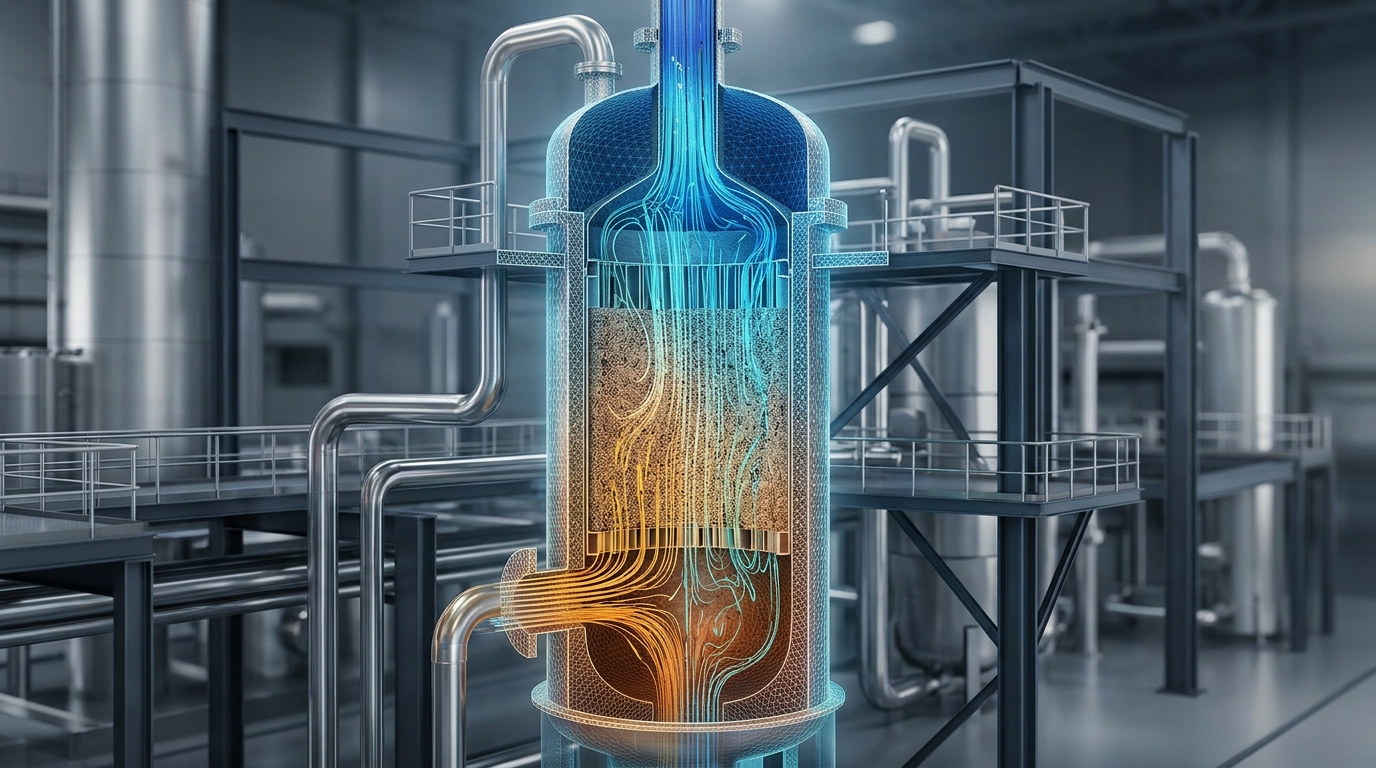
Engineers have built a full three-dimensional computer model of an industrial high-temperature water-gas shift reactor and checked it directly against measurements from an operating ammonia plant, and the numbers line up remarkably well. The simulated axial temperature profile tracked the plant data with a mean absolute error of 3.50 kelvin and a coefficient of determination of 0.950, while the predicted outlet gas composition landed within a mean absolute percentage error of roughly 5.30 percent. Those error figures, reported by a research team working with the State Company of Fertilizers South Region in Basra, Iraq, matter because they show that a detailed simulation can reproduce what actually happens inside a full-scale vessel, not just in a laboratory tube.
The water-gas shift reaction sits at the heart of ammonia production. In this step, carbon monoxide in the synthesis gas reacts with steam over an iron-chromium oxide catalyst to form carbon dioxide and additional hydrogen. Boosting hydrogen yield and cutting the carbon monoxide content of the gas before downstream purification and ammonia synthesis is exactly what the shift section is there to do. The reaction is reversible and exothermic, which creates a fundamental tension for operators: raising the temperature speeds up the reaction kinetics, but it simultaneously lowers the equilibrium constant, so lower temperatures favor higher ultimate carbon monoxide conversion. Managing that trade-off is one of the central design problems of high-temperature shift reactors.
What makes the new study distinctive is its multiscale approach. The researchers modeled the reactor in COMSOL Multiphysics 6.2 using the actual dimensions of the industrial vessel: a total length of 7.5 meters, an internal diameter of 4.45 meters, and a catalyst bed height of 3.66 meters. The model couples momentum transport, heat transfer, and multicomponent species transport in the gas flowing between catalyst pellets with diffusion and reaction occurring inside the porous pellets themselves, where the active sites are located. That two-scale coupling means local gas concentrations set the conditions at each pellet surface, while the diffusion-reaction flux inside the pellets feeds back into the macroscopic species balance. Most earlier work, the authors note, has relied on kinetic measurements, one- or two-dimensional reactor models, or laboratory and pilot-scale units, and few detailed models of this kind have been validated against industrial data.
The operating conditions were taken from the plant itself. The reactor runs adiabatically at an inlet pressure of 30 bar and an inlet temperature of 638 kelvin, with a feed containing carbon monoxide at 7.4 mole percent, steam at 39.1 percent, hydrogen at 34.1 percent, carbon dioxide at 5.5 percent, methane at 0.18 percent, nitrogen at 13.56 percent, and argon at 0.16 percent. Methane, nitrogen, and argon were treated as inert. The catalyst is an iron-chromium oxide packed as spherical pellets with a radius of 2.2 millimeters and a bed void fraction of 0.595, and the steam-to-carbon-monoxide molar ratio in the feed is 5.28. The reaction rate was described with an empirical power-law expression that accounts for the partial pressures of reactants and products together with the thermodynamic driving force toward equilibrium, an approach previously shown to work for reactor-scale modeling of commercial iron-chromium high-temperature shift catalysts.
The simulation solved the coupled conservation equations for mass, momentum, and energy in the porous medium with a finite element method, using a stationary segregated solver and a tetrahedral mesh. A mesh independence study tested four resolutions, and a fine mesh of 840 elements was selected as a compromise between accuracy and computational cost; refining further to 1,640 elements changed the predicted outlet carbon monoxide mole fraction by only about 2.09 percent while increasing solution time by 74 percent. The chosen mesh showed a minimum element quality of 0.6587 and an average of 0.7942, which the authors describe as satisfactory over the computational domain.
Inside the running reactor, the model paints a coherent physical picture. Gas velocity is nonuniform across the bed cross-section, with lower speeds near the walls and higher speeds in the interior, a pattern set by the wall boundary condition and the momentum resistance of the packed bed. Temperature climbs progressively along the axial direction, from the inlet section through a thermal gradient in the middle, reaching roughly 700 to 710 kelvin near the catalyst-bed outlet, consistent with the exothermic reaction and the adiabatic assumption. The mole fractions of carbon monoxide and steam fall through the catalytic region between 1.92 and 5.58 meters as both are consumed, while carbon dioxide and hydrogen rise, with the sharpest composition changes occurring in the central part of the bed before the profiles flatten near the outlet where little reaction remains.
Pressure behaves almost exactly as a plant engineer would hope. It stays nearly constant at about 30 bar in the inlet section, then falls approximately linearly through the catalyst bed to 28.35 bar, a total loss of about 1.65 bar driven by the viscous and inertial resistance of the packed particles. The near-linear shape indicates that bed properties and flow resistance stay essentially constant along the bed length. Beyond the bed outlet, the pressure drop is negligible because the packed-bed resistance is no longer present.
One of the more technically interesting results concerns what happens inside a single catalyst pellet. The model resolves radial concentration gradients within the porous pellets, and it finds that the pellet interior is not spatially uniform. Carbon monoxide concentration increases from the pellet center toward the external surface, the signature of inward diffusion coupled with consumption at the active sites. Along the bed axis, surface and center concentrations drop from 39.6 to 23.2 moles per cubic meter at the surface and from 37.0 to 17.4 at the center, while the gap between surface and center widens from 2.6 to 5.8 moles per cubic meter, indicating greater intraparticle nonuniformity downstream. Calculated effectiveness factors were 0.99, 0.98, and 0.92 at axial positions of 2.3, 3.75, and 5.2 meters, with Thiele moduli of about 0.39, 0.56, and 1.13, showing that diffusion resistance grows toward the outlet but remains limited. The pellet-average carbon monoxide concentration stays below the surrounding gas-phase value, while pellet carbon dioxide runs higher than the gas phase because the product is generated inside the pellets and diffuses outward.
The validated model then served as a virtual laboratory for exploring operating parameters. Raising the inlet temperature lifted predicted carbon monoxide conversion from about 38.5 percent at 618 kelvin to roughly 64 percent at the plant’s base-case 638 kelvin, then to about 70.5 percent at 648 kelvin, before the conversion plateaued near 71 percent between 653 and 658 kelvin with a slight decrease predicted at the highest temperature. That plateau reflects the competition between faster kinetics at high temperature and a less favorable equilibrium for this exothermic reaction. Separately, increasing the steam-to-carbon-monoxide molar ratio from 4.0 to 6.0, at constant inlet temperature, pressure, and total molar flow, raised the predicted conversion from about 50 percent to about 70 percent, because more steam pushes the forward reaction toward consuming carbon monoxide and producing hydrogen and carbon dioxide. At the industrial base-case ratio of about 5.28, the model predicts conversion of roughly 63 to 64 percent.
The authors position the work as a novel combination of multiscale COMSOL simulation and full-scale plant validation for a high-temperature shift reactor in an ammonia unit, and they suggest the validated model can serve as a practical tool for assessing reactor operation in ammonia-producing facilities. They also caution that the remaining discrepancies with plant data, in both the temperature profile and outlet composition, can be traced to measurement uncertainty, simplified reaction kinetics, the assumption of uniform catalyst properties, and the steady-state, adiabatic idealization. Even with those caveats, a model that reproduces an industrial temperature profile to within a few kelvin and outlet composition to within a few percent gives ammonia plant engineers something genuinely useful: a way to test changes in inlet temperature or steam ratio on a computer before committing to them in a vessel that stands 7.5 meters tall and processes synthesis gas at 30 bar.
Subject of Research: Multiscale COMSOL modeling and industrial validation of a high-temperature water-gas shift reactor in an ammonia production plant
Article Title: Multiscale modeling and industrial validation of the water-gas shift reactor in an ammonia unit using COMSOL multiphysics
Article References: Salih, S. M., Makki, D. S., Abdulabbas, A. A., Abdelkareem, H., & Abdulqader, M. A. (2026). Multiscale modeling and industrial validation of the water-gas shift reactor in an ammonia unit using COMSOL multiphysics. Frontiers in Chemical Engineering, 8, Article 1966277. https://doi.org/10.3389/fceng.2026.1966277
Image Credits: AI Generated
DOI: 10.3389/fceng.2026.1966277
Keywords: water-gas shift, COMSOL Multiphysics, ammonia production, hydrogen production, Fe-Cr catalyst, packed-bed reactor, intraparticle diffusion, industrial validation, CO conversion, pressure drop, effectiveness factor, adiabatic reactor
News Source: Bethany Barker. (November 4, 2026). 3D COMSOL Model of Industrial Water-Gas Shift Reactor Matches Ammonia Plant Data. Scienmag.