• HOME
  • NEWS
  • EXPLORE
    • CAREER
      • Companies
      • Jobs
    • EVENTS
    • iGEM
      • News
      • Team
    • PHOTOS
    • VIDEO
    • WIKI
  • BLOG
  • COMMUNITY
    • FACEBOOK
    • INSTAGRAM
    • TWITTER
Sunday, September 27, 2026
BIOENGINEER.ORG
No Result
View All Result
  • Login
  • HOME
  • NEWS
  • EXPLORE
    • CAREER
      • Companies
      • Jobs
        • Lecturer
        • PhD Studentship
        • Postdoc
        • Research Assistant
    • EVENTS
    • iGEM
      • News
      • Team
    • PHOTOS
    • VIDEO
    • WIKI
  • BLOG
  • COMMUNITY
    • FACEBOOK
    • INSTAGRAM
    • TWITTER
  • HOME
  • NEWS
  • EXPLORE
    • CAREER
      • Companies
      • Jobs
        • Lecturer
        • PhD Studentship
        • Postdoc
        • Research Assistant
    • EVENTS
    • iGEM
      • News
      • Team
    • PHOTOS
    • VIDEO
    • WIKI
  • BLOG
  • COMMUNITY
    • FACEBOOK
    • INSTAGRAM
    • TWITTER
No Result
View All Result
Bioengineer.org
No Result
View All Result
Home NEWS Science News Cancer

Machine learning platform guides pancreatic cyst management in patients

Bioengineer by Bioengineer
July 17, 2019
in Cancer
Reading Time: 2 mins read
0
IMAGE
Share on FacebookShare on TwitterShare on LinkedinShare on RedditShare on Telegram

IMAGE

Credit: S. Springer et al., Science Translational Medicine (2019)

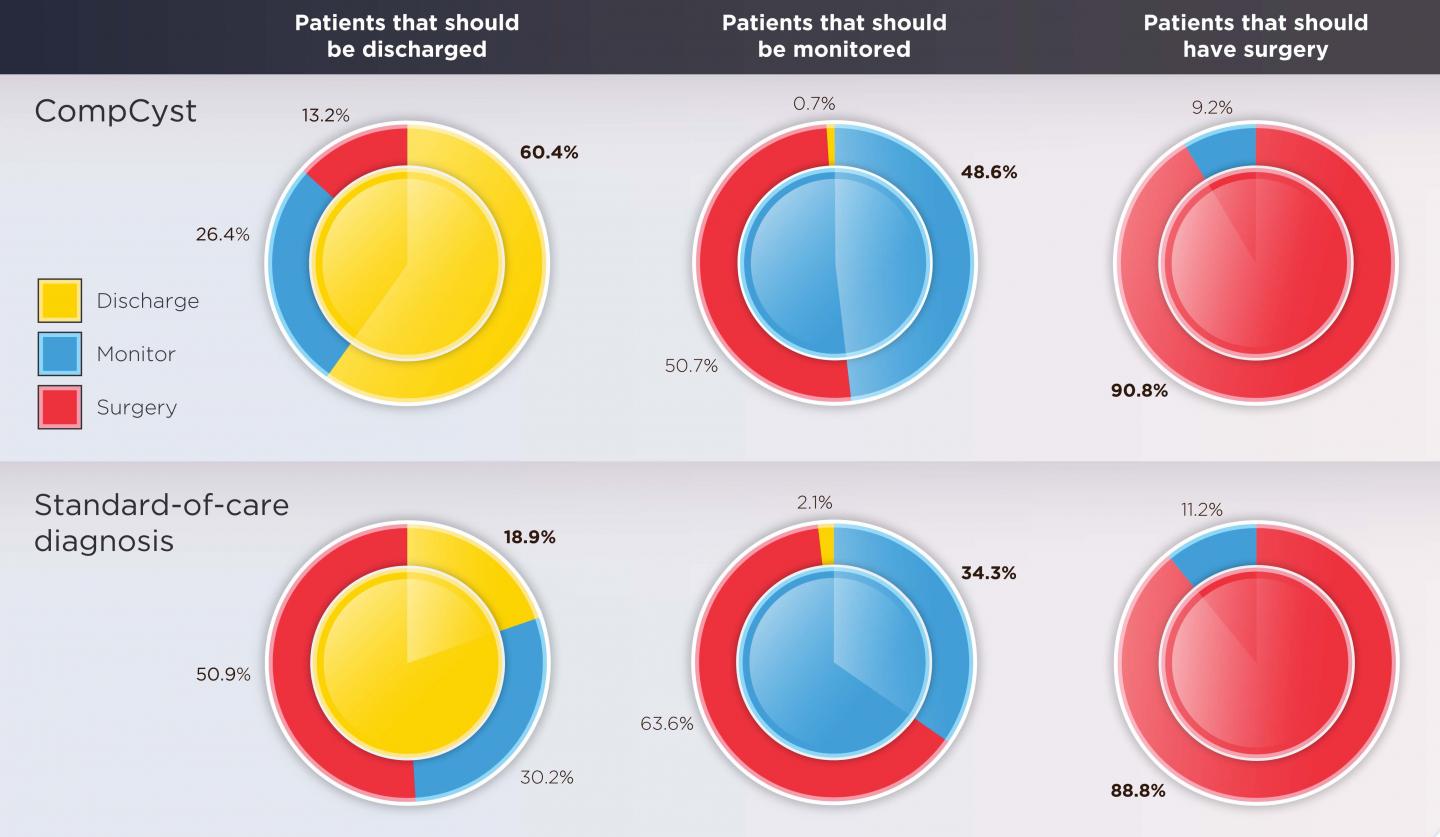
Researchers have created a comprehensive test based on machine learning algorithms to better guide the management of patients with pancreatic cysts – a potential precursor of pancreatic cancer. The new assay, called CompCyst, outperformed the current gold standard-of-care in an international, multicenter study of 875 patients. Crucially, the test would have avoided surgery in 60% of patients who underwent unnecessary surgical removal, suggesting its use could lead to fewer unneeded surgeries and lower health and economic costs. Pancreatic cysts are fluid-filled lesions in the pancreas that are found in up to 8% of all people over the age of 70. Although most cysts are benign, some pancreatic cysts that produce mucin can transform into an aggressive form of pancreatic cancer. What’s more, it is difficult to distinguish precancerous cysts from benign ones, so noncancerous cysts are often misclassified and unnecessarily removed with pancreatic surgery. To overcome this dilemma, Simeon Springer and colleagues enrolled 875 patients with pancreatic cysts and collected information of the mutations, proteins, and other markers linked to their either benign or mucin-producing cysts. They used deep learning techniques to train CompCyst to read these markers and classify patients into those that should be monitored, not monitored, or receive surgery. After training the test protocol with 436 of the original patients, the researchers found the test largely outperformed standard-of-care pathology when evaluated in 426 other patients: it correctly identified 60.4% of patients who should have been discharged (versus 18.9% using standard-of-care diagnosis), 48.6% of patients that should have been monitored (versus 34.3%), and 90.8% of patients in need of surgery (versus 88.8%). Future work will be necessary to prospectively validate the markers used in the test, but Springer et al. say their platform has strong potential to be used in the clinic as a complement to existing approaches.

###

Media Contact
Science Press Package Team
[email protected]

Related Journal Article

http://dx.doi.org/10.1126/scitranslmed.aav4772

Tags: cancerGeneticsMedicine/Health
Share12Tweet8Share2ShareShareShare2

Related Posts

Low-Dose Radiation Shows Promise for Slowing Knee Osteoarthritis in Long-Term Trial

September 27, 2026

Gold Nanorods and Laser Light Strike at Cancer Stem Cells in Cats With Breast Tumors

September 27, 2026

Proton Beam Therapy Shows Durable Tumor Control in Rare Adult Brain Tumors

September 27, 2026

Radiation Oncology Takes Center Stage as Mayo Clinic Unveils Research at ASTRO 2026

September 26, 2026
Please login to join discussion

POPULAR NEWS

  • Trunk Control May Hold a Key to Balance and Fall Risk in Older Adults

    29 shares
    Share 12 Tweet 7
  • AI Tells Doctors When It Is Unsure About Cancer Treatment Success

    29 shares
    Share 12 Tweet 7
  • Engineered mini CRISPR enzyme gets a 60-fold power boost for gene editing

    29 shares
    Share 12 Tweet 7
  • When Autism Diagnoses Fade: Early Intervention and Milder Symptoms Mark Children Who Lose the Label

    29 shares
    Share 12 Tweet 7

About

We bring you the latest biotechnology news from best research centers and universities around the world. Check our website.

Follow us

Recent News

Trunk Control May Hold a Key to Balance and Fall Risk in Older Adults

AI Tells Doctors When It Is Unsure About Cancer Treatment Success

Engineered mini CRISPR enzyme gets a 60-fold power boost for gene editing

Subscribe to Blog via Email

Enter your email address to subscribe to this blog and receive notifications of new posts by email.

Join 85 other subscribers
  • Contact Us

Bioengineer.org © Copyright 2023 All Rights Reserved.

Welcome Back!

Login to your account below

Forgotten Password?

Retrieve your password

Please enter your username or email address to reset your password.

Log In
No Result
View All Result
  • Homepages
    • Home Page 1
    • Home Page 2
  • News
  • National
  • Business
  • Health
  • Lifestyle
  • Science

Bioengineer.org © Copyright 2023 All Rights Reserved.