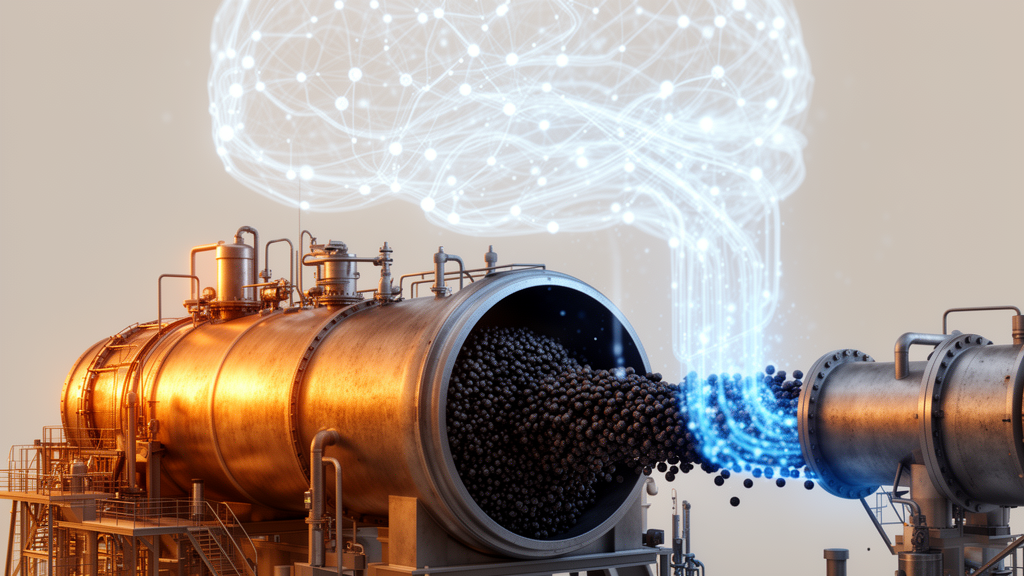
Hydrothermal carbonization, or HTC, has quietly become one of the most versatile tools in the biomass conversion toolbox. By heating wet feedstocks in water under subcritical conditions, the process transforms everything from sewage sludge to agricultural residues into carbon-rich solids called hydrochars, whose energy content, porosity, and surface chemistry can be tuned for applications ranging from solid fuels to water treatment adsorbents and battery precursors. Yet despite decades of laboratory study, researchers still struggle to predict exactly what properties a given hydrochar will have before they make it. A new critical review published in Frontiers in Chemical Engineering argues that the path to predictable, application-driven hydrochar design lies in combining two computational approaches: design of experiments and machine learning.
The core problem, according to the review, is complexity. HTC is not a single reaction but a tangled network of coupled processes, including dehydration, decarboxylation, polymerization, and recondensation, all unfolding simultaneously in an aqueous reactor. These transformations reshape the elemental composition, surface functionality, and microstructure of the starting biomass, which means that small changes in operating conditions can produce dramatically different materials. Feedstock heterogeneity compounds the challenge: two batches of the same agricultural waste can differ in moisture, ash content, and lignocellulosic composition, throwing off reproducibility between laboratories and even between runs in the same facility.
Design of experiments, a statistical discipline with roots in agricultural field trials and industrial quality control, offers a structured way to tame this complexity. Rather than varying one factor at a time, DoE frameworks such as factorial designs and response surface methodologies explore many variables simultaneously with statistically efficient experimental layouts. In the HTC context, the key variables include reaction temperature, residence time, the solid-to-liquid ratio in the reactor, system pressure, and the use of catalysts. By quantifying both the main effects of each variable and the interactions between them, DoE generates structured datasets that reveal which parameters matter most and how they combine to shape the final product.
Where DoE alone reaches its limits, machine learning picks up the baton. Classical response surface models fit relatively simple polynomial equations to experimental data, but HTC’s reaction networks are strongly nonlinear, with high-order interactions that polynomials struggle to capture. The review highlights how algorithms including artificial neural networks, ensemble methods, gradient boosting, and Bayesian approaches can learn these nonlinearities directly from data, substantially improving predictions of material-critical outputs. Among the most important targets are mass yield, the higher heating value, fixed carbon content, carbon retention, and textural and chemical descriptors that determine how well a hydrochar performs as an adsorbent or as a precursor for electrochemical materials.
The combination of the two approaches is more than the sum of its parts, the authors argue. DoE provides the statistically sound experimental backbone that ensures the training data for machine learning models actually covers the operating space of interest, while machine learning supplies the predictive muscle to capture relationships that classical models miss. This coupling proves particularly valuable for multi-objective optimization, one of the central tensions in hydrochar engineering. Energy densification, which maximizes heating value and fixed carbon, often works against the retention of oxygen-containing functional groups and the development of porosity, yet those very features determine whether a hydrochar can adsorb pollutants from water or serve as a scaffold for advanced carbon materials.
The choice of optimization target depends entirely on the intended application. Hydrochars destined for use as solid fuels benefit from conditions that push carbon content and calorific value upward, while chars intended for water and gas treatment require carefully preserved surface functionality and pore structure. A third family of applications treats hydrochar as a precursor for advanced carbon materials, where the priorities shift again. Because these objectives frequently conflict, the review emphasizes that DoE-guided machine learning allows researchers to map trade-off surfaces explicitly, identifying operating windows that balance competing demands rather than optimizing a single property in isolation.
Despite the promise, the review is candid about the bottlenecks that currently limit transferability and industrial robustness. Data quality and comparability across studies rank among the most serious. Machine learning models are only as good as the datasets they learn from, and HTC literature contains results generated under widely varying definitions, measurement protocols, and reporting standards. Pooling data across publications therefore risks training models on inconsistent inputs, a problem familiar to anyone who has tried to build predictive models from heterogeneous literature data in other fields of chemistry and materials science.
Interpretability presents a second hurdle. Deep neural networks and complex ensemble models may deliver impressive predictive accuracy, but they often behave as black boxes, offering little physical insight into why a particular combination of temperature, time, and feedstock produces a given outcome. For a field that still seeks mechanistic understanding of its reaction networks, models that cannot be interrogated risk becoming predictive oracles without explanatory power. The review suggests that hybrid strategies, in which DoE structure constrains and interprets machine learning predictions, offer a route to models that are both accurate and scientifically meaningful.
The systematic treatment of biomass variability rounds out the list of open challenges. Because feedstock composition varies with season, geography, and preprocessing, models trained on one biomass type may fail badly when applied to another. Building variability explicitly into experimental designs and model inputs, rather than treating it as noise, emerges as a methodological priority for anyone hoping to move hydrochar production from laboratory curiosity to industrial process.
Taken together, the review sketches a roadmap for moving HTC from empirical tuning toward data-informed, property-targeted engineering. By pairing statistically rigorous experimental design with machine learning capable of capturing high-order nonlinearities, researchers can begin to specify the hydrochar they need and work backward to the operating conditions that produce it. The authors outline methodological directions for developing more reliable hybrid DoE-ML strategies, with the goal of accelerating rational design of hydrochar materials at scale. If those strategies mature, the humble wet-biomass reactor could become a predictable manufacturing platform for carbon materials tailored to energy, environmental, and electrochemical applications alike.
Subject of Research: Design of experiments-guided machine learning for predicting hydrochar properties in hydrothermal carbonization
Article Title: Toward predictable hydrochar properties at scale: a critical review of design of experiments-guided machine learning in hydrothermal carbonization
Article References: El Ouadrhiri, F., & Lahkimi, A. (2026). Toward predictable hydrochar properties at scale: a critical review of design of experiments-guided machine learning in hydrothermal carbonization. Frontiers in Chemical Engineering, 8, Article 1883652. https://doi.org/10.3389/fceng.2026.1883652
Image Credits: AI Generated
DOI: 10.3389/fceng.2026.1883652
Keywords: hydrothermal carbonization, hydrochar, machine learning, design of experiments, biomass conversion, response surface methodology, neural networks, multi-objective optimization, higher heating value, adsorption, carbon materials, data-driven modeling
News Source: Teresa Odom. (October 16, 2026). Machine Learning Meets Design of Experiments to Predict Hydrochar Properties at Scale. Scienmag.