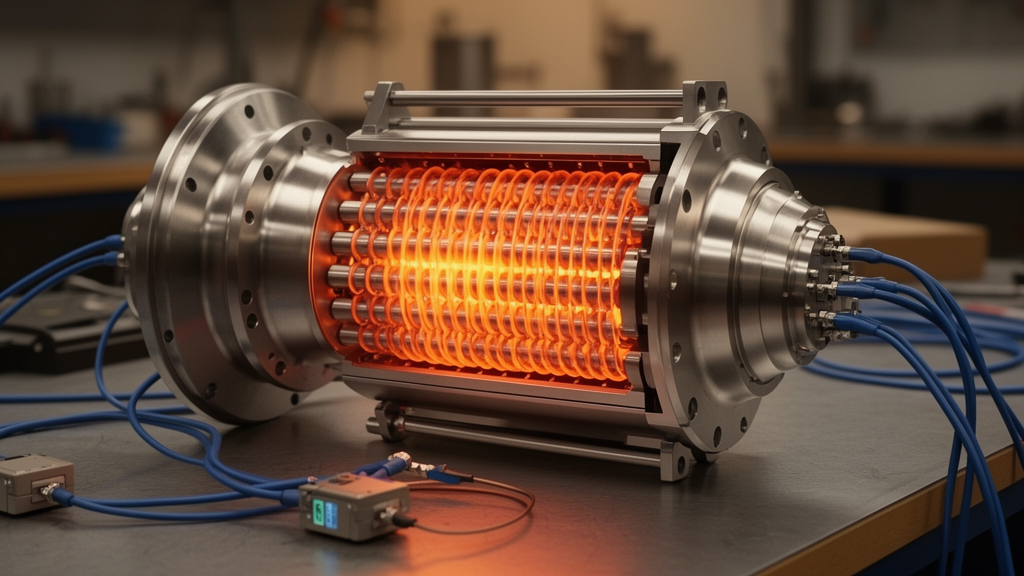
A quiet revolution is brewing inside the combustion chambers of the gas turbines that power aircraft and generate electricity. For nearly a century, these machines have burned fuel at essentially constant pressure, a thermodynamic constraint that caps how much useful work engineers can extract from every kilogram of fuel. Now, a growing international research community is betting on pressure gain combustion, a family of technologies in which the combustor itself raises the pressure of the working gas before it reaches the turbine. An editorial published in Frontiers in Aerospace Engineering by Simone Salvadori of the Politecnico di Torino, Paolo Gaetani of the Politecnico di Milano, and Guillermo Paniagua of Purdue University surveys the state of this field through a dedicated Research Topic, drawing together experimental and computational studies that probe one of its most stubborn challenges: how to feed fuel and air into a combustion chamber that is, quite literally, exploding in a continuous, rotating wave.
The appeal of pressure gain combustion is rooted in fundamental thermodynamics. In a conventional gas turbine cycle, the working fluid loses pressure as it flows through the combustor, and that loss must be paid for with additional compression work upstream. If the combustor could instead deliver a net pressure rise, the same turbine expansion could produce more power from the same fuel, or the same power from less fuel. The most actively pursued embodiment of this idea is the rotating detonation combustor, or RDC, in which a detonation wave spins around an annular chamber at speeds that can exceed a kilometre per second, compressing and burning the fresh reactants almost instantaneously as it passes. Unlike the slow, subsonic deflagration that burns fuel in today’s engines, a detonation is a supersonic combustion wave, and harnessing it promises a step change in cycle efficiency and specific power.
There is also a climate dimension to this engineering race. The editorial highlights that pressure gain combustion cycles are natural candidates for hydrogen fuel, which burns rapidly enough to keep pace with the passing detonation wave and produces no carbon dioxide at the point of use. Swapping kerosene for hydrogen in a pressure gain cycle could therefore eliminate direct CO2 emissions from the engine while simultaneously exploiting the fast flame chemistry that hydrogen offers. The authors are careful, however, to flag that nitrogen oxide emissions remain an open question, since the extreme temperatures reached inside a detonation wave are precisely the conditions that promote NOx formation. Solving the efficiency problem while containing the pollution problem is the double bind that defines modern detonation research.
Despite decades of interest, the actual performance benefit that a pressure gain combustor can deliver when bolted onto a real gas turbine is still hotly debated. The pressure rise measured inside the combustor does not translate one-to-one into cycle efficiency, because the outflow from a rotating detonation chamber is violently unsteady, non-uniform, and in places supersonic. How such a flow couples with the turbine blades downstream, whether they are designed for subsonic or supersonic inflow, remains under investigation by several research groups around the world, including those of the editorial authors themselves. Getting this coupling right is fundamental: an imperfectly matched turbine can squander the pressure gain that the combustor works so hard to produce, erasing the very benefit that motivated the technology.
Part of the difficulty is experimental. The environment inside an operating rotating detonation combustor is extraordinarily hostile, with exhaust temperatures high enough to destroy conventional instrumentation, local Mach numbers that reach supersonic values, and characteristic frequencies so high that standard measurement techniques simply cannot resolve what is happening. These conditions make it extremely difficult to evaluate the aero-thermo-mechanical behaviour of the chamber experimentally, which is why the field leans heavily on high-fidelity computational fluid dynamics to peer inside the flame front. But simulation brings its own traps, as the three studies gathered in the Research Topic make abundantly clear.
The first of these studies, by Le Naour and colleagues, tackles a deceptively simple question: does the shape of the fuel injector matter? The answer, it turns out, is emphatically yes. Using large eddy simulation, the team compared a conventional semi-impinging injection element against a newly developed configuration called ITEM, short for Injection To Enhance Mixing. In a non-reactive environment, the ITEM design demonstrated superior mixing efficiency, and when the researchers simulated detonation propagation across a series of these elements, in both linear and annular arrangements, the higher mixing efficiency of ITEM held in both cases. The study also reported results from small-scale and large-scale test facilities, providing measured thrust data from the smaller rig and observations of detonation stability across varying mass flows and total temperatures from the larger one, findings that lined up encouragingly with the numerical predictions.
The second study, led by Sato and colleagues, exposes a subtlety that could undermine years of computational work in the field. The team ran high-fidelity simulations of an experimental rotating detonation combustor, using detailed chemical kinetics for the hydrogen-air system, and tested two different ways of specifying the boundary conditions at the chamber inlet. When they prescribed a total pressure at the feed plenum and increased the mass flow rate, the simulation failed to reproduce the axial pressure distribution seen in the experiment. When they instead prescribed a fixed mass flow rate, the simulations confirmed experimental trends both qualitatively and quantitatively. The choice of a boundary condition, often treated as a routine modelling decision, turned out to determine whether the simulation was physically meaningful at all.
Sato’s simulations also revealed the microscopic inefficiencies that erode detonation combustor performance. Because the fuel and air do not mix perfectly before the wave arrives, the local equivalence ratio varies around the chamber, meaning some regions burn too rich and others too lean. Worse, as the detonation wave sweeps past an injector, the sudden pressure spike pushes hot gas backwards into the fuel and oxidizer supply passages, a backflow phenomenon that further degrades the mixing of the next charge. And in the mixing region ahead of the wave, the researchers observed parasitic combustion, a slow, uncontrolled burning that stretches the reaction zone across the wave front rather than confining it to the sharp detonation structure. Each of these effects represents energy that is consumed without contributing to the pressure gain the cycle is designed to deliver.
The third contribution, by Hellard and colleagues, addresses the computational cost problem head-on. Full-scale, high-fidelity simulation of a rotating detonation combustor is enormously expensive, so the team applied a modelling strategy developed at ONERA, the French aerospace research laboratory, to simulate the transitory injection process in two existing RDCs and one still under development. A key element of their approach is a strategy for retrieving accurate boundary conditions to simulate the expansion of burnt gas back into the chamber, a problem the community calls the reinjection problem. Their numerical data suggest that reinjection simulation can indeed guide the design of an optimized injector that achieves efficient propellant mixing at a fraction of the computational cost of full simulation. However, there is a catch: the detonation speed inferred from the mixture state in their reinjection simulation can differ from the velocity measured in experiments, meaning that reduced models cannot yet be trusted to predict wave speed from a heterogeneous mixture. More work is needed before these fast models can stand in for full physics.
Taken together, the studies collected in the Research Topic cover a substantial portion of the open questions surrounding injector geometry and mixing performance in rotating detonation combustors, and they map out the limitations of current numerical methods with unusual candour. The editorial authors argue that this combined evidence paves the way for more accurate analysis of reactive flows, a detailed survey of pollutant emissions, and, ultimately, the design of more efficient injectors. Those may sound like incremental steps, but in a technology where the margin between a working engine and an expensive flame holder is measured in mixing microseconds and boundary conditions, they are the steps on which the entire promise of greener propulsion depends. If hydrogen-fuelled pressure gain combustion is to power the aircraft and power plants of a decarbonized future, it will be built on precisely this kind of painstaking, unglamorous groundwork.
Subject of Research: Pressure gain combustion and rotating detonation combustor research for efficient, hydrogen-fuelled gas turbine propulsion
Article Title: Editorial: Pressure Gain Combustion technologies for a Greener propulsion
Article References: Salvadori, S., Gaetani, P., & Paniagua, G. (2024). Editorial: Pressure Gain Combustion technologies for a Greener propulsion. Frontiers in Aerospace Engineering, 2, Article 1357800. https://doi.org/10.3389/fpace.2023.1357800
Image Credits: AI Generated
DOI: 10.3389/fpace.2023.1357800
Keywords: pressure gain combustion, rotating detonation combustor, gas turbine, hydrogen fuel, computational fluid dynamics, large eddy simulation, fuel injectors, mixing efficiency, detonation wave, aerospace propulsion, NOx emissions, thermodynamic efficiency
News Source: Audrey Campbell. (October 16, 2026). Pressure Gain Combustion Moves Closer to Greener Gas Turbine Propulsion. Scienmag.