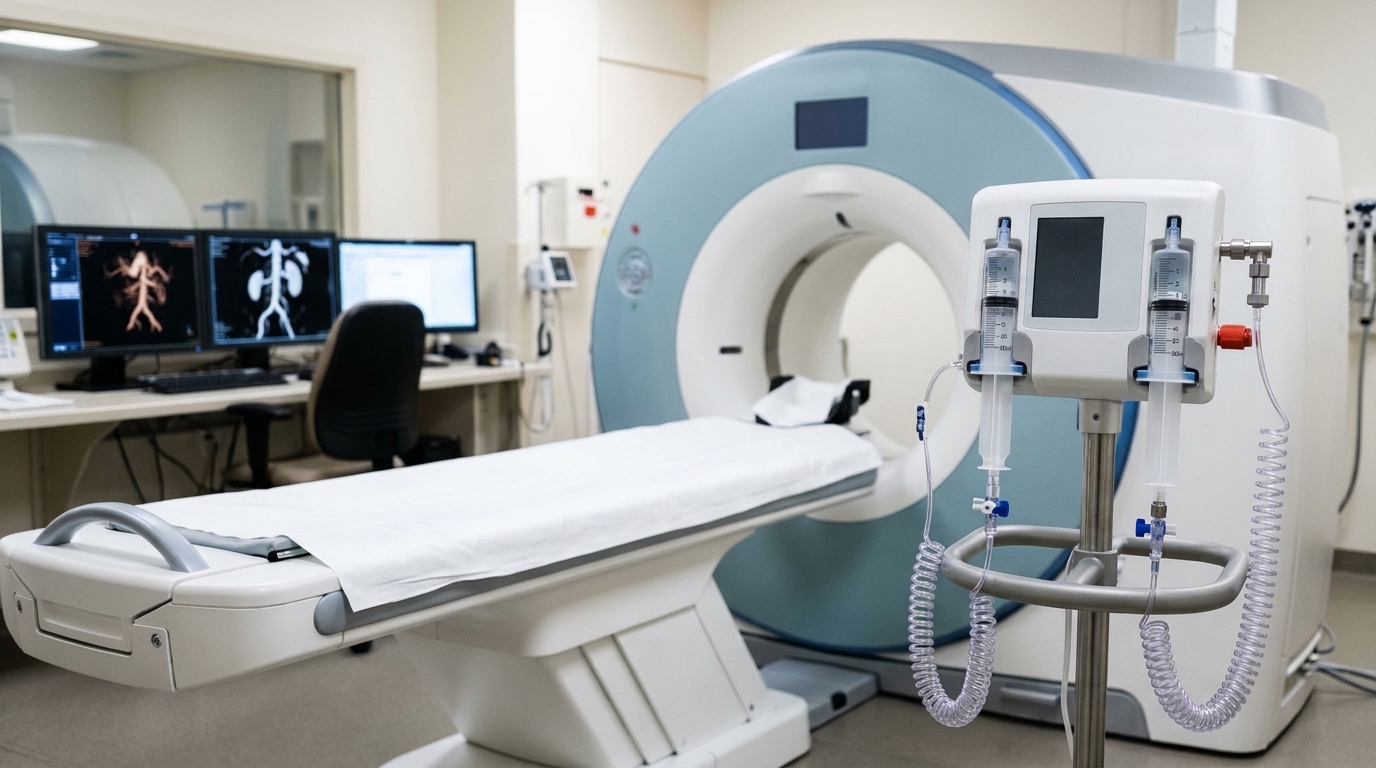
Combining a reduced tube voltage of 80 kV with a high-concentration contrast medium of 400 mg I/ml allows for effective imaging during one-stop head-neck and coronary computed tomography angiography while significantly lowering patient radiation dose. According to research published in BMC Medical Imaging, implementing a low-dose protocol that incorporates a cranial-to-heart scanning sequence enables clinicians to achieve substantial radiation reductions without compromising diagnostic image quality. The study demonstrated that adjusting these technical exposure factors and sequence trajectories provides robust visualization across both vascular territories simultaneously.
The primary objective of the investigation was to determine whether pairing high-concentration contrast media with low tube voltage could successfully decrease radiation exposure during simultaneous head-neck CT angiography and coronary CT angiography without degrading image quality. To evaluate this approach, the researchers studied a clinical cohort consisting of patients with confirmed atherosclerosis as well as individuals with suspected atherosclerosis. Participants in the study were randomly assigned across four distinct examination groups designed to test specific combinations of tube voltage, contrast concentration, and scanning directions.
The experimental design contrasted conventional-dose protocols against low-dose protocols while alternating the directional sequence of the scan. Patients assigned to Group A and Group B underwent conventional-dose imaging protocols using a contrast medium concentration of 320 mg I/ml and a tube voltage of 100 kV for the head-neck portion of the examination. In contrast, patients in Group C and Group D received low-dose protocols utilizing a high-concentration contrast agent containing 400 mg I/ml alongside a lower tube voltage of 80 kV for head-neck angiography. Regarding scanning trajectory, Group A and Group C were evaluated using a heart-to-cranial scanning sequence, whereas Group B and Group D were examined using a cranial-to-heart sequence.
Image assessment involved both subjective scoring and quantitative objective analysis. Subjective image quality was independently evaluated by two radiologists, while objective image quality metrics and overall effective dose were systematically compared across the four cohorts. When examining overall performance on a per-patient basis for the complete one-stop examination, Group D achieved the highest evaluation scores among all study arms. In the head-neck CT angiography assessments, conventional-dose protocols showed significantly lower background noise only in limited locations, specifically at the common carotid artery (p < 0.01 and p < 0.05) and the vertebral artery (p < 0.001). Conversely, the low-dose Group C demonstrated significantly higher signal-to-noise ratio at the middle cerebral artery and superior contrast-to-noise ratio at both the internal carotid artery and vertebral artery.
The coronary CT angiography evaluations further reinforced the advantages of the low-dose strategy. Across all coronary branches, the low-dose cohorts exhibited significantly lower background noise compared to conventional protocols, with all differences reaching statistical significance (p < 0.05). Furthermore, Group C achieved higher signal-to-noise ratios and contrast-to-noise ratios across all evaluated coronary arterial branches when compared directly against Group A (p < 0.05), with the sole exception being the aortic root where differences did not reach statistical significance (p > 0.05).
Radiation dose measurements confirmed marked exposure reductions under the optimized imaging pathway. Patients assigned to Group D, who underwent the low-dose 80 kV protocol using 400 mg I/ml contrast medium paired with a cranial-to-heart scanning sequence, recorded the lowest effective dose of any cohort at 4.13 ± 0.63 mSv (p < 0.001). Based on these quantitative findings, the study concluded that combining an 80 kV tube voltage with 400 mg I/ml contrast media enables effective one-stop angiography, and that applying a cranial-to-heart scanning sequence in this low-dose regimen further diminishes radiation dose while maintaining overall image quality.
Subject of Research: Radiation dose and image quality in one-stop head-neck and coronary CT angiography
Article Title: One-stop head-neck and coronary CT angiography: impact of high-concentration contrast media and low tube voltage on image quality and radiation dose
Article References: Zhao, X., Zhao, C., Cui, Y., Wang, C., Shan, Y., Cao, R., Zheng, C., Yan, S., Zhang, M., & Lu, J. (2026). One-stop head-neck and coronary CT angiography: impact of high-concentration contrast media and low tube voltage on image quality and radiation dose. BMC Medical Imaging. https://doi.org/10.1186/s12880-026-02934-8
Image Credits: AI Generated
DOI: 10.1186/s12880-026-02934-8
Keywords: computed tomography angiography, radiation dose, contrast media, coronary CT angiography, head-neck CT angiography, tube voltage, atherosclerosis, medical imaging, One-stop, head-neck, coronary, angiography
News Source: Ophelia Keating. (November 6, 2026). Low Tube Voltage and High-Concentration Contrast Media Optimize One-Stop CT Angiography. Scienmag.