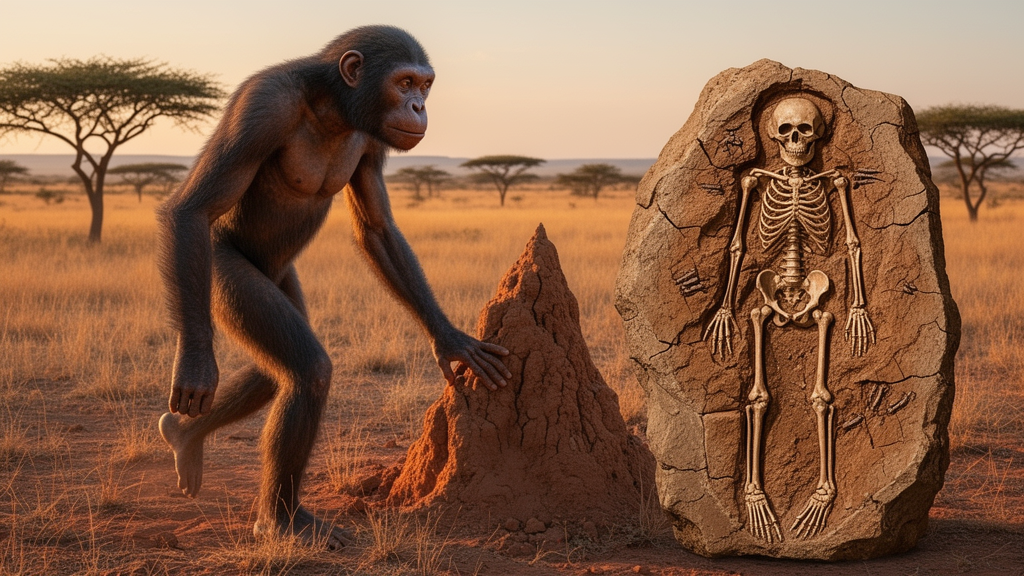
A comparison of limb bones from the approximately 3.67-million-year-old Little Foot skeleton and other fossil hominins indicates that Australopithecus combined substantial tree climbing with regular upright walking, while early Homo had shifted toward life on the ground by about 1.8 million years ago. The peer-reviewed study, published in Science Advances, assessed relative bone strength in the arms and legs of fossil ancestors alongside modern humans and living apes, finding evidence of a pronounced change in how the human lineage used its limbs.
Researchers from the University of the Witwatersrand’s Evolutionary Studies Institute and Sterkfontein Caves research programme, with international collaborators, added measurements from Little Foot, formally designated StW 573, and compared them with fossils from Dmanisi in Georgia dating to about 1.8 million years ago. The analysis considered the strength of arm and thigh bones as well as patterns within the lower limbs. Little Foot and other Australopithecus specimens retained relatively strong arms compared with their thighs, a pattern resembling African apes more closely than modern humans. Because climbing and other weight-bearing activities in trees place substantial demands on the upper limbs, the researchers interpreted this distribution of bone strength as evidence that Australopithecus regularly relied on trees.
Little Foot’s lower limbs, however, displayed a more modern human-like relationship between the strength of the thigh and lower-leg bones. This combination—ape-like relative arm strength paired with a human-like lower-limb pattern—suggests a distinctive form of locomotion. The authors concluded that these ancestors did not move simply like modern chimpanzees or modern humans. Instead, they appear to have combined frequent movement in trees with habitual bipedalism on the ground, a behavioral mixture for which no living species provides a direct analogue. The result also shows that bipedal walking did not necessarily entail abandoning climbing.
In contrast, the Dmanisi fossils and other specimens attributed to early Homo and Homo erectus exhibited limb-strength patterns much closer to those of modern humans. The researchers interpret these findings as evidence that, by roughly 1.8 million years ago, members of the human lineage were more strongly committed to terrestrial bipedalism and used trees much less. They propose that this transition may represent a threshold separating the adaptive patterns of Australopithecus from those of Homo. The timing overlapped with a broad period of increasing brain size in the human lineage, but the study does not establish that changes in locomotion, ranging behavior or brain size directly caused one another. The cause of the shift remains uncertain, with possible links to changes in ranging, food gathering and other selective pressures favoring stronger lower limbs and greater dependence on the ground. The bone-strength evidence supports the proposed behavioral difference, but it does not by itself reveal the full range of activities undertaken by these ancestors.
Subject of Research: Fossil evidence for changes in hominin tree climbing and terrestrial bipedalism between about 3 million and 1.8 million years ago
Article Title: Little Foot study points to major shift in how human ancestors moved
Article References: Little Foot study points to major shift in how human ancestors moved. Original publication (Bibliographic details unavailable.)
Image Credits: AI Generated
DOI: Not provided
Keywords: Little Foot, Australopithecus, early Homo, Homo erectus, hominin locomotion, bipedalism, tree climbing, fossil bone strength, Dmanisi fossils, human evolution, Little, Foot
News Source: Drew Townsend. (October 26, 2026). Little Foot fossils reveal a major shift toward terrestrial movement. Scienmag.