Hairy-root cultures of the medicinal plant Perilla frutescens produced more shikonin and amounts of luteolin comparable to those measured in greenhouse-grown plants, according to a two-stage cultivation study. The work combines optimized transformation of plant explants with a separate comparison of culture systems and lighting conditions, identifying dark-grown roots in a temporary immersion bioreactor as the most productive format for biomass accumulation. The researchers describe the approach as a promising platform for producing two valuable plant secondary metabolites, although their findings concern cultivated plant material rather than clinical effects in people.
Perilla frutescens is an important medicinal plant with potential as a source of bioactive compounds. The researchers first examined how explant type and the duration of co-cultivation with the bacterium Rhizobium rhizogenes affected the induction of hairy roots. They tested leaf, cotyledon, hypocotyl and stem-internode explants, with co-cultivation periods of 48 and 72 hours using strain ATCC 15834. Cotyledons exposed to the bacterium for 48 hours gave the highest transformation efficiency in the first experiment, reaching 66%. The result identified young cotyledon tissue and a relatively short bacterial co-cultivation period as favorable starting conditions for establishing the transformed root cultures.
A second experiment tested the effects of bacterial strain, explant age and culture-medium composition. The researchers compared R. rhizogenes strains A4 and ATCC 15834, used explants aged 14, 21 or 28 days, and cultivated the material on either full-strength Murashige and Skoog medium or half-strength MS medium. Cotyledon explants inoculated with ATCC 15834 and maintained on half-strength MS medium again achieved the strongest overall performance. Transformation efficiency was 66.0 ± 6.1%, rooting took 7.33 ± 0.49 days, each explant produced an average of 10.33 ± 1.58 roots, and six secondary hairy roots were recorded per explant. These measurements show that the selected combination supported transformation and early root development, though the reported percentages and counts also indicate variation around the mean values.
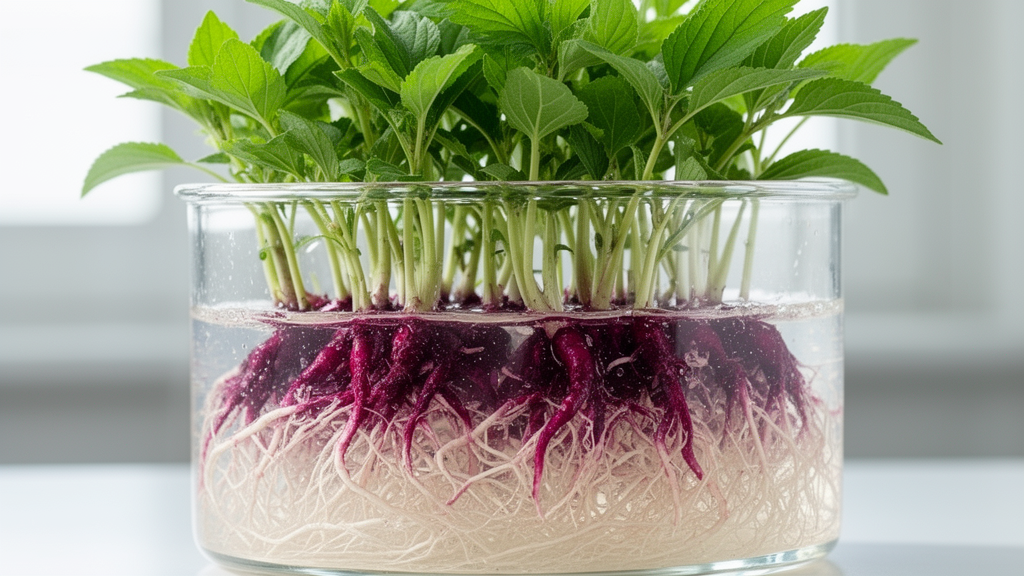
The investigators then separated biomass production from the transformation experiments by comparing culture systems and light conditions. Hairy roots maintained in a temporary immersion bioreactor under dark conditions produced the greatest biomass, measured at 20.96 ± 0.61 g. By contrast, roots grown in shake flasks under light conditions produced the lowest amount, 4.14 ± 0.50 g. The bioreactor result was therefore more than four times the shake-flask value, based on the reported measurements. Because the source reports this as a distinct experiment focused on biomass accumulation, it does not establish whether every tested explant or bacterial-strain combination would deliver the same yields.
Molecular analysis supported the identity of the induced cultures. PCR detected the integration of the rolA, rolB and rolC genes associated with R. rhizogenes-induced hairy roots. At the same time, the absence of virD amplification was used to confirm that the root cultures were free of residual bacterial contamination. Chemical analysis by high-performance liquid chromatography found that the hairy roots accumulated luteolin at levels comparable to those in greenhouse-grown P. frutescens, while shikonin accumulation was higher in the hairy roots. The source does not provide numerical metabolite concentrations in the supplied text, so the comparison can be reported only qualitatively. Taken together, the results indicate that transformed perilla roots can combine high biomass with the production of both target compounds, providing a controlled plant-cell system that the authors say may support more sustainable production. The work does not, by itself, establish economic viability, consistency across additional culture formats or benefits to human health.
Subject of Research: Optimization of hairy-root Perilla frutescens cultures for shikonin and luteolin production
Article Title: Shikonin and luteolin production in hairy root culture of Perilla frutescens (L.) Britton
Article References: Mahmoudi, M., Sadat Noori, S. A., Bahmankar, M., Ebrahimi, M., Fadavi, A., & Salehi, M. (2026). Shikonin and luteolin production in hairy root culture of Perilla frutescens (L.) Britton. BMC Plant Biology. https://doi.org/10.1186/s12870-026-09741-x
Image Credits: AI Generated
DOI: 10.1186/s12870-026-09741-x
Keywords: Perilla frutescens, hairy-root culture, shikonin, luteolin, plant secondary metabolites, Rhizobium rhizogenes, temporary immersion bioreactor, plant transformation, biomass production, production, hairy, root
News Source: Alan Morgan. (October 26, 2026). Hairy-root perilla yields more shikonin and comparable luteolin. Scienmag.