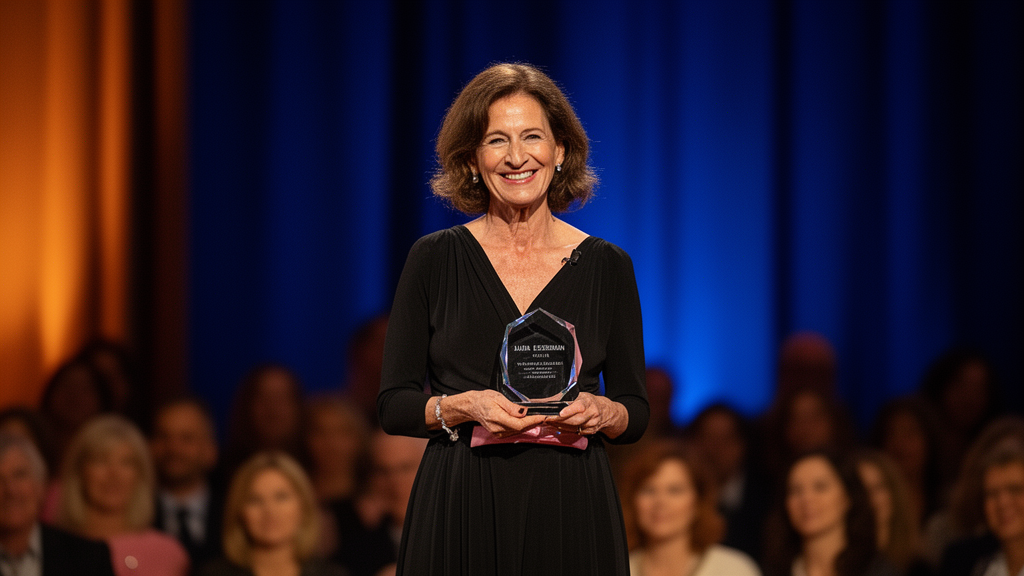
Laura Esserman, a breast surgeon and clinical-trial leader at the University of California, San Francisco, has been selected unanimously by the 2026 Blue Ribbon Selection Committee to receive the AIM-HI Beacon Award for Women Leaders in Oncology. The announcement, made on 21 September 2026, recognizes Esserman for her leadership in personalized breast cancer research and care, including work spanning response-adaptive clinical trials, risk-based screening and active surveillance of ductal carcinoma in situ. Esserman is the Alfred A. de Lorimier Endowed Chair in General Surgery, director of the UCSF Breast Care Center and professor of surgery and radiology at the university. The award, sponsored by the National Foundation for Cancer Research, is intended to recognize women leaders in health and life sciences who have significantly affected efforts to improve and accelerate cancer treatment, detection and diagnosis.
One of Esserman’s most prominent roles has been as leader of the I-SPY TRIALs since 2002, a national public-private collaboration involving the National Cancer Institute, the U.S. Food and Drug Administration, nearly 45 major cancer research centers and dozens of pharmaceutical and biotechnology companies. The I-SPY platform uses imaging and molecular markers to classify tumors and track treatment response in real time. It is a response-adaptive platform, allowing therapies to be escalated or de-escalated according to the biology observed in an individual patient’s tumor rather than following one unchanged regimen for every participant. More than 2,500 patients have enrolled in the trials, 25 drugs have completed evaluation and three have advanced to accelerated FDA approval, including a pathway supporting approval of pembrolizumab for advanced triple-negative breast cancer. Esserman also co-founded Quantum Leap Healthcare Collaborative, the nonprofit organization that sponsors the I-SPY and RECAST trials.
The scale and structure of I-SPY illustrate the technical approach associated with Esserman’s work. Rather than separating translational research from treatment delivery, the platform links serial measurements with decisions about therapy during a trial. Imaging and molecular information provide a changing account of how a tumor responds, while adaptive treatment allows the regimen to change when those measurements indicate that a different level of intervention is warranted. The reported figures describe the program’s scope at the time of the award announcement: enrollment in more than 2,500 patients, evaluation of 25 drugs and three drugs reaching accelerated FDA approval. Esserman co-founded Quantum Leap Healthcare Collaborative, the nonprofit that sponsors the I-SPY and RECAST trials, placing both the treatment platform and the active-surveillance research within the same collaborative infrastructure.
Esserman’s work on RECAST DCIS addresses another major issue in breast cancer care: whether some lesions currently labeled as ductal carcinoma in situ can be monitored rather than treated immediately. She designed and leads RECAST DCIS as a long-term active-surveillance registry. The release describes the registry as showing that many such lesions can be safely monitored rather than immediately treated, while also presenting RECAST as an active research effort rather than a closed question. This distinction is important because its findings concern the feasibility and safety of surveillance in the population and protocols studied, not a universal policy for every form of ductal carcinoma in situ. ESSerman’s position has consistently emphasized the need to consider over-diagnosis and over-treatment, and RECAST DCIS is presented as part of that effort.
At the institutional level, Esserman led the creation of the University of California-wide Athena Breast Health Network and serves as principal investigator of WISDOM, a national study designed to test whether personalized, risk-based breast cancer screening can safely replace a one-size-fits-all annual mammography schedule. The study has enrolled more than 55,000 women. Results published in JAMA in December 2025 found that risk-based screening was non-inferior to annual screening in the study’s defined comparison. Among women in the highest-risk group who received more frequent screening, the researchers observed no stage IIB or higher cancers. The result supports the study’s assessment of risk-based screening as non-inferior under its specified approach, but it does not establish that every woman can safely reduce screening frequency. The finding remains bounded by the population, risk classifications and screening schedules evaluated in WISDOM.
Esserman is now leading WISDOM 2.0, the next phase of that screening study. The planned phase will incorporate polygenic risk and mammographic artificial intelligence to further personalize screening and prevention. The announcement describes both inputs as planned components of the continuing research, not as tools already validated for routine clinical use. WISDOM 2.0 therefore represents an extension of the study rather than a new set of reported outcomes. The original WISDOM trial has also inspired sister trials in Europe and Israel, broadening the international scope of research into screening schedules based on measured risk. Across WISDOM and its planned successor, the technical focus remains the use of risk information to organize screening, with the central test being whether personalized schedules can preserve performance while reducing unnecessary screening for appropriately classified participants.
Esserman’s leadership also includes mentoring and institutional training. She supports trainees at multiple career stages through a post-baccalaureate research program and UCSF’s surgical oncology training grant. She has authored or co-authored more than 500 peer-reviewed publications. The award announcement lists other distinctions including the Komen Visionary Award, the Komen Brinker Award for Scientific Distinction in Clinical Research and the Ernest C. Arbuckle Award from Stanford Graduate School of Business. She has also received fellowships from the American Association for Cancer Research and the American Society of Clinical Oncology and has been named to TIME magazine’s list of the 100 Most Influential People and its 2026 TIME 100 Health list. Together, these roles and honors document a record that combines direct scientific work, trial leadership, training and broader organizational influence.
The selection committee emphasized those different dimensions of Esserman’s career. Anna D. Barker, chief strategy officer of the Ellison Medical Institute and co-chair of the 2026 Beacon Award Selection Committee, said Esserman had spent more than two decades combining cancer research and care to build information-driven learning systems. Barker described her work through I-SPY and WISDOM as an example of connecting clinical trials with patient-centered care, and said she had challenged conventional approaches to over-treatment and quality-of-life problems in breast cancer. Webster Cavenee, a distinguished professor of medicine at the University of California, San Diego and the committee’s other co-chair, said Esserman had combined scientific rigor with patient advocacy. He described I-SPY as a model for public-private collaboration that accelerated drug development and said she had continued working to ensure progress reached patients faster and with less harm.
Esserman said the recognition belonged equally to the patients, collaborators, advocates and trainees who shaped I-SPY, WISDOM, RECAST and REWIRE DCIS. She said her aim was to move cancer care toward an approach that is more personalized, less harmful and adaptive to risk and response. She also emphasized the need to work across institutions and disciplines, challenge long-held paradigms and act on information produced by trials while studies are underway. “The goal is to keep learning – and to test and provide new options when our patients need them most,” she said. Esserman will be honored at the AIM-HI Beacon Award Ceremony on 9 October 2026 at the National Press Club in Washington, D.C. The ceremony is part of the National Foundation for Cancer Research’s Global Summit and Award Ceremonies for Cancer Research and Entrepreneurship, which brings together leaders in cancer research, drug development, business, investment, government, patient advocacy and research support.
The award highlights a career built around several complementary but distinct research programs. I-SPY uses serial imaging and molecular markers to adapt treatment during response-adaptive trials; WISDOM evaluates screening schedules according to measured risk; RECAST DCIS examines active surveillance for lesions now labeled as ductal carcinoma in situ; and WISDOM 2.0 plans to add polygenic risk and mammographic artificial intelligence to the screening study. Esserman’s selected roles and record provide the connective structure for these efforts, while the recognition itself is not a new trial result. The reported findings already include more than 2,500 patients and 25 evaluated drugs in I-SPY, more than 55,000 women enrolled in WISDOM and the December 2025 non-inferiority result for risk-based screening. Other components, including RECAST DCIS as an ongoing registry and the planned expansion of WISDOM 2.0, remain active areas of research rather than completed interventions awaiting a single verdict.
Subject of Research: Laura Esserman’s leadership in personalized breast cancer trials, risk-based screening and active surveillance
Article Title: Dr. Laura Esserman selected as the 2026 AIM-HI Beacon Award winner for her visionary leadership in breast cancer research and care
Article References: Dr. Laura Esserman selected as the 2026 AIM-HI Beacon Award winner for her visionary leadership in breast cancer research and care. Original publication (Bibliographic details unavailable.)
Image Credits: AI Generated
DOI: Not provided
Keywords: Laura Esserman, breast cancer, AIM-HI Beacon Award, I-SPY trials, WISDOM study, risk-based screening, ductal carcinoma in situ, clinical trials, personalized medicine, UCSF, Laura, Esserman
News Source: Nathaniel Bowman. (October 26, 2026). Laura Esserman Wins 2026 AIM-HI Beacon Award for Breast Cancer Leadership. Scienmag.