• HOME
  • NEWS
  • EXPLORE
    • CAREER
      • Companies
      • Jobs
    • EVENTS
    • iGEM
      • News
      • Team
    • PHOTOS
    • VIDEO
    • WIKI
  • BLOG
  • COMMUNITY
    • FACEBOOK
    • INSTAGRAM
    • TWITTER
Tuesday, July 7, 2026
BIOENGINEER.ORG
No Result
View All Result
  • Login
  • HOME
  • NEWS
  • EXPLORE
    • CAREER
      • Companies
      • Jobs
        • Lecturer
        • PhD Studentship
        • Postdoc
        • Research Assistant
    • EVENTS
    • iGEM
      • News
      • Team
    • PHOTOS
    • VIDEO
    • WIKI
  • BLOG
  • COMMUNITY
    • FACEBOOK
    • INSTAGRAM
    • TWITTER
  • HOME
  • NEWS
  • EXPLORE
    • CAREER
      • Companies
      • Jobs
        • Lecturer
        • PhD Studentship
        • Postdoc
        • Research Assistant
    • EVENTS
    • iGEM
      • News
      • Team
    • PHOTOS
    • VIDEO
    • WIKI
  • BLOG
  • COMMUNITY
    • FACEBOOK
    • INSTAGRAM
    • TWITTER
No Result
View All Result
Bioengineer.org
No Result
View All Result
Home NEWS Science News Chemistry

Liquid metals break down organic fuels into ultra-thin graphitic sheets

Bioengineer by Bioengineer
June 10, 2020
in Chemistry
Reading Time: 2 mins read
0
IMAGE
Share on FacebookShare on TwitterShare on LinkedinShare on RedditShare on Telegram

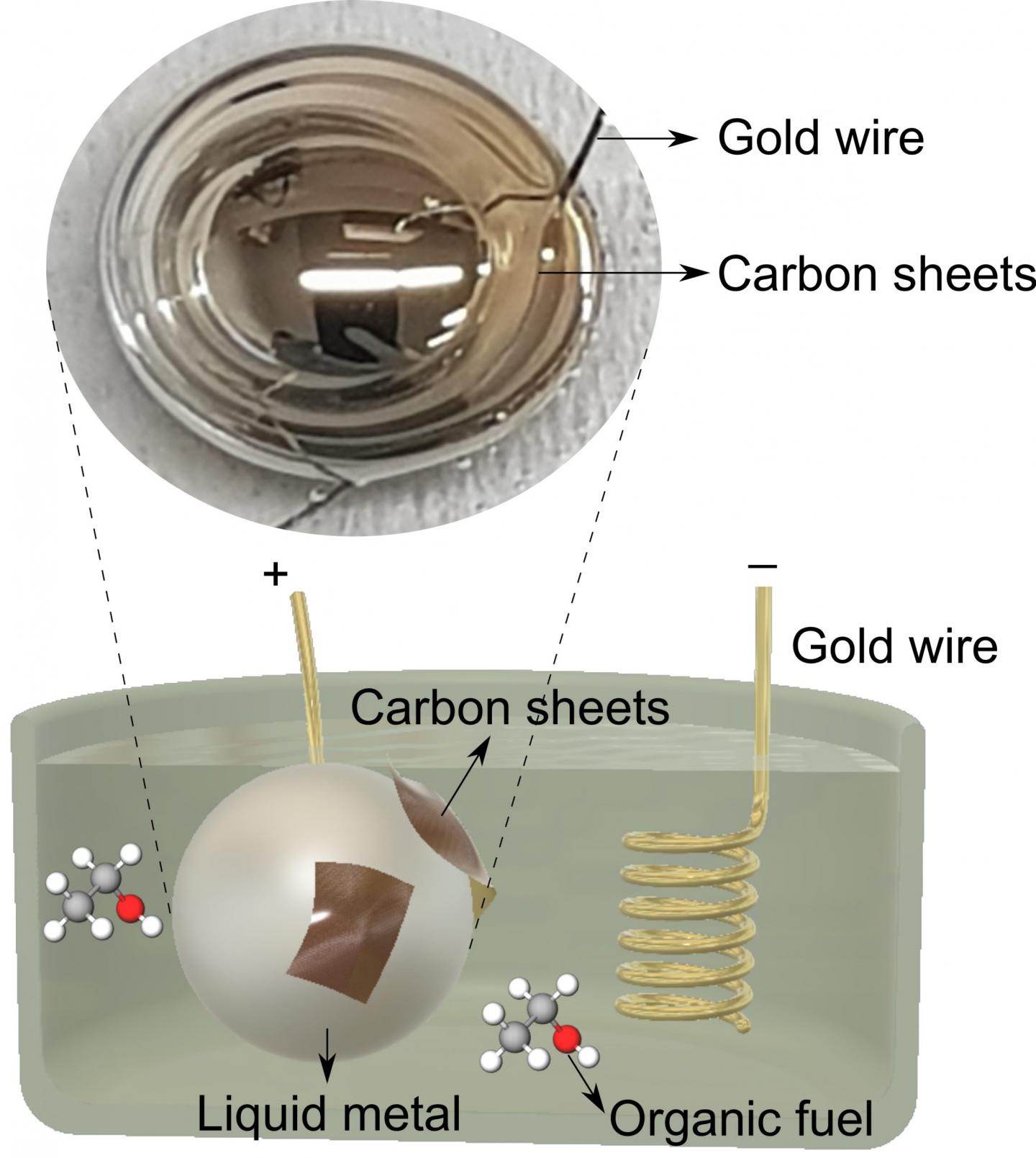
First synthesis of ultra-thin graphitic materials at room temperature using organic fuels
IMAGE

Credit: UNSW, Sydney

For the first time, FLEET researchers at UNSW, Sydney show the synthesis of ultra-thin graphitic materials at room temperature using organic fuels (which can be as simple as basic alcohols such as ethanol).

Graphitic materials, such as graphene, are ultra-thin sheets of carbon compounds that are sought after materials with great promises for battery storage, solar cells, touch panels and even more recently fillers for polymers.

These researchers were able to synthesize ultra-thin carbon-based materials on the surface of liquid metals at room temperature electrochemically. Before this report, others had shown electro-formation of such carbon-based materials only by transferring sheets onto the electrodes or electrode exfoliation of naturally-occurring carbon crystals from mines.

“Using gallium liquid metal, we could catalytically break down the fuels and form carbon-carbon bonds (the base of graphitic sheets) from organic fuels at room temperature. The ultra-smooth surface of liquid metals could then template atomically-thin carbon based sheets. Removal of these sheets was easy as they do not stick to the liquid metal surface,” suggested Prof Kalantar-Zadeh, the lead of this project and the Director of the Centre for Advanced Solid and Liquid based Electronics and Optics (CASLEO) at UNSW.

“It is simple. Why has room temperature electro-synthesis of two-dimensional graphitic materials not been achieved before? We cannot offer a definitive answer. Perhaps disregarding ultra-catalysts such as liquid metals and too much emphasis on solid electrodes which are inherently not smooth.” added Dr Mohannad Mayyas the first author of the paper.

###

The paper Liquid-Metal-Templated Synthesis of 2D Graphitic Materials at Room Temperature was published in highly reputed journal of Advanced Materials on the 8th of June 2020 (DOI: 10.1002/adma.202001997)

Researchers from RMIT, University of California Los Angeles (UCLA) and the Center for Multidimensional Carbon Materials, Institute for Basic Science (IBS), Korea are the other collaborators of the research and authors of the manuscript.

Contact detail: Dr. Mohannad Mayyas, [email protected]

Media Contact
Errol Hunt
[email protected]

Original Source

http://www.fleet.org.au/blog/liquid-metals-break-down-organic-fuels-into-ultra-thin-graphitic-sheets/

Related Journal Article

http://dx.doi.org/10.1002/adma.202001997

Tags: Chemistry/Physics/Materials SciencesElectromagneticsMaterialsNanotechnology/MicromachinesSuperconductors/Semiconductors
Share12Tweet8Share2ShareShareShare2

Related Posts

Salt adaptation linked to higher disease risk, Mizzou study finds

Salt adaptation linked to higher disease risk, Mizzou study finds

July 6, 2026
Intelligent Microgrid Management Promises Lower Household Energy Bills and Reduced Diesel Emissions — Chemistry

Intelligent Microgrid Management Promises Lower Household Energy Bills and Reduced Diesel Emissions

July 4, 2026

Graz University of Technology Deciphers the Structural Secrets of MOF Thin Films

July 2, 2026

Breaking Thermodynamic Limits: Wavelength-Driven Catalysis Advances Ammonia Synthesis

July 2, 2026
Please login to join discussion

POPULAR NEWS

  • Detection of EDCs in Breast Milk and Infant Urine Up to Six Months Highlights Early Exposure Risks

    77 shares
    Share 31 Tweet 19
  • New Drug Candidate Developed at McMaster Shows Potential for Treating Brain Cancer

    58 shares
    Share 23 Tweet 15
  • Saying Goodbye to PGY-6: Pediatric Fellowship Realities

    103 shares
    Share 41 Tweet 26
  • KTU Researchers Explore Ultrasound’s Role in Enhancing Blood Flow Beyond Diagnostics

    53 shares
    Share 21 Tweet 13

About

We bring you the latest biotechnology news from best research centers and universities around the world. Check our website.

Follow us

Recent News

Flame retardant BDE-209 targets molecularly linked to ulcerative colitis

Ultra-high frequency particle impacts mimic rockbursts to shatter hard rock

Kidney transplant outcomes in older adults studied by German researchers

Subscribe to Blog via Email

Enter your email address to subscribe to this blog and receive notifications of new posts by email.

Join 83 other subscribers
  • Contact Us

Bioengineer.org © Copyright 2023 All Rights Reserved.

Welcome Back!

Login to your account below

Forgotten Password?

Retrieve your password

Please enter your username or email address to reset your password.

Log In
No Result
View All Result
  • Homepages
    • Home Page 1
    • Home Page 2
  • News
  • National
  • Business
  • Health
  • Lifestyle
  • Science

Bioengineer.org © Copyright 2023 All Rights Reserved.