• HOME
  • NEWS
  • EXPLORE
    • CAREER
      • Companies
      • Jobs
    • EVENTS
    • iGEM
      • News
      • Team
    • PHOTOS
    • VIDEO
    • WIKI
  • BLOG
  • COMMUNITY
    • FACEBOOK
    • INSTAGRAM
    • TWITTER
Friday, July 3, 2026
BIOENGINEER.ORG
No Result
View All Result
  • Login
  • HOME
  • NEWS
  • EXPLORE
    • CAREER
      • Companies
      • Jobs
        • Lecturer
        • PhD Studentship
        • Postdoc
        • Research Assistant
    • EVENTS
    • iGEM
      • News
      • Team
    • PHOTOS
    • VIDEO
    • WIKI
  • BLOG
  • COMMUNITY
    • FACEBOOK
    • INSTAGRAM
    • TWITTER
  • HOME
  • NEWS
  • EXPLORE
    • CAREER
      • Companies
      • Jobs
        • Lecturer
        • PhD Studentship
        • Postdoc
        • Research Assistant
    • EVENTS
    • iGEM
      • News
      • Team
    • PHOTOS
    • VIDEO
    • WIKI
  • BLOG
  • COMMUNITY
    • FACEBOOK
    • INSTAGRAM
    • TWITTER
No Result
View All Result
Bioengineer.org
No Result
View All Result
Home NEWS Science News Chemistry

Lipid gradient that keeps your eyes wet

Bioengineer by Bioengineer
April 7, 2020
in Chemistry
Reading Time: 2 mins read
0
IMAGE
Share on FacebookShare on TwitterShare on LinkedinShare on RedditShare on Telegram

IMAGE

Credit: Hokkaido University

New understandings of how lipids function within tears could lead to better drugs for treating dry eye disease.

A new approach has given Hokkaido University researchers insight into the synthesis and functions of lipids found in tears. Their findings, published in the journal eLife, could help the search for new treatments for dry eye disease.

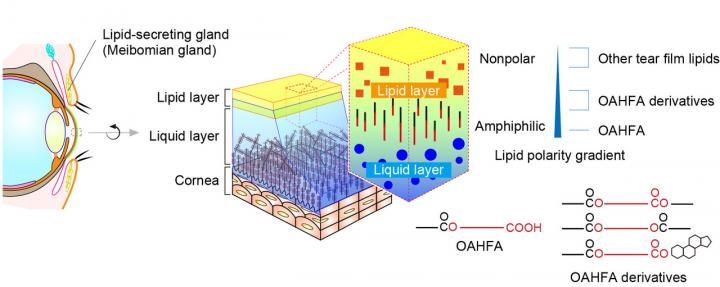
The film of tears covering the eye’s surface is vital for eliminating foreign objects, providing oxygen and nutrients to the eye’s outer tissues, and reducing friction with the eyelid. The film is formed of an outer lipid layer and an inner liquid layer. The outer lipid layer, which is itself formed of two sublayers, prevents water evaporation from the liquid layer. Dry eye disease develops when the glands that produce these lipids dysfunction. However, it has remained unclear how those generally incompatible layers — water and lipid — can form and maintain tear films.

Hokkaido University biochemist Akio Kihara and colleagues wanted to understand the functions of a subclass of lipids called OAHFAs (O-Acyl)-ω-hydroxy fatty acids) that are present in the inner lipid sublayer (amphiphilic lipid sublayer) just above the liquid layer of the tear film. OAHFAs are known to have both polar and non-polar ends in its molecule, giving them affinity for both water and lipid.

To do this, they turned off a gene called Cyp4f39 in mice that is known for its involvement in ω-hydroxy fatty acid synthesis. Previous attempts at studying the gene’s functions in this way had led to neonatal death in mice, as it impaired the skin’s protective role. The team used a way to turn the gene off, except in the skin.

The mice were found to have damaged corneas and unstable tear films, both indicative of dry eyes. Further analyses showed that these mice were lacking OAHFAs and their derivatives in their tear films. Interestingly, the scientists also discovered that the OAHFA derivatives have polarities intermediate between OAHFAs and other lipids in the tear film. This strongly suggests that those lipids together form a polarity gradient that plays an important role in connecting the tear film’s inner liquid layer and outer lipid layer, helping the film spread uniformly over the surface of the eye.

“Drugs currently used in dry eye disease target the liquid layer of the tear film, but there aren’t any drugs that target its lipid layer,” says Akio Kihara. “Since most cases of dry eye disease are caused by abnormalities in the lipid layer, eye drops containing OAHFAs and their derivatives could be an effective treatment.”

Further studies are required to fully understand the functions and synthesis of OAHFAs.

###

Media Contact
Naoki Namba
[email protected]

Original Source

https://www.global.hokudai.ac.jp/blog/lipid-gradient-that-keeps-your-eyes-wet/

Related Journal Article

http://dx.doi.org/10.7554/eLife.53582

Tags: BiochemistryBiologyMedicine/HealthMolecular BiologyPhysiology
Share12Tweet8Share2ShareShareShare2

Related Posts

Graz University of Technology Deciphers the Structural Secrets of MOF Thin Films — Chemistry

Graz University of Technology Deciphers the Structural Secrets of MOF Thin Films

July 2, 2026
Breaking Thermodynamic Limits: Wavelength-Driven Catalysis Advances Ammonia Synthesis — Chemistry

Breaking Thermodynamic Limits: Wavelength-Driven Catalysis Advances Ammonia Synthesis

July 2, 2026

From Quantum Mechanics to AI-Powered Materials Discovery: MARVEL Marks 12 Years of Transforming Computational Science

July 2, 2026

Djire Recognized with National Award for Outstanding Contributions in Research and Teaching

July 2, 2026
Please login to join discussion

POPULAR NEWS

  • Detection of EDCs in Breast Milk and Infant Urine Up to Six Months Highlights Early Exposure Risks

    77 shares
    Share 31 Tweet 19
  • Saying Goodbye to PGY-6: Pediatric Fellowship Realities

    103 shares
    Share 41 Tweet 26
  • New Drug Candidate Developed at McMaster Shows Potential for Treating Brain Cancer

    58 shares
    Share 23 Tweet 15
  • KTU Researchers Explore Ultrasound’s Role in Enhancing Blood Flow Beyond Diagnostics

    53 shares
    Share 21 Tweet 13

About

BIOENGINEER.ORG

We bring you the latest biotechnology news from best research centers and universities around the world. Check our website.

Follow us

Recent News

Steatosis Drives Liver Metastasis Diversity in CRC

Unlocking the Mysteries of Alzheimer’s Disease

Pensoft Introduces New Peer-Reviewed Journal of Regeneration to Advance Restorative Biology Across Species

Subscribe to Blog via Email

Enter your email address to subscribe to this blog and receive notifications of new posts by email.

Join 83 other subscribers
  • Contact Us

Bioengineer.org © Copyright 2023 All Rights Reserved.

Welcome Back!

Login to your account below

Forgotten Password?

Retrieve your password

Please enter your username or email address to reset your password.

Log In
No Result
View All Result
  • Homepages
    • Home Page 1
    • Home Page 2
  • News
  • National
  • Business
  • Health
  • Lifestyle
  • Science

Bioengineer.org © Copyright 2023 All Rights Reserved.