• HOME
  • NEWS
  • EXPLORE
    • CAREER
      • Companies
      • Jobs
    • EVENTS
    • iGEM
      • News
      • Team
    • PHOTOS
    • VIDEO
    • WIKI
  • BLOG
  • COMMUNITY
    • FACEBOOK
    • INSTAGRAM
    • TWITTER
Sunday, May 10, 2026
BIOENGINEER.ORG
No Result
View All Result
  • Login
  • HOME
  • NEWS
  • EXPLORE
    • CAREER
      • Companies
      • Jobs
        • Lecturer
        • PhD Studentship
        • Postdoc
        • Research Assistant
    • EVENTS
    • iGEM
      • News
      • Team
    • PHOTOS
    • VIDEO
    • WIKI
  • BLOG
  • COMMUNITY
    • FACEBOOK
    • INSTAGRAM
    • TWITTER
  • HOME
  • NEWS
  • EXPLORE
    • CAREER
      • Companies
      • Jobs
        • Lecturer
        • PhD Studentship
        • Postdoc
        • Research Assistant
    • EVENTS
    • iGEM
      • News
      • Team
    • PHOTOS
    • VIDEO
    • WIKI
  • BLOG
  • COMMUNITY
    • FACEBOOK
    • INSTAGRAM
    • TWITTER
No Result
View All Result
Bioengineer.org
No Result
View All Result
Home NEWS Science News Cancer

Like racecars and geese, cancer cells draft their way to new tumor sites

Bioengineer by Bioengineer
March 25, 2019
in Cancer
Reading Time: 2 mins read
0
IMAGE
Share on FacebookShare on TwitterShare on LinkedinShare on RedditShare on Telegram

New research gives boost to fighting disease through cell metabolism
IMAGE

Credit: Reinhart-King Laboratory/Vanderbilt University

NASCAR has nothing on cancer cells when it comes to exploiting the power of drafting, letting someone else do the hard work of moving forward while you coast behind.

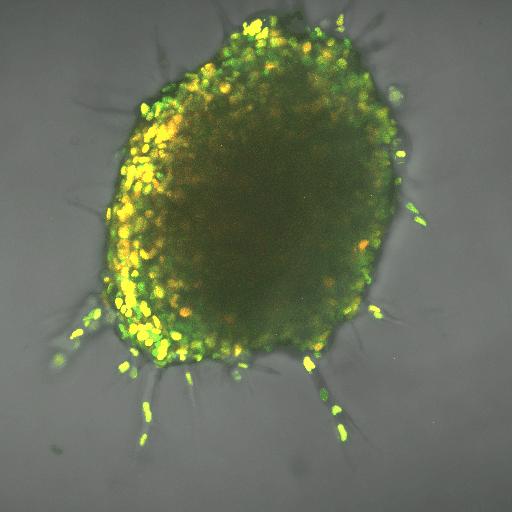
Building on the relatively new discovery that metastatic cancer cells leave tumors and travel in clusters, not singles, a Vanderbilt University team of biomedical engineers learned the process is aided by leader-follower behavior. Like racecar drivers and geese, the front cell expends vastly more energy making its way forward through tissue to establish a new tumor site. When it tires, it moves to the back of the cluster, and a cell from behind that’s been saving energy begins leading.

The finding gives a boost to the field of metabolomics, the next big thing in fighting cancer, said Cynthia Reinhart-King, Cornelius Vanderbilt Professor of Engineering. It can complement immunotherapies, which use the body’s natural defenses to kill cancer cells. So far, researchers have applied the field to slowing tumor growth, but learning about mechanisms such as the one Reinhart-King’s team found can help apply it to metastasis.

“Our work is the first to say, in addition to proliferation, migration is also energy-demanding,” she said. “That means we can also target migration through metabolism. Our experiments used breast cancer cells, but the same mechanism holds true to lung, colorectal, skin and other cancers, so the underlying research is vital to learning how we might defeat all of those.”

The FDA approved the first-in-class cancer metabolism drug in 2017.

The Vanderbilt team’s findings appear Monday, March 25, in the Proceedings of the National Academy of Sciences in a paper titled, “Energetic regulation of coordinated leader-follower dynamics during collective invasion of breast cancer cells.”

The team worked using breast cancer cells in three-dimensional, created tissue. The lead author on the paper, postdoctoral associate Jian Zhang, also developed computational models that demonstrated the energy needs of the leader cell vs. the followers. The leader needed up to 50 percent more energy, depending on the density of the tissue it was fighting through, and the cells switched leader-follower positions every two to eight hours, Zhang said.

Reinhart-King said the development of fluorescent biosensors allowed for her team’s research, because the engineers could track energy consumption and production within cells.

###

Media Contact
Heidi Nieland Hall
[email protected]

Related Journal Article

http://dx.doi.org/10.1073/pnas.1809964116

Tags: Biomedical/Environmental/Chemical EngineeringBreast CancercancerCell BiologyMedicine/HealthMetabolism/Metabolic Diseases
Share12Tweet8Share2ShareShareShare2

Related Posts

Estrogen Deficiency Triggers Bone EVs Causing Cell Aging

May 9, 2026

Epidermal MHC-II Drives NK Cell Attack in Psoriasis

May 9, 2026

Akkermansia Boosts Gut-Bladder Nerve Sensitivity via 5-HT3aR

May 9, 2026

AI Predicts Chemoresistance in Bladder Cancer

May 9, 2026
Please login to join discussion

POPULAR NEWS

  • Research Indicates Potential Connection Between Prenatal Medication Exposure and Elevated Autism Risk

    840 shares
    Share 336 Tweet 210
  • New Study Reveals Plants Can Detect the Sound of Rain

    727 shares
    Share 290 Tweet 181
  • Scientists Investigate Possible Connection Between COVID-19 and Increased Lung Cancer Risk

    68 shares
    Share 27 Tweet 17
  • Salmonella Haem Blocks Macrophages, Boosts Infection

    61 shares
    Share 24 Tweet 15

About

We bring you the latest biotechnology news from best research centers and universities around the world. Check our website.

Follow us

Recent News

Evaluating Digoxin Use in Patients with Symptomatic Rheumatic Heart Disease

Evaluating the Effectiveness and Safety of Digitalis Glycosides in Treating Heart Failure

Urdu Fall Risk Questionnaire Adapted for Elderly

Subscribe to Blog via Email

Success! An email was just sent to confirm your subscription. Please find the email now and click 'Confirm' to start subscribing.

Join 82 other subscribers
  • Contact Us

Bioengineer.org © Copyright 2023 All Rights Reserved.

Welcome Back!

Login to your account below

Forgotten Password?

Retrieve your password

Please enter your username or email address to reset your password.

Log In
No Result
View All Result
  • Homepages
    • Home Page 1
    • Home Page 2
  • News
  • National
  • Business
  • Health
  • Lifestyle
  • Science

Bioengineer.org © Copyright 2023 All Rights Reserved.