• HOME
  • NEWS
  • EXPLORE
    • CAREER
      • Companies
      • Jobs
    • EVENTS
    • iGEM
      • News
      • Team
    • PHOTOS
    • VIDEO
    • WIKI
  • BLOG
  • COMMUNITY
    • FACEBOOK
    • INSTAGRAM
    • TWITTER
Saturday, February 7, 2026
BIOENGINEER.ORG
No Result
View All Result
  • Login
  • HOME
  • NEWS
  • EXPLORE
    • CAREER
      • Companies
      • Jobs
        • Lecturer
        • PhD Studentship
        • Postdoc
        • Research Assistant
    • EVENTS
    • iGEM
      • News
      • Team
    • PHOTOS
    • VIDEO
    • WIKI
  • BLOG
  • COMMUNITY
    • FACEBOOK
    • INSTAGRAM
    • TWITTER
  • HOME
  • NEWS
  • EXPLORE
    • CAREER
      • Companies
      • Jobs
        • Lecturer
        • PhD Studentship
        • Postdoc
        • Research Assistant
    • EVENTS
    • iGEM
      • News
      • Team
    • PHOTOS
    • VIDEO
    • WIKI
  • BLOG
  • COMMUNITY
    • FACEBOOK
    • INSTAGRAM
    • TWITTER
No Result
View All Result
Bioengineer.org
No Result
View All Result
Home NEWS Science News Biology

Lighting up bone repair

Bioengineer by Bioengineer
March 24, 2021
in Biology
Reading Time: 2 mins read
0
IMAGE
Share on FacebookShare on TwitterShare on LinkedinShare on RedditShare on Telegram

IMAGE

Credit: Department of Inorganic Biomaterials,TMDU

Researchers led by TMDU fabricate a material that will aid bone healing, help medical practitioners clearly assess the full damage to bones after an injury, and clarify probable patient outcomes

Tokyo, Japan – Bone repair wasn’t generally successful until the late 1800s. Until then, there were few options to repair major bone damage. Most materials don’t have the functionality of bone and don’t support blood vessels growing through them. Repair materials such as clay were commonly used yet often failed. In 1892, medical practitioners started using gypsum–calcium sulfate–as the first effective bone substitute material. Bone repair is much more straightforward and less risky these days, but repairing large-scale bone damage remains challenging.

Medical practitioners today use octacalcium phosphate–OCP–as a substitute bone material. It’s a precursor of bone tissue and a logical choice for bone repair. However, medical practitioners may not be able to unambiguously assess the complete extent of bone damage by X-ray analysis. This may hinder their ability to accurately predict recovery timelines and other prognoses for patients.

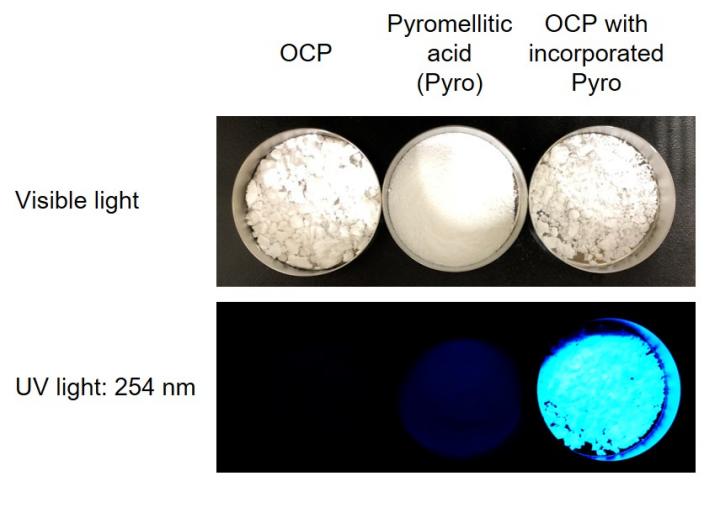
In a study recently published in Communications Chemistry, a team led by researchers at Tokyo Medical and Dental University (TMDU) incorporated a fluorescent molecule–pyromellitic acid–into OCP. When used in clinical practice, this advanced modification to OCP will improve diagnostic analyses and predictions of therapeutic outcomes.

“We incorporated pyromellitic acid by a hydrolysis reaction with dicalcium phosphate dihydrate,” explains Taishi Yokoi, lead author. “Analytical characterization and computational analyses confirmed that we prepared our target material.”

Their synthetic approach avoided formation of undesired salts–calcium carboxylates–that would otherwise hinder the full functionality of pyromellitic acid. By carefully tailoring the pH and pyromellitic acid concentrations during synthesis, the researchers were able to optimize incorporation of pyromellitic acid into OCP.

“We found that 81% of the monohydrogen phosphate in OCP was replaced by pyromellitic acid,” says senior author Masakazu Kawashita. “This is important for pyromellitic acid to help connect different inorganic layers into an intact whole, and facilitate complete repair.”

The researchers’ improved bone replacement material was bright blue, much brighter than pyromellitic acid is when it is not mixed with bone precursors. This opens up obvious possibilities for real-time visual analysis, and will help medical practitioners predict the time course of patient recovery and other diagnostic outcomes.

“Our improved OCP has distinct advantages over conventional bone repair materials,” explains Yokoi. “We’re optimistic that our material can quickly overcome regulatory hurdles and find use in dental implants, bone fractures, and other challenging surgical applications in the coming years.”

###

The article, “Incorporation of tetracarboxylate ions into octacalcium phosphate for the development of next-generation biofriendly materials,” was published in Communications Chemistry at DOI: 10.1038/s42004-020-00443-5

Media Contact
Taishi YOKOI
[email protected]

Original Source

http://www.tmd.ac.jp/english/press-release/20210112-1/index.html

Related Journal Article

http://dx.doi.org/10.1038/s42004-020-00443-5

Tags: Biomedical/Environmental/Chemical EngineeringBiotechnologyChemistry/Physics/Materials SciencesMaterials
Share13Tweet8Share2ShareShareShare2

Related Posts

Florida Cane Toad: Complex Spread and Selective Evolution

Florida Cane Toad: Complex Spread and Selective Evolution

February 7, 2026
New Study Uncovers Mechanism Behind Burn Pit Particulate Matter–Induced Lung Inflammation

New Study Uncovers Mechanism Behind Burn Pit Particulate Matter–Induced Lung Inflammation

February 6, 2026

DeepBlastoid: Advancing Automated and Efficient Evaluation of Human Blastoids with Deep Learning

February 6, 2026

Navigating the Gut: The Role of Formic Acid in the Microbiome

February 6, 2026
Please login to join discussion

POPULAR NEWS

  • Robotic Ureteral Reconstruction: A Novel Approach

    Robotic Ureteral Reconstruction: A Novel Approach

    82 shares
    Share 33 Tweet 21
  • Digital Privacy: Health Data Control in Incarceration

    63 shares
    Share 25 Tweet 16
  • Study Reveals Lipid Accumulation in ME/CFS Cells

    57 shares
    Share 23 Tweet 14
  • Breakthrough in RNA Research Accelerates Medical Innovations Timeline

    53 shares
    Share 21 Tweet 13

About

We bring you the latest biotechnology news from best research centers and universities around the world. Check our website.

Follow us

Recent News

TPMT Expression Predictions Linked to Azathioprine Side Effects

Improving Dementia Care with Enhanced Activity Kits

Decoding Prostate Cancer Origins via snFLARE-seq, mxFRIZNGRND

Subscribe to Blog via Email

Enter your email address to subscribe to this blog and receive notifications of new posts by email.

Join 73 other subscribers
  • Contact Us

Bioengineer.org © Copyright 2023 All Rights Reserved.

Welcome Back!

Login to your account below

Forgotten Password?

Retrieve your password

Please enter your username or email address to reset your password.

Log In
No Result
View All Result
  • Homepages
    • Home Page 1
    • Home Page 2
  • News
  • National
  • Business
  • Health
  • Lifestyle
  • Science

Bioengineer.org © Copyright 2023 All Rights Reserved.