• HOME
  • NEWS
  • EXPLORE
    • CAREER
      • Companies
      • Jobs
    • EVENTS
    • iGEM
      • News
      • Team
    • PHOTOS
    • VIDEO
    • WIKI
  • BLOG
  • COMMUNITY
    • FACEBOOK
    • INSTAGRAM
    • TWITTER
Thursday, May 21, 2026
BIOENGINEER.ORG
No Result
View All Result
  • Login
  • HOME
  • NEWS
  • EXPLORE
    • CAREER
      • Companies
      • Jobs
        • Lecturer
        • PhD Studentship
        • Postdoc
        • Research Assistant
    • EVENTS
    • iGEM
      • News
      • Team
    • PHOTOS
    • VIDEO
    • WIKI
  • BLOG
  • COMMUNITY
    • FACEBOOK
    • INSTAGRAM
    • TWITTER
  • HOME
  • NEWS
  • EXPLORE
    • CAREER
      • Companies
      • Jobs
        • Lecturer
        • PhD Studentship
        • Postdoc
        • Research Assistant
    • EVENTS
    • iGEM
      • News
      • Team
    • PHOTOS
    • VIDEO
    • WIKI
  • BLOG
  • COMMUNITY
    • FACEBOOK
    • INSTAGRAM
    • TWITTER
No Result
View All Result
Bioengineer.org
No Result
View All Result
Home NEWS Science News Chemistry

Lighting the way to porous electronics and sensors

Bioengineer by Bioengineer
June 3, 2020
in Chemistry
Reading Time: 3 mins read
0
IMAGE
Share on FacebookShare on TwitterShare on LinkedinShare on RedditShare on Telegram

Researchers from Osaka University introduce a straightforward fabrication method that dramatically improves the gas sensing performance of a common ceramic
IMAGE

Credit: Osaka University

Osaka, Japan – Many common household items and devices have a coating that improves performance. For example, the thin Teflon coating on cookware helps prevent food from sticking to the surface. However, it’s difficult to prepare–at room temperature–the strongly adhering, high-performance ceramic coatings that are commonly used in many applications, such as electronics. Now, researchers from Japan have solved this problem.

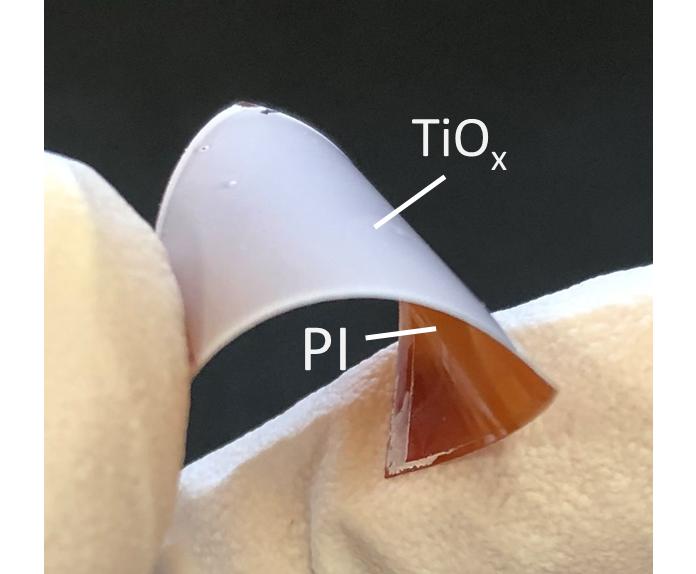
In a study published in ACS Applied Electronic Materials, researchers from Osaka University have shown how to coat glass and plastic–and presumably many other surfaces–with a thin, porous ceramic. The fabrication process is straightforward, the materials are cheap, and the ceramic’s gas sensing performance is considerably improved compared with current devices.

The researchers’ ceramic coating, porous titanium dioxide, is an exciting material.

“Titanium dioxide is cheap and abundant, and has many applications such as in gas sensing,” explains Tohru Sugahara, senior author. “Porous films have a high surface area to volume ratio, and can detect gas analytes at lower concentrations than corresponding nonporous films.”

The researchers first used spin coating to deposit a thin film–approximately 1 micrometer thick–of porous titanium dioxide onto a glass or plastic surface, in only one step. They then tested two approaches to strongly adhere their films onto the surface: high-temperature sintering for the glass, and high-intensity light for the plastic. Both approaches retain the nanometer-scale pores and strongly adhere the ceramic film.

The thin ceramic films prepared by high-temperature sintering performed remarkably compared with nonporous titanium-based gas sensors. “For example, gas detection is fast,” says Sugahara. “The response time–the time required for the sensor to attain an optimum response–is approximately 1 s, whereas other sensors require a few minutes.”

The researchers envision many applications of their porous ceramic coatings. For example, viruses can be entrapped in the pores. Once caught, the viruses can be destroyed by irradiating the films with UV or visible light, without damaging the films. Another application is whitening agents; the porous films diffuse a great deal of UV and visible light. Many useful applications are possible with the researchers’ economical, straightforward approach to strongly adherent ceramic coatings.

###

The article, “Formation of metal-organic decomposition derived nanocrystalline structure titanium dioxide by heat sintering and photosintering methods for advanced coating process, and its volatile organic compounds’ gas-sensing properties,” was published in ACS Applied Electronic Materials at DOI: https://doi.org/10.1021/acsaelm.0c00237

About Osaka University

Osaka University was founded in 1931 as one of the seven imperial universities of Japan and now has expanded to one of Japan’s leading comprehensive universities. The University has now embarked on open research revolution from a position as Japan’s most innovative university and among the most innovative institutions in the world according to Reuters 2015 Top 100 Innovative Universities and the Nature Index Innovation 2017. The university’s ability to innovate from the stage of fundamental research through the creation of useful technology with economic impact stems from its broad disciplinary spectrum.
Website: https://resou.osaka-u.ac.jp/en/top

Media Contact
Saori Obayashi
[email protected]

Related Journal Article

http://dx.doi.org/10.1021/acsaelm.0c00237

Tags: Chemistry/Physics/Materials SciencesMaterialsNanotechnology/Micromachines
Share12Tweet8Share2ShareShareShare2

Related Posts

Advancing In Vivo and In Situ Monitoring: Science Bulletin Highlights Host-Based Antifouling Gold Nanotube Sensor for Selective Detection of Mechanically Sensitive Serotonin Release in Intestinal Mucosa — Chemistry

Advancing In Vivo and In Situ Monitoring: Science Bulletin Highlights Host-Based Antifouling Gold Nanotube Sensor for Selective Detection of Mechanically Sensitive Serotonin Release in Intestinal Mucosa

May 20, 2026
How Magnetic Orientation Could Influence the Building Blocks of Life — Chemistry

How Magnetic Orientation Could Influence the Building Blocks of Life

May 20, 2026

Breaking a 200-Year-Old Belief: Novel Surface Design Achieves Two Distinct Wetting States on One Substrate

May 20, 2026

Unveiling Sound Waves: Scientists Discover Hidden Behaviors in Acoustic Phenomena

May 20, 2026
Please login to join discussion

POPULAR NEWS

  • blank

    New Study Reveals Plants Can Detect the Sound of Rain

    733 shares
    Share 292 Tweet 183
  • ESMO 2025: mRNA COVID Vaccines Enhance Efficacy of Cancer Immunotherapy

    302 shares
    Share 121 Tweet 76
  • Research Indicates Potential Connection Between Prenatal Medication Exposure and Elevated Autism Risk

    846 shares
    Share 338 Tweet 212
  • Breastmilk Balances E. coli and Beneficial Bacteria in Infant Gut Microbiomes

    58 shares
    Share 23 Tweet 15

About

We bring you the latest biotechnology news from best research centers and universities around the world. Check our website.

Follow us

Recent News

New Breakthrough Enables the Body to Combat Entire Families of Viruses

Early Delivery Improves Outcomes for Mothers and Babies in Hypertensive Pregnancies

Polypharmacy’s Impact on Elderly Staircase Fall Deaths

Subscribe to Blog via Email

Enter your email address to subscribe to this blog and receive notifications of new posts by email.

Join 82 other subscribers
  • Contact Us

Bioengineer.org © Copyright 2023 All Rights Reserved.

Welcome Back!

Login to your account below

Forgotten Password?

Retrieve your password

Please enter your username or email address to reset your password.

Log In
No Result
View All Result
  • Homepages
    • Home Page 1
    • Home Page 2
  • News
  • National
  • Business
  • Health
  • Lifestyle
  • Science

Bioengineer.org © Copyright 2023 All Rights Reserved.