• HOME
  • NEWS
  • EXPLORE
    • CAREER
      • Companies
      • Jobs
    • EVENTS
    • iGEM
      • News
      • Team
    • PHOTOS
    • VIDEO
    • WIKI
  • BLOG
  • COMMUNITY
    • FACEBOOK
    • INSTAGRAM
    • TWITTER
Tuesday, October 20, 2026
BIOENGINEER.ORG
No Result
View All Result
  • Login
  • HOME
  • NEWS
  • EXPLORE
    • CAREER
      • Companies
      • Jobs
        • Lecturer
        • PhD Studentship
        • Postdoc
        • Research Assistant
    • EVENTS
    • iGEM
      • News
      • Team
    • PHOTOS
    • VIDEO
    • WIKI
  • BLOG
  • COMMUNITY
    • FACEBOOK
    • INSTAGRAM
    • TWITTER
No Result
View All Result
Bioengineer.org
No Result
View All Result
Home NEWS Science News Technology

Laboratory study finds trade-offs in reinforced PLA biocomposites

by
October 20, 2026
in Technology
Reading Time: 2 mins read
0
Laboratory study finds trade-offs in reinforced PLA biocomposites

Sugar beet waste and Amazonian fibers turn 3D-printed PLA into stronger biodegradable implants

Share on FacebookShare on TwitterShare on LinkedinShare on RedditShare on Telegram

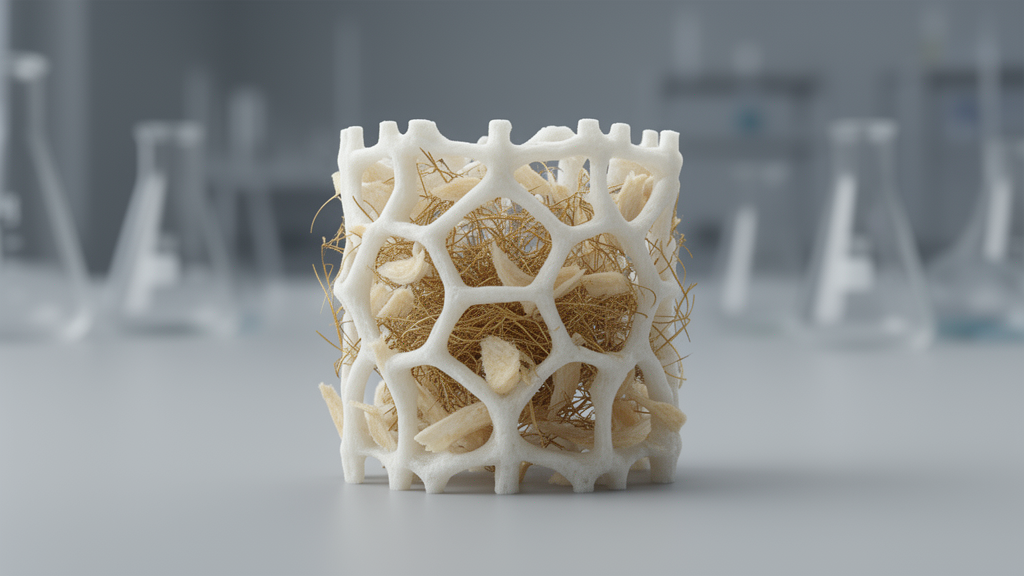
A laboratory study of polylactic acid (PLA) biocomposites fabricated by fused deposition modeling found that reinforcement with Montrichardia linifera microfibers and sugar-beet-derived hydroxyapatite nanoparticles produced the strongest overall mechanical performance at a microfiber content of 40 vol.% and hydroxyapatite content of 3 vol.%. The article’s abstract reports that this formulation, designated PMH2, achieved a tensile strength of 125 MPa, flexural strength of 138 MPa, impact energy of 3.3 J and hardness of 83 Shore D. These values represented reported improvements over neat PLA of 123.2%, 102.9%, 400% and 6.41%, respectively.

The researchers systematically investigated the mechanical, tribological, swelling and in vitro degradation behavior of the reinforced materials as hydroxyapatite content varied. A different formulation, PMH3 containing 5 vol.% hydroxyapatite, gave the most favorable measured tribological and degradation results in the abstract. It recorded the lowest specific wear rate, 0.02 mm3/Nm, and coefficient of friction of 0.30, together with the highest swelling and degradation values at week 4: 21.73% and 11.37%, respectively. The abstract associates these observations with increased ceramic content, improved surface hardness and enhanced bioactivity, but the available evidence does not establish the mechanisms responsible for the measured differences.

The reported results show a trade-off between mechanical performance and the tribological and in vitro degradation measurements rather than a single formulation that was best across every tested property. The authors attribute PMH2’s mechanical results to a synergistic interaction between well-dispersed hydroxyapatite nanoparticles and microfibers, which they associate with interfacial bonding, stress transfer and crack-pinning mechanisms while preserving matrix continuity. They describe the hybrid reinforcement as effectively tailoring the composites’ strength, surface durability and biodegradation characteristics and as making the materials promising candidates for load-bearing and bioresorbable biomedical uses.

This evidence comes from a materials-testing study rather than a review, protocol, simulation, animal experiment or human clinical study. The supplied source provides only the article abstract and does not report the full methods, statistical uncertainty, biological assays or thermal-performance results, despite thermal performance appearing in the original title. The findings therefore apply to the tested laboratory formulations and their measured mechanical, wear, friction, swelling and four-week in vitro degradation outcomes; they do not establish performance in patients or in vivo safety and effectiveness.

Subject of Research: Laboratory evaluation of mechanical, tribological, swelling and in vitro degradation properties of reinforced PLA biocomposites

Article Title: Mechanical, biological, and thermal performance of fused deposition modeled PLA biocomposites reinforced with sugar-beet-derived hydroxyapatite nanofillers and Montrichardia linifera microfibers

Article References: Jayabalakrishnan, D., Gobu, N., Manoj Kumar, S., & Uvaraja, V. C. (2026). Mechanical, biological, and thermal performance of fused deposition modeled PLA biocomposites reinforced with sugar-beet-derived hydroxyapatite nanofillers and Montrichardia linifera microfibers. Journal of Materials Science. https://doi.org/10.1007/s10853-026-13904-4

Image Credits: AI Generated

DOI: 10.1007/s10853-026-13904-4

Keywords: polylactic acid, fused deposition modeling, hydroxyapatite nanoparticles, Montrichardia linifera, biocomposites, mechanical properties, tribology, in vitro degradation, swelling, materials science, Mechanical, biological

News Source: Denise Maddox. (October 20, 2026). Laboratory study finds trade-offs in reinforced PLA biocomposites. Scienmag.


Tags: biocompositesbiologicalfused deposition modelinghydroxyapatite nanoparticlesin vitro degradationmaterials sciencemechanicalmechanical propertiesMontrichardia liniferapolylactic acidswellingtribology
Share12Tweet7Share2ShareShareShare1

Related Posts

First public DNA barcode reference dataset covers pteridophytes of Réunion

First public DNA barcode reference dataset covers pteridophytes of Réunion

October 20, 2026
Research report: Distribution dataset of chondrichthyan species occurring in French metropolitan waters and across the North-East Atlantic

Research report: Distribution dataset of chondrichthyan species occurring in French metropolitan waters and across the North-East Atlantic

October 20, 2026

CFH risk variant linked to complement changes in non-AMD eyes

October 20, 2026

Long-term camera trap monitoring of mammalian diversity and activity rhythms of threatened species in Xianxialing Nature Reserve, Zhejiang Province, China

October 20, 2026

POPULAR NEWS

  • Laboratory study reports first Mexican isolation of Halomicrobium mukohataei and assays its pigments

    Laboratory study reports first Mexican isolation of Halomicrobium mukohataei and assays its pigments

    29 shares
    Share 12 Tweet 7
  • New Myxozoan Parasite Found Lurking in the Intestinal Wall of Barbel Chub in China

    29 shares
    Share 12 Tweet 7
  • First public DNA barcode reference dataset covers pteridophytes of Réunion

    29 shares
    Share 12 Tweet 7
  • Field study documents first confirmed development of a rare weevil in Swiss wormwood

    29 shares
    Share 12 Tweet 7

About

We bring you the latest biotechnology news from best research centers and universities around the world. Check our website.

Follow us

Recent News

Laboratory study reports first Mexican isolation of Halomicrobium mukohataei and assays its pigments

New Myxozoan Parasite Found Lurking in the Intestinal Wall of Barbel Chub in China

First public DNA barcode reference dataset covers pteridophytes of Réunion

Subscribe to Blog via Email

Enter your email address to subscribe to this blog and receive notifications of new posts by email.

Join 85 other subscribers
  • Contact Us

Bioengineer.org © Copyright 2023 All Rights Reserved.

Welcome Back!

Login to your account below

Forgotten Password?

Retrieve your password

Please enter your username or email address to reset your password.

Log In
No Result
View All Result
  • Homepages
    • Home Page 1
    • Home Page 2
  • News
  • National
  • Business
  • Health
  • Lifestyle
  • Science

Bioengineer.org © Copyright 2023 All Rights Reserved.