A new reference dataset provides the first publicly available, BOLD-compliant DNA barcode library for the pteridophyte flora of Réunion Island, linking sequences to taxonomically verified herbarium specimens and complete collection metadata. The dataset focuses on ferns and lycophytes and was assembled as part of the French Barcode of Life network, known as FRBOL, in collaboration with the National Museum of Natural History and the REU Herbarium at the University of Réunion.
DNA barcoding uses short, taxonomically informative DNA regions to support rapid and reliable species identification. The reliability of molecular identification, including metabarcoding and environmental DNA applications, depends on reference libraries in which sequences are tied to accurately identified and documented voucher specimens. The new resource is intended to improve the availability of validated reference data for pteridophytes occurring in Réunion and to support taxonomic, biogeographic and conservation research.
Réunion is a French overseas department in the south-western Indian Ocean. The island is volcanic, covers 2,512 km² and forms part of the Mascarene Archipelago. Its national taxonomic reference database, TaxRef version 18, lists 320 valid pteridophyte species names, including native, endemic and introduced taxa. The project included all of these status categories because native, endemic and introduced species may be encountered in molecular surveys and each requires reliable reference data for taxonomic assignment.
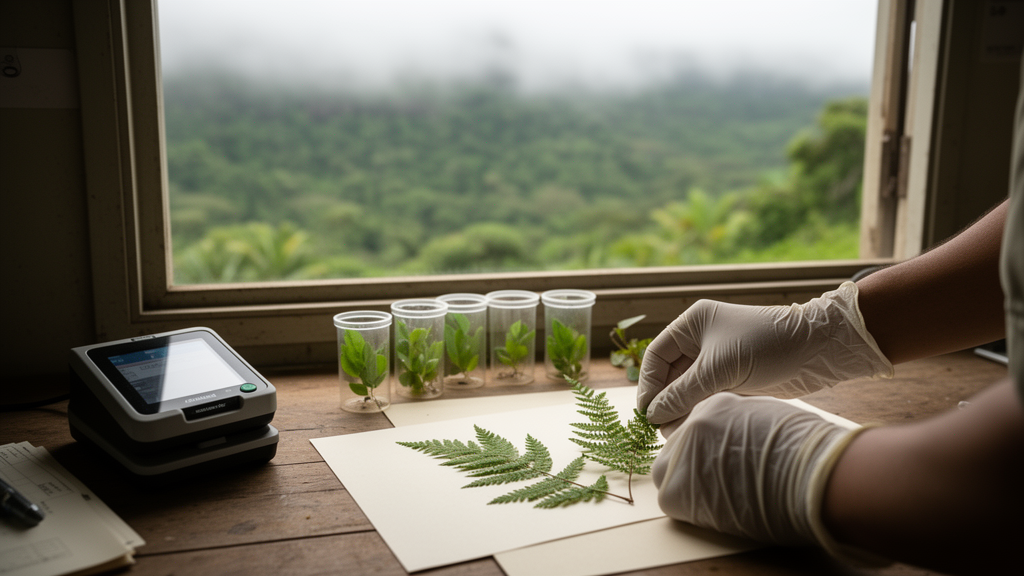
Samples were collected from natural environments in the municipalities of Cilaos, Plaine-des-Palmistes, Saint-Benoît, Saint-Joseph and Saint-Philippe, representing different habitats across the island. Following collection, specimens were dried and mounted as herbarium sheets. One collector initially identified each specimen morphologically, and a pteridophyte specialist then verified the identification. The specimens were photographed and entered into a database before being stored at the REU Herbarium, where digitised specimens are accessible through the herbarium collection website.
Leaves from the voucher specimens were dried in silica gel and used for DNA barcoding. DNA extraction and sequencing took place at the Canadian Centre for DNA Barcoding, and the results were made available through BOLD, the Barcode of Life Data System. Its structured records support comparison of sequences, taxonomic assessment and analysis of barcode clusters. The deposit also preserves the trace files, georeferenced collection information and specimen images needed to trace sequences back to the physical material on which they were based.
Researchers generated sequences for two plastid markers: rbcL, represented in the dataset by the rbcLa primer region, and trnH–psbA. The rbcL marker is widely used in plant barcoding because of its high amplification success and reliable alignment, but it may not contain enough variation to distinguish closely related species. The study notes particular limitations for discrimination in genera such as Asplenium and Pteris and in some members of Dryopteridaceae. Although matK had previously been proposed with rbcL as a plant barcode marker, the project did not use it because universal primers for amplifying matK in pteridophytes were not available.
The trnH–psbA marker was selected because previous large-scale floristic studies had demonstrated its effectiveness in species discrimination, and earlier work had also found strong discriminatory power in pteridophytes. Together, rbcL and trnH–psbA are the two plastid markers recommended by BOLD for ferns and lycophytes. The resulting dataset is described as the first BOLD-compliant reference dataset for Réunion’s flora that includes complete metadata, GPS coordinates, sequence trace files and specimen images for its pteridophyte records.
This release is explicitly a first contribution rather than an exhaustive inventory. The specimens were assembled through opportunistic sampling, so several taxa remain unsampled and some habitats are under-represented. Targeted field surveys are being conducted with the Conservatoire Botanique National de Mascarin, whose knowledge of the distribution of the island’s flora is guiding the selection of indigenous taxa absent from the initial dataset. The DS-PTEREU records on BOLD are therefore intended to be updated as further specimens are collected and sequenced.
The permanent curation of herbarium vouchers and silica gel-preserved tissues at the REU Herbarium, together with DNA extracts archived at the Canadian Centre for DNA Barcoding, also preserves material that may support sequencing of additional genetic markers to improve species discrimination. As coverage expands, the reference library may support broader taxonomic, biogeographical and conservation studies, including environmental DNA and metabarcoding applications involving Réunion’s pteridophytes.
Subject of Research: DNA barcode reference data for the pteridophyte flora of Réunion Island
Article Title: Contribution to the DNA barcode reference library for Réunion Pteridophyta
Article References: Gauche, M., Fontanié, N., Grangaud, E., Wilding, N., Rougerie, R., Lapègue, M., & Ah-Peng, C. (2026). Contribution to the DNA barcode reference library for Réunion Pteridophyta. Biodiversity Data Journal, 14, Article e199400. https://doi.org/10.3897/bdj.14.e199400
Image Credits: AI Generated
Keywords: DNA barcoding, Réunion, pteridophytes, ferns, lycophytes, rbcL, trnH–psbA, BOLD, herbarium vouchers, reference library, Contribution, barcode
News Source: Drew Townsend. (October 20, 2026). First public DNA barcode reference dataset covers pteridophytes of Réunion. Scienmag.