Parkinson’s disease has long been framed as a disorder of dying dopamine neurons, but a growing body of work points to two quieter accomplices: a misbehaving peripheral immune system and a leaky, inflamed blood-brain barrier. A new study in Acta Neuropathologica Communications asks a deceptively simple question about that pairing — does the laboratory model we use to study immune cells crossing the human barrier change the answer we get? The researchers' conclusion is a cautionary tale for the field: model architecture strongly influenced the readouts, and the authors argue that biological insights into BBB function are inherently shaped by the experimental model used, underscoring the need for complementary human BBB platforms.
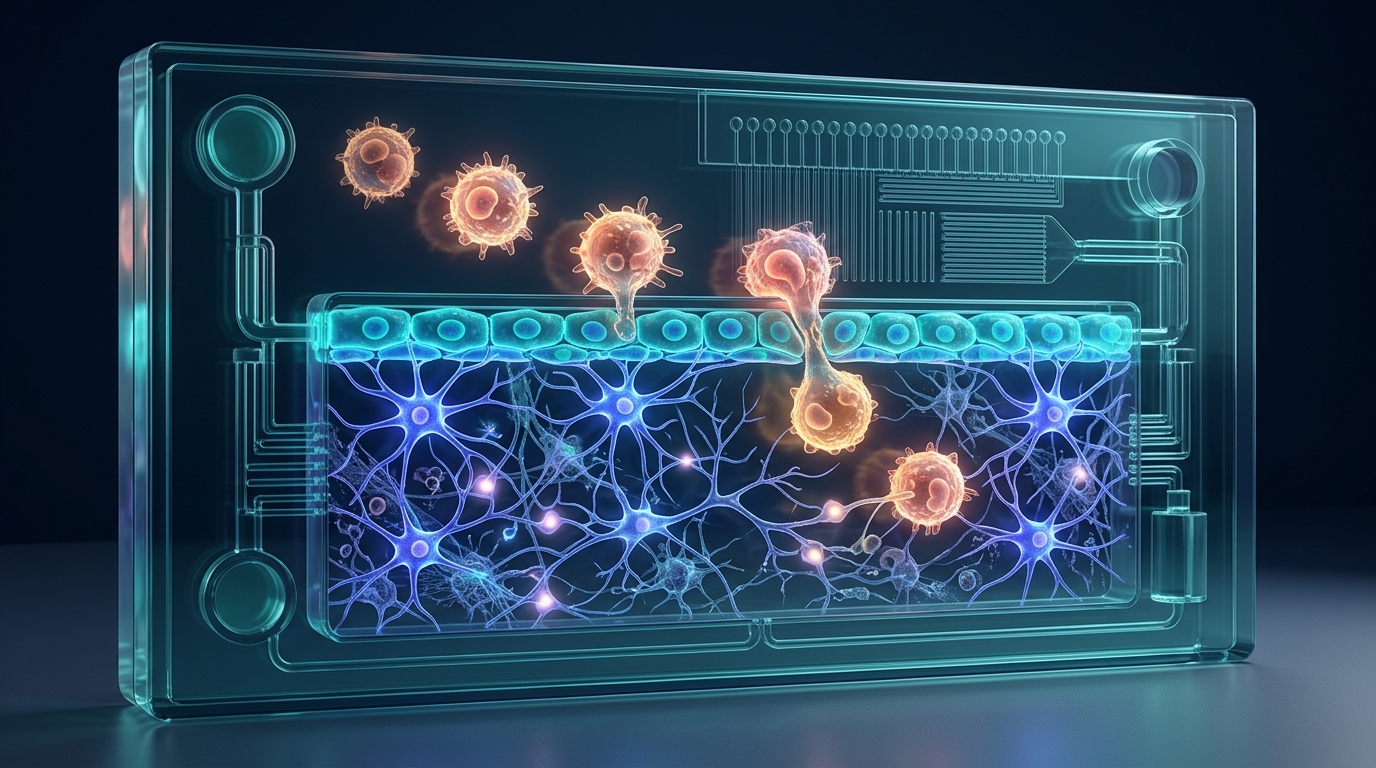
The team, led by Oceane Martinez, Lucile Gentile and Aurelie de Rus Jacquet, compared how peripheral blood mononuclear cells — PBMCs, the mixed population of immune cells circulating in blood — from control donors and from people with Parkinson’s disease behaved in two fundamentally different human blood-brain barrier platforms. Both were built from human induced pluripotent stem cells, but their architectures diverged sharply. One was a conventional two-dimensional system in which endothelial cells grow on a permeable membrane insert, with no fluid flow. The other was a three-dimensional microfluidic BBB chip, in which cells were exposed to flow from circulating culture medium.
The endothelial cells themselves carried a genetic twist. The researchers leveraged their brain chip platform to establish a model based on expression of the Parkinson's-associated SNCA triplication mutation, which involves the gene encoding alpha-synuclein. This gave the team a way to ask whether the same immune cells behave differently when confronted with a genetically susceptible barrier, and whether the answer depends on the plumbing of the experiment.
The immune cells were then challenged in three ways: according to the disease status of the donor, according to the genetic background of the endothelium — control or SNCA triplication — and according to exposure to alpha-synuclein in two forms, as soluble monomers or as preformed fibrils, the seed-like aggregates used to model pathological alpha-synuclein spread in laboratory studies. Attachment to the endothelial lining and transmigration through it were the two readouts, capturing the first steps by which circulating immune cells might infiltrate the brain.
In the insert-based models, the picture was rich with disease-specific signals. PBMCs from Parkinson’s donors showed increased baseline reactivity and altered endothelial interactions compared with cells from controls. Greater PBMC attachment was associated with SNCA triplication endothelial cells relative to controls, and — notably — transmigration was selectively increased for the PD-derived PBMCs on that diseased background. Exposure to alpha-synuclein preformed fibrils increased attachment without affecting transmigration. Taken at face value, this combination would suggest that, in the insert-based models, attachment and transmigration were associated with the SNCA triplication endothelial background and with alpha-synuclein exposure, with transmigration selectively increased for PD-derived PBMCs on the diseased background.
Then came the twist. In the microfluidic BBB chip, attachment was largely unchanged by either the endothelial background or alpha-synuclein exposure. Transmigration did increase, but following pre-treatment with alpha-synuclein monomers — not the fibrils that had driven attachment in the inserts. The direction of the results differed between the two platforms: attachment signals seen in the inserts were largely absent in the chip, and the alpha-synuclein form associated with increased transmigration changed from fibrils in the inserts to monomers in the chip.
The authors’ synthesis is blunt: PBMC-blood-brain barrier interactions in Parkinson’s disease appear to be shaped by immune cell status, endothelial background and alpha-synuclein exposure, but are strongly influenced by the architecture of the barrier model itself. In other words, the authors emphasize that biological insights into BBB function are inherently shaped by the experimental model used. The chip incorporates flow and a three-dimensional architecture, and in this study it produced a different pattern of PBMC attachment and transmigration results.
A static insert presents a two-dimensional endothelial layer on a permeable membrane; a microfluidic chip presents a three-dimensional, flow-based system. The study does not resolve which platform is definitively more faithful to the human brain, but the authors underscore the need for complementary human BBB platforms.
Organ-on-chip approaches have attracted significant interest across the blood-brain barrier field as platforms to interrogate how circulating immune cells interact with the human BBB. This study adds a caveat to that enthusiasm: in this work, switching platforms changed which experimental factors were associated with attachment and transmigration, and the authors emphasize that biological insights are inherently shaped by the experimental model used. The authors argue for physiologically relevant multicellular and flow-based systems, and for complementary human BBB platforms used side by side.
For patients and clinicians, the work is early and preclinical, built on stem-cell-derived models and donor cells rather than direct observation of immune trafficking in living brains. It does not establish that immune cell infiltration drives neurodegeneration in people, nor does it identify a therapeutic target. What it does deliver is a human-focused framework for studying peripheral immune cell trafficking across a diseased barrier, and a methodological point from the authors: biological insights into BBB function are inherently shaped by the experimental model used, underscoring the need for complementary human BBB platforms.
Subject of Research: How blood-brain barrier model architecture influences the assessment of peripheral immune cell trafficking in Parkinson's disease
Article Title: Blood-brain barrier model architecture shapes peripheral immune cell trafficking in Parkinson’s disease
Article References: Martinez, O., Gentile, L., Bretheau, F., Yearwood, A., Arevalo, O., Alves Martins Borba, F. N., Boutin, M., Morin, F., Vaillancourt, M., Breton, S., Boilard, E., Luk, K. C., Cicchetti, F., & de Rus Jacquet, A. (2026). Blood-brain barrier model architecture shapes peripheral immune cell trafficking in Parkinson’s disease. Acta Neuropathologica Communications. https://doi.org/10.1186/s40478-026-02464-y
Image Credits: AI Generated
DOI: 10.1186/s40478-026-02464-y
Keywords: Parkinson's disease, blood-brain barrier, peripheral immune cells, PBMCs, alpha-synuclein, SNCA triplication, organ-on-chip, microfluidics, iPSC-derived models, preformed fibrils, transmigration, endothelial cells
News Source: Cassandra Pierce. (November 4, 2026). Lab-on-a-chip reveals how Parkinson’s immune cells breach the blood-brain barrier. Scienmag.