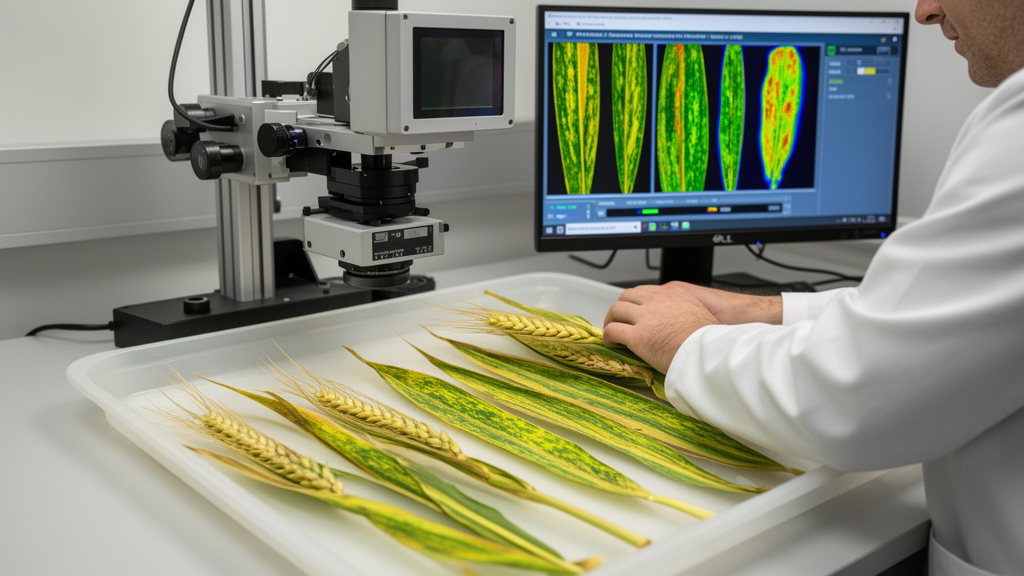
A low-cost, modified Canon camera combined with a knowledge-distilled MobileNetV2 model classified healthy, early-stage and diseased wheat in field images from three South African provinces. In the study’s independent test set, the student model reached 91.25% mean accuracy with the K590 filter, matching its DenseNet121 teacher, while the standalone MobileNetV2 averaged 77.92% across the six filters. The results support the use of compressed models for three-stage wheat stripe mosaic virus (WhSMV) classification, but they do not establish a fully validated field diagnostic system or performance on a commercial edge device.
WhSMV is a vector-borne viral disease of wheat that has been reported in southern Brazil and South Africa. Traditional recognition is based on field inspection by trained specialists, which can be labor-intensive, subjective and difficult to scale. The research addressed two practical constraints: early disease signs may be difficult to distinguish from healthy plants using ordinary visible-light images, and high-performing deep-learning models can require substantial computing resources. The investigators tested whether spectral-filter images captured with an affordable camera could support machine-learning classification under natural field conditions, and whether knowledge distillation could transfer that performance to a much smaller model.
The dataset contained 3,840 images distributed across six filter configurations: 1,002 images labeled healthy, 1,338 labeled early-stage diseased and 1,500 labeled diseased. Images were collected from 22 to 25 August and 2–6 October 2023 at farms in KwaZulu-Natal, Mpumalanga and North West provinces. A Canon EOS 800D equipped with the six filter configurations was used to capture the data under sunlight, with camera angle, distance and zoom kept consistent during collection. Soil moisture and pH readings were also recorded, with the dataset maintained within a pH range of 6.5 to 7.0. Plant health labels were assigned through visual assessment by a specialist WhSMV panel from the Forestry and Agricultural Biotechnology Institute at the University of Pretoria. The panel was led by senior pathologists involved in molecular isolation and the first published report of WhSMV in South Africa, but the individual image labels in this dataset were not supported by molecular confirmation for every sample.
The raw Canon files were processed in RawTherapee and converted from CR2 to JPG, reducing file size and making the images easier to handle in the model-training workflow. The Retinex algorithm was applied to retain detail under uneven lighting, with manually adjusted settings that included a scale and slope of 3, a color-restoration factor of 1.3, and highlight and shadow tonal widths of 80. Training data received geometric augmentation consisting of rotation, shear, zoom and horizontal and vertical flipping. Cropping and positional shifts were deliberately excluded so that the location of leaves within the images remained representative. Each model also used 50% dropout, and early stopping with a patience of 15 epochs was used during training. Bayesian optimization selected the optimizer and learning rate from Adam, AdamW and stochastic gradient descent, with learning rates searched between 1 × 10⁻⁸ and 1 × 10⁻³.
Twelve transfer-learning architectures were evaluated: DenseNet121, Xception, InceptionV3 and ResNet50V2 convolutional neural networks; ViT-S16, ViT-B16 and ViT-L16 Vision Transformers; two hybrid ViT models; and three Swin Transformers. DenseNet121 gave the strongest overall performance, reaching 91.25 ± 0.93% accuracy on K590 and 90.21 ± 0.57% on BlueIR. ViT-B16 was the strongest transformer, with 89.17 ± 0.93% accuracy on K590. Performance was lower for some models and filters: across the 12 architectures, HotMirror accuracy ranged from 60.21% to 84.79%, while K850 ranged from 61.46% to 82.08%. Standard deviations among the five fold-trained models ranged from approximately 0.47 to 1.65 percentage points, indicating that the reported results were relatively stable across the training-validation partitions.
The researchers then used response-based knowledge distillation to transfer predictions from the four strongest teacher architectures to MobileNetV2. In this method, the teacher’s class probabilities were softened using a temperature parameter, while alpha controlled the balance between the distillation loss and the student’s categorical cross-entropy loss. Bayesian optimization searched temperature values from 1 to 10 and alpha values from 0.1 to 0.9. DenseNet121, with approximately 8 million parameters, produced the strongest students. ViT-B16, with approximately 87 million parameters, was the second-most effective teacher. The larger ViT_R50_L32, at approximately 329 million parameters, and Swin_large, at approximately 197 million, did not transfer as consistently.
Relative to standalone MobileNetV2, the student distilled from DenseNet121 improved mean accuracy on every filter by 7.29 to 12.50 percentage points. It matched its teacher at 91.25% on K590 and averaged 87.88% across all six filters, compared with 77.92% for the standalone student. The DenseNet121-distilled student also improved the standalone student’s accuracy on every filter for DenseNet121, ViT-B16 and Swin_large teachers, and on five of six filters for ViT_R50_L32, with no change on HotMirror. This difference between the largest teacher and the more effective teachers is consistent with the authors’ conclusion that teacher–student capacity matching can influence how much knowledge is successfully transferred; teacher size alone did not determine student performance.
Statistical analysis found evidence that the model configuration affected accuracy. A Shapiro–Wilk test did not reject normality of the ANOVA residuals, and Levene’s tests found no significant evidence against equal variances across teachers or filters. ANOVA gave an F-statistic of 7.34 and a p-value of 0.00047. In the pooled Tukey HSD comparison, students distilled from DenseNet121 and ViT-B16 significantly outperformed standalone MobileNetV2, while the gains from Swin_large and ViT_R50_L32 were not significant. These tests concerned the pooled model comparisons; the researchers did not report separate per-filter significance tests for every teacher–student pair. The results therefore support the overall conclusion that DenseNet121 and ViT-B16 were the most effective teachers in this experiment, without establishing that every individual filter-level improvement was statistically significant.
For the DenseNet121-distilled MobileNetV2, K590 produced the strongest class-level results: 93.42% F1 for diseased plants, 90.00% for early-stage disease and 90.34% for healthy plants. The early-stage category was more difficult across the filters, with minimum values of 83.65% precision, 83.12% recall and 83.39% F1. Grad-CAM visualizations for K590, K850 and HotMirror showed a concentrated activation region for K590 and broader or more diffuse regions for the other two filters. These qualitative maps indicate where the model focused, but they do not by themselves establish which spectral or physiological features caused the performance difference. The study also did not directly compare the learned features with vegetation indices such as NDVI or NDRE.
Although K590 covered 590–1,000 nanometers, including the red-edge and near-infrared regions, the experiment did not isolate spectral information outside the visible range as the cause of improved classification. The study’s direct comparison was between filter configurations and model performance, not a controlled analysis of individual spectral mechanisms. The authors discuss relationships between plant stress, pigment changes, leaf structure and water content, while noting that quantitative spectral analysis and physiological measurements would be needed to establish those explanations. MobileNetV2 also had the lowest estimated computational cost among the tested models, at approximately 0.3 GFLOPs, and an inference time below 1 millisecond for 224 × 224-pixel inputs on the experimental hardware. The model was not tested on actual smartphones, drones or embedded processors, so its field speed, memory use, power consumption and accuracy on representative edge devices remain unverified.
Several limitations affect how the results can be interpreted and generalized. The dataset was small, with 640 images per filter, and was drawn from private farms in South Africa using the same wheat cultivar. Cloud cover and shadowing varied during acquisition, but their independent effect was not quantified. The independent test set was balanced at 32 images per disease stage per filter and was separated from training and validation data by plot, reducing leakage, but the small number of test plots still limits statistical power. The early-stage labels depended on expert visual assessment rather than a quantitative disease-severity index or molecular confirmation for every image. Subtle early symptoms may overlap with nutrient deficiencies, drought stress or other abiotic stresses, making the ground truth less certain for the most difficult class. Larger and more geographically diverse datasets, repeated imaging of individual plants, laboratory-supported labels and tests on representative edge hardware would be needed before the approach could be considered ready for operational farm use.
Subject of Research: Three-stage wheat stripe mosaic virus classification using multispectral field images and a knowledge-distilled MobileNetV2 model.
Article Title: Early detection of wheat stripe mosaic virus using economical multispectral imaging and model compression
Article References: De Silva, M., & Brown, D. (2026). Early detection of wheat stripe mosaic virus using economical multispectral imaging and model compression. Smart Agricultural Technology, 15, Article 102637. https://doi.org/10.1016/j.atech.2026.102637
Image Credits: AI Generated
DOI: 10.1016/j.atech.2026.102637
Keywords: wheat stripe mosaic virus, multispectral imaging, knowledge distillation, MobileNetV2, DenseNet121, plant disease classification, near-infrared imaging, computer vision, South Africa, edge AI, Early, detection
News Source: Alan Morgan. (October 20, 2026). Knowledge-distilled multispectral model classifies wheat stripe mosaic virus stages. Scienmag.