In a groundbreaking advancement poised to redefine therapeutic strategies for metastatic cervical cancer, a new study published in the British Journal of Cancer unveils key clinico-molecular predictors that forecast durable responses to immune checkpoint inhibitors (ICI). This research, led by Barraud, Roussel-Simonin, Pautier, and colleagues, represents a quantum leap toward precision oncology, offering hope to patients grappling with a malignancy historically resistant to conventional treatments.
Metastatic cervical cancer remains a formidable clinical challenge, characterized by aggressive progression and limited responsiveness to standard therapies. Immune checkpoint inhibitors, which unleash the body’s immune system against tumor cells by blocking inhibitory signaling pathways such as PD-1/PD-L1 and CTLA-4, have revolutionized oncology but show heterogeneous effectiveness. Understanding which patients derive sustained benefit from ICIs has been an imperative yet elusive goal, until now.
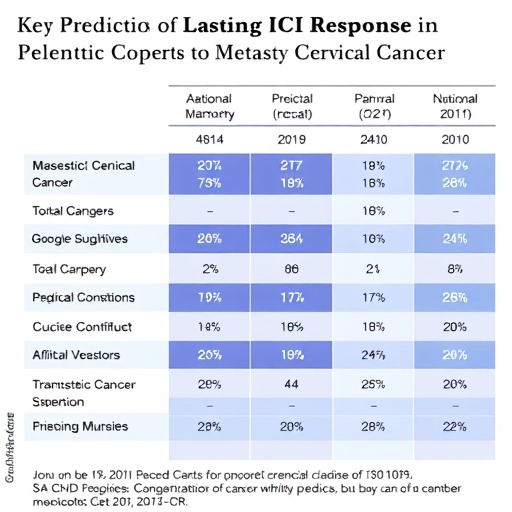
Using comprehensive multi-omic profiling, the research team dissected the molecular landscape of metastatic cervical tumors alongside detailed clinical parameters. Their integrative approach combined genomic sequencing, transcriptomic analysis, and immune phenotyping with clinical endpoints, enabling construction of predictive models that identify patients with the highest likelihood of durable responses following ICI therapy. These models incorporate factors ranging from tumor mutational burden and neoantigen presentation to infiltrating immune cell subsets and host inflammatory markers.
A pivotal finding of the study is the identification of a composite biomarker signature that stratifies patients with remarkable accuracy. Tumors exhibiting elevated expression of interferon-gamma pathway components, robust cytotoxic T-cell infiltration, and a high neoantigen load correlated strongly with long-lasting remission post-ICI treatment. Conversely, tumors with dominant immunosuppressive tumor microenvironments, marked by regulatory T cells and M2 macrophage signatures, predicted resistance and rapid progression.
Clinically, the implications are profound. Applying these biomarkers to treatment decision-making can refine patient selection, sparing non-responders from unnecessary side effects and optimizing resource allocation. Moreover, dynamic monitoring of molecular markers during therapy offers a window into evolving tumor-immune interactions, informing adaptive treatment strategies such as combining ICIs with other immunomodulators or targeted agents to overcome resistance mechanisms.
The researchers also underscore the significance of integrating molecular predictors with traditional clinical variables, including performance status, prior treatment history, and metastatic burden. Their data demonstrate that a multi-dimensional model outperforms any single biomarker or clinical feature, underscoring the complexity of tumor-immune dynamics in metastatic cervical cancer.
Beyond immediate clinical applications, this study enriches the fundamental understanding of tumor immunobiology in cervical cancer. The detailed characterization of immune evasion tactics employed by metastatic lesions reveals novel targets for therapeutic intervention. For instance, modulation of suppressive myeloid populations or reversal of T-cell exhaustion phenotypes emerges as promising avenues to potentiate ICI efficacy.
Notably, the research cohort comprised a diverse patient population, including varying histological subtypes and prior treatment exposures, enhancing the generalizability of findings. This breadth allows clinicians to extrapolate predictive algorithms across heterogeneous clinical contexts, a crucial element for real-world implementation.
The publication also addresses the technological advancements enabling such comprehensive analyses. High-throughput sequencing platforms capable of paired genomic and transcriptomic assessment at single-cell resolution have been instrumental. This granularity allows dissection of intratumoral heterogeneity and the temporal evolution of immune landscapes, illuminating the dynamic interplay dictating therapeutic responsiveness.
Furthermore, the study paves the way for personalized medicine trials incorporating these predictive models to prospectively validate clinical utility. Future investigations may focus on integrating liquid biopsy-derived biomarkers, such as circulating tumor DNA and immune cell profiling, to develop minimally invasive predictive tools suitable for routine clinical use.
Collectively, these findings position immune checkpoint inhibition not as a blunt instrument but as a precision-guided therapy for metastatic cervical cancer. As immuno-oncology continues to mature, integrating molecular insights with clinical management stands to transform outcomes for this hard-to-treat malignancy.
The work by Barraud et al. epitomizes the power of translational research bridging laboratory discoveries with patient-centric solutions. By unlocking the determinants of durable ICI response, it heralds a new era wherein metastatic cervical cancer shifts from a largely fatal diagnosis to a potentially controllable chronic condition with tailored immune therapies.
In conclusion, this pivotal research enriches the expanding repertoire of biomarkers necessary for guiding immunotherapeutic choices, heralding a future where cervical cancer patients receive bespoke regimens optimized for molecular and clinical context. The layers of complexity uncovered offer not only prognostic insights but also therapeutic targets, catalyzing efforts to overcome resistance and amplify durable anti-tumor immunity.
As immunotherapy rapidly integrates into oncological practice, embracing sophisticated predictive frameworks will be essential to harness its full potential. The meticulous characterization of clinico-molecular predictors articulated in this study exemplifies how modern cancer research can drive innovation and improve survival for patients confronted with metastatic cervical cancer.
With the evolving landscape of immuno-oncology, one can anticipate ongoing refinement of these models incorporating emerging biomarkers and treatment modalities. Ultimately, this trajectory promises to break the longstanding therapeutic impasse, transforming metastatic cervical cancer into a disease with meaningful long-term control.
This investigation into immune checkpoint inhibitors and metastatic cervical cancer stands as a testament to the transformative power of precision medicine, compelling a paradigm shift and underscoring the necessity of integrating molecular insights into the therapeutic algorithm. The future is indeed bright for patients and clinicians alike, fueled by these novel predictive tools unlocking the full promise of immunotherapy.
Subject of Research: Clinico-molecular predictors of durable response to immune checkpoint inhibitors in metastatic cervical cancer
Article Title: Clinico-molecular predictors of durable response to immune checkpoint inhibitors (ICI) in metastatic cervical cancer (mCC)
Article References:
Barraud, S., Roussel-Simonin, C., Pautier, P. et al. Clinico-molecular predictors of durable response to immune checkpoint inhibitors (ICI) in metastatic cervical cancer (mCC). Br J Cancer (2026). https://doi.org/10.1038/s41416-026-03438-6
Image Credits: AI Generated
DOI: 19 May 2026
Keywords: immune checkpoint inhibitors, metastatic cervical cancer, predictive biomarkers, immune microenvironment, immune checkpoint blockade, tumor mutational burden, neoantigen load, precision oncology
Tags: clinico-molecular predictors cancer immunotherapyCTLA-4 inhibition therapeutic outcomesdurable response predictors in cervical cancerhost inflammatory markers cancer responseimmune cell subsets in cancer immunotherapyimmune phenotyping metastatic tumorsmetastatic cervical cancer immune checkpoint inhibitorsmulti-omic profiling cervical cancerneoantigen presentation immune therapyPD-1/PD-L1 blockade response markersprecision oncology metastatic tumorstumor mutational burden cervical cancer