• HOME
  • NEWS
  • EXPLORE
    • CAREER
      • Companies
      • Jobs
    • EVENTS
    • iGEM
      • News
      • Team
    • PHOTOS
    • VIDEO
    • WIKI
  • BLOG
  • COMMUNITY
    • FACEBOOK
    • INSTAGRAM
    • TWITTER
Wednesday, August 12, 2026
BIOENGINEER.ORG
No Result
View All Result
  • Login
  • HOME
  • NEWS
  • EXPLORE
    • CAREER
      • Companies
      • Jobs
        • Lecturer
        • PhD Studentship
        • Postdoc
        • Research Assistant
    • EVENTS
    • iGEM
      • News
      • Team
    • PHOTOS
    • VIDEO
    • WIKI
  • BLOG
  • COMMUNITY
    • FACEBOOK
    • INSTAGRAM
    • TWITTER
  • HOME
  • NEWS
  • EXPLORE
    • CAREER
      • Companies
      • Jobs
        • Lecturer
        • PhD Studentship
        • Postdoc
        • Research Assistant
    • EVENTS
    • iGEM
      • News
      • Team
    • PHOTOS
    • VIDEO
    • WIKI
  • BLOG
  • COMMUNITY
    • FACEBOOK
    • INSTAGRAM
    • TWITTER
No Result
View All Result
Bioengineer.org
No Result
View All Result
Home NEWS Science News Health

Kansas State University virologists publish new findings on SARS-CoV-2 treatment option

Bioengineer by Bioengineer
July 2, 2021
in Health
Reading Time: 2 mins read
0
IMAGE
Share on FacebookShare on TwitterShare on LinkedinShare on RedditShare on Telegram

IMAGE

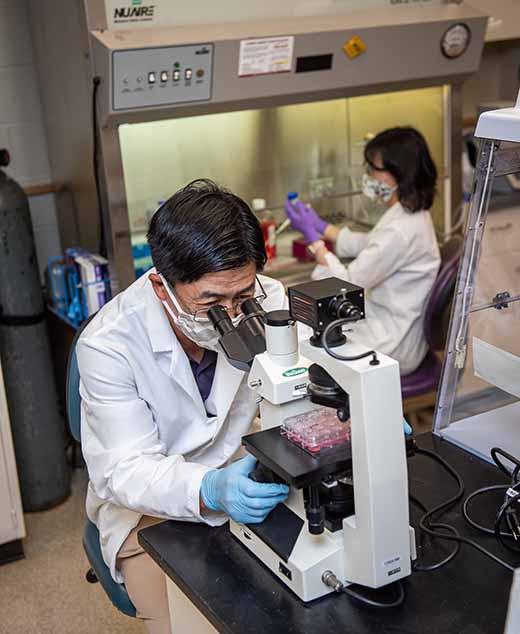
Credit: Kansas State University

MANHATTAN, KANSAS — A recent study by Kansas State University virologists demonstrates successful postinfection treatment for SARS-CoV-2, the virus that causes COVID-19.

College of Veterinary Medicine researchers Yunjeong Kim and Kyeong-Ok “KC” Chang published the study in the prestigious journal Proceedings of the National Academy of Sciences of the United States of America, or PNAS. They found that animal models infected with SARS-CoV-2 and treated with a deuterated protease inhibitor had significantly increased survival and decreased lung viral load.

The results suggest that postinfection treatment with inhibitors of proteases that are essential for viral replication may be an effective treatment against SARS-CoV-2. These protease inhibitors are a class of antiviral drugs that prevent viral replication by selectively binding to viral proteases and blocking the activation of proteins that are necessary for the production of infectious viral particles.

“We developed the protease inhibitor GC376 for treating a fatal coronavirus infection in cats, which is now under commercial development as an investigational new animal drug,” said Kim, associate professor of diagnostic medicine and pathobiology. “After COVID-19 emerged, many research groups reported that this inhibitor is also effective against the coronavirus that causes COVID-19, and many are currently pursuing the development of protease inhibitors as a treatment.”

Kim and Chang modified GC376 using a tool called deuteration to test its efficacy against SARS-CoV-2.

“Treating SARS-CoV-2-infected mice with deuterated GC376 significantly improved survival, viral replication in lungs and weight losses, which shows the efficacy of the antiviral compound,” said Chang, professor of diagnostic medicine and pathobiology. “The results suggest deuterated GC376 has a potential for further development, and this deuteration method can be utilized to other antiviral compounds to generate potent inhibitors.”

The virologists are continuing to develop improved inhibitors using various methods. Deuterated GC376 is currently being evaluated for further potential development.

###

Previous work done by Kim and Chang is continuing development through licensing agreements with industry partners.

Media Contact
Kyeong-Ok Chang
[email protected]

Original Source

https://www.k-state.edu/media/newsreleases/2021-07/chang-kim-pnas-covid.html

Related Journal Article

http://dx.doi.org/10.1073/pnas.2101555118

Tags: BiologyInfectious/Emerging DiseasesMedicine/HealthVirology
Share13Tweet8Share2ShareShareShare2

Related Posts

UC San Diego Health and West Health accelerate the future of patient care

August 12, 2026

Lead Carboxylates Improve Passivation in Meter-Scale Perovskite Solar Modules

August 12, 2026

Early Autism Risk Factors Identified in Five-Year Study of Very Preterm Children

August 12, 2026

AI may enable earlier diagnosis and treatment pathways for Crohn’s disease

August 12, 2026
Please login to join discussion

POPULAR NEWS

  • Hybrid AI system recognizes violence across levels using convolutional-attention and recurrent networks

    29 shares
    Share 12 Tweet 7
  • Finer grains help sodium-ion batteries resist hidden cracking

    29 shares
    Share 12 Tweet 7
  • AI May Reveal Which Tumor Cells Seed Metastasis

    29 shares
    Share 12 Tweet 7
  • Cosmic breadcrumb trail uncovers hidden dark matter

    29 shares
    Share 12 Tweet 7

About

We bring you the latest biotechnology news from best research centers and universities around the world. Check our website.

Follow us

Recent News

Hybrid AI system recognizes violence across levels using convolutional-attention and recurrent networks

Finer grains help sodium-ion batteries resist hidden cracking

AI May Reveal Which Tumor Cells Seed Metastasis

Subscribe to Blog via Email

Enter your email address to subscribe to this blog and receive notifications of new posts by email.

Join 86 other subscribers
  • Contact Us

Bioengineer.org © Copyright 2023 All Rights Reserved.

Welcome Back!

Login to your account below

Forgotten Password?

Retrieve your password

Please enter your username or email address to reset your password.

Log In
No Result
View All Result
  • Homepages
    • Home Page 1
    • Home Page 2
  • News
  • National
  • Business
  • Health
  • Lifestyle
  • Science

Bioengineer.org © Copyright 2023 All Rights Reserved.