• HOME
  • NEWS
  • EXPLORE
    • CAREER
      • Companies
      • Jobs
    • EVENTS
    • iGEM
      • News
      • Team
    • PHOTOS
    • VIDEO
    • WIKI
  • BLOG
  • COMMUNITY
    • FACEBOOK
    • INSTAGRAM
    • TWITTER
Tuesday, August 11, 2026
BIOENGINEER.ORG
No Result
View All Result
  • Login
  • HOME
  • NEWS
  • EXPLORE
    • CAREER
      • Companies
      • Jobs
        • Lecturer
        • PhD Studentship
        • Postdoc
        • Research Assistant
    • EVENTS
    • iGEM
      • News
      • Team
    • PHOTOS
    • VIDEO
    • WIKI
  • BLOG
  • COMMUNITY
    • FACEBOOK
    • INSTAGRAM
    • TWITTER
  • HOME
  • NEWS
  • EXPLORE
    • CAREER
      • Companies
      • Jobs
        • Lecturer
        • PhD Studentship
        • Postdoc
        • Research Assistant
    • EVENTS
    • iGEM
      • News
      • Team
    • PHOTOS
    • VIDEO
    • WIKI
  • BLOG
  • COMMUNITY
    • FACEBOOK
    • INSTAGRAM
    • TWITTER
No Result
View All Result
Bioengineer.org
No Result
View All Result
Home NEWS Science News Biology

Jurassic crocodile discovery sheds light on reptiles’ family tree

Bioengineer by Bioengineer
April 4, 2019
in Biology
Reading Time: 2 mins read
0
IMAGE
Share on FacebookShare on TwitterShare on LinkedinShare on RedditShare on Telegram

Ancient fossil named as new species
IMAGE

Credit: Joschua Knüppe

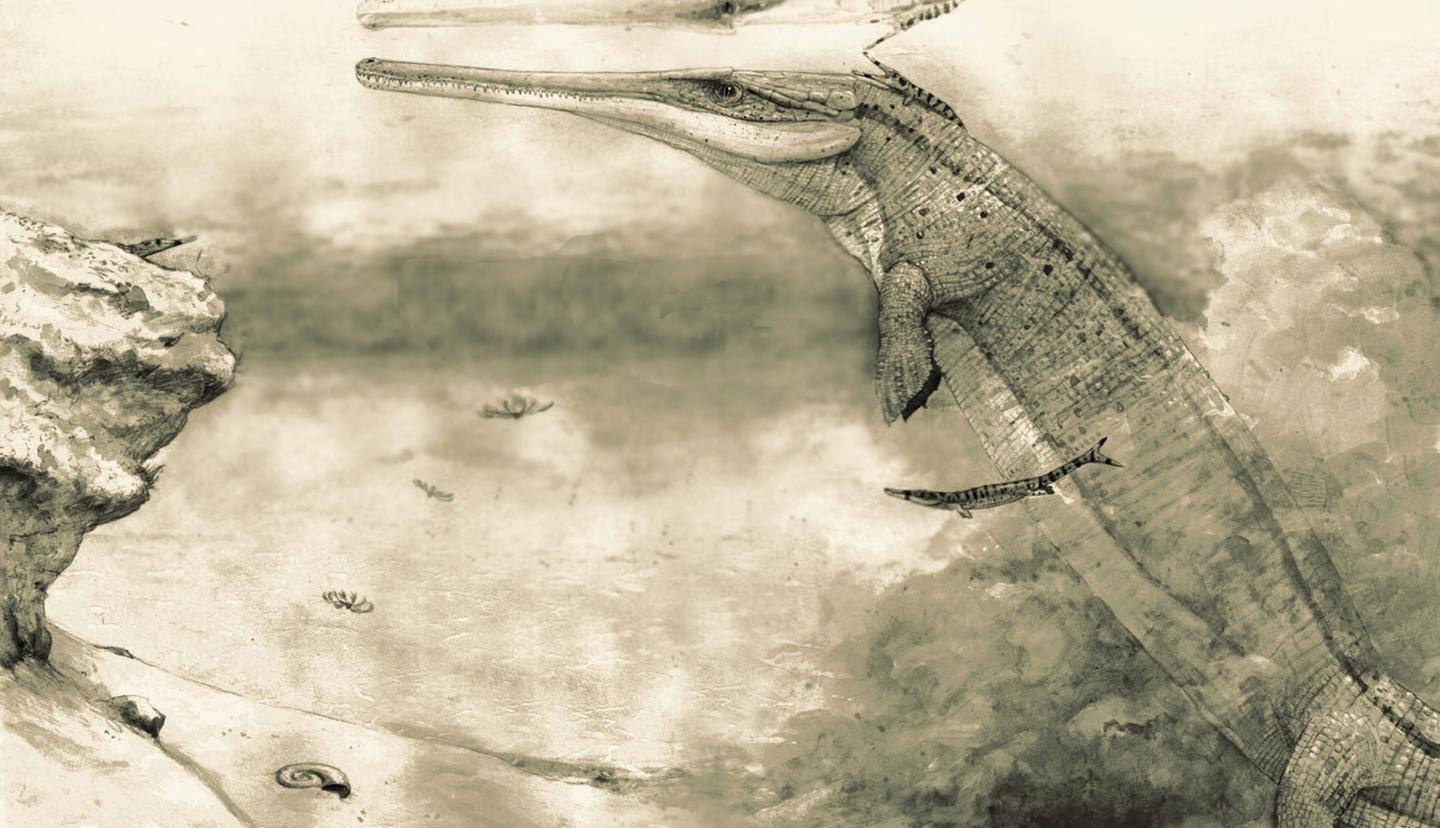
A newly identified species of 150 million-year-old marine crocodile has given insights into how a group of ancient animals evolved.

The ancestor of today’s crocodiles belonged to a group of animals that developed a tail fin and paddle-like limbs for life in the sea, resembling dolphins more than crocodiles.

These slender animals, which fed on fast-moving prey such as squid and small fish, lived during the Jurassic era in shallow seas and lagoons in what is now Germany. Related species have previously been found in Mexico and Argentina.

An international team of scientists, including researchers from Germany and the University of Edinburgh, identified the new species from a remarkably well-preserved skeleton.

The fossil was discovered in 2014 in a quarry near the town of Bamberg in Bavaria, Germany by a team from the Naturkunde-Museum Bamberg, where it is now housed. The species, Cricosaurus bambergensis, takes its name from the town.

Researchers compared the fossil with those from other museum collections, and confirmed that it was a previously unseen species.

The skeleton has several distinguishing features in its jaws, the roof of its mouth and tail, some of which have not been seen in any other species.

Experts created digital images of the fossil in high resolution, to enable further research. They expect the fossil will aid greater understanding of a wider family of ancient animals, known as metriorhynchid, to which this species belonged.

The research, carried out with Naturkunde-Museum Bielefeld, Eberhard-Karls Universität Tübingen and commercial partners Palaeo3D, is published in Acta Palaeontologica Polonica.

Dr Mark Young, of the University of Edinburgh’s School of GeoSciences, who took part in the study, said: “The rock formations of southern Germany continue to give us fresh insights into the age of dinosaurs. These rock layers were deposited at a time when Europe was covered by a shallow sea, with countries such as Germany and the UK being a collection of islands.”

Sven Sachs, from the Naturkunde-Museum Bielefeld, who led the project, said: “The study reveals peculiar features at the palate that have not been described in any fossil crocodile so far. There are two depressions which are separated by a pronounced bar. It is not clear what these depressions were good for.”

###

Media Contact
Catriona Kelly
[email protected]

Original Source

https://www.ed.ac.uk/news/2019/jurassic-crocodile-sheds-light-on-family-tree

Related Journal Article

http://dx.doi.org/10.4202/app.00541.2018

Tags: Earth ScienceEvolutionMarine/Freshwater BiologyPaleontologyZoology/Veterinary Science
Share13Tweet8Share2ShareShareShare2

Related Posts

Gene Family Reveals How Tropical Crops Adapt to Heat

Gene Family Reveals How Tropical Crops Adapt to Heat

August 11, 2026
Fungal Necrotizing Otitis Externa: Three Key Clinical Questions Answered

Fungal Necrotizing Otitis Externa: Three Key Clinical Questions Answered

August 11, 2026

Ophthalmic Foundation Models Advance: Technical Progress, Clinical Evidence, and Unanswered Questions

August 11, 2026

Dogs Distinguish Human Fear from Sadness, Study Finds

August 11, 2026
Please login to join discussion

POPULAR NEWS

  • Blood Metabolomic Signatures Link Air Pollution to Lung Cancer in Prevention Studies

    29 shares
    Share 12 Tweet 7
  • DGAT1 Controls Macrophage Pyroptosis During Klebsiella pneumoniae Infection

    29 shares
    Share 12 Tweet 7
  • ML Identifies Brain Regions Linked to Impulsivity in Young Adults With Obesity

    29 shares
    Share 12 Tweet 7
  • AI Helps NUS Researchers Decode Singapore Shophouses’ Architectural DNA

    29 shares
    Share 12 Tweet 7

About

We bring you the latest biotechnology news from best research centers and universities around the world. Check our website.

Follow us

Recent News

Blood Metabolomic Signatures Link Air Pollution to Lung Cancer in Prevention Studies

DGAT1 Controls Macrophage Pyroptosis During Klebsiella pneumoniae Infection

ML Identifies Brain Regions Linked to Impulsivity in Young Adults With Obesity

Subscribe to Blog via Email

Enter your email address to subscribe to this blog and receive notifications of new posts by email.

Join 86 other subscribers
  • Contact Us

Bioengineer.org © Copyright 2023 All Rights Reserved.

Welcome Back!

Login to your account below

Forgotten Password?

Retrieve your password

Please enter your username or email address to reset your password.

Log In
No Result
View All Result
  • Homepages
    • Home Page 1
    • Home Page 2
  • News
  • National
  • Business
  • Health
  • Lifestyle
  • Science

Bioengineer.org © Copyright 2023 All Rights Reserved.