


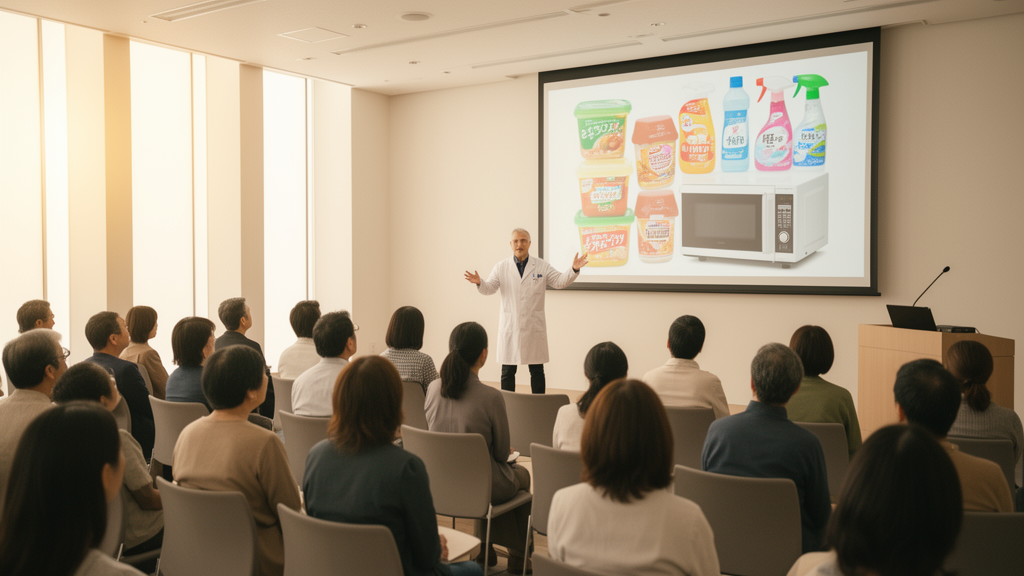
How safe is the food on your plate, the air in your living room, or the bacteria in your gut? Those questions drove the open symposium of the Japanese Environmental Mutagen and Genome Society (JEMS), held on June 14, 2025 under the title “The Science Behind Safety in Our Daily Lives.” The meeting took place at Shimadzu Tokyo Innovation Plaza in Kawasaki, Kanagawa, Japan, with remote attendance via Microsoft Teams in a hybrid format. Organized annually to present cutting-edge technologies and science related to genetic toxicology and environmental mutagenesis to the public, the symposium this year featured presentations by five scientists, including both JEMS and non-JEMS members. The organizers, Naoki Koyama of Chugai Pharmaceutical and Masataka Tsuda of the National Institute of Health Sciences, presented a summary of the event in a meeting report published in the journal Genes and Environment.
The symposium opened with an inaugural speech by Tomonari Matsuda, president of the Japanese Environmental Mutagen and Genome Society and a researcher at Kyoto University, followed by an introduction from Naoki Koyama. The program was divided into two sessions. The first, chaired by Masataka Tsuda, addressed the safety of pharmaceuticals and foods, with talks on chemical substances in pharmaceuticals and foods, the health effects of per- and polyfluoroalkyl substances known as PFAS, and radioactive substances and food safety after the Fukushima Daiichi Nuclear Power Plant accident. The second session, chaired by Koyama, covered environmental exposure and health risks, including formaldehyde in indoor and ambient air and colibactin, a genotoxin produced by certain gut bacteria that has been implicated in colorectal cancer. Masataka Tsuda delivered the concluding speech.
The first presentation, by Masamitsu Honma of the National Institute of Health Sciences, asked a deceptively simple question: is it safe to eat? His answer hinged on a distinction central to modern toxicology. Genotoxic carcinogens can induce DNA damage and mutations even at very low doses, whereas non-genotoxic carcinogens exhibit threshold-dependent risks, allowing regulators to establish acceptable exposure levels. Honma explained essential risk assessment concepts, including dose–response relationships and threshold values, using quantitative indices such as the TD50, the tumorigenic dose rate 50, and the virtually safe dose. Through case studies of historical and naturally occurring substances—AF-2, a banned food additive; arsenic found in rice and hijiki; benzo[a]pyrene in smoked foods; and acrylamide formed during high-temperature cooking—he demonstrated how carcinogenic potency and actual human exposure levels differ, highlighting the contrast between scientifically assessed risks and public perception and underscoring the need for evidence-based risk communication.
Honma also turned to recent regulatory initiatives targeting genotoxic impurities in pharmaceuticals, with particular focus on nitrosamines, a class of compounds that has drawn international attention after being detected in some drug products. In alignment with international guidelines such as ICH-M7, he introduced the Carcinogenic Potency Categorization Approach, or CPCA, a structure-based framework that enables more refined classification of nitrosamines and supports the setting of substance-specific acceptable intake limits. He concluded by emphasizing that while zero risk is unattainable, science-based regulation grounded in quantitative thresholds plays a vital role in protecting public health. He stressed the importance of effective risk communication to help the public understand these scientific principles and to alleviate growing concerns over chemical safety in daily life.
The second talk, by Akihiko Hirose of the Chemicals Evaluation and Research Institute, examined the health effects of PFAS, a family of synthetic chemicals that has become one of the most prominent environmental health concerns worldwide. Hirose explained that PFAS is a collective term for various organofluorine compounds, and that multiple definitions exist for identifying them. According to the OECD’s 2018 definition, over 4,730 PFAS-related compounds had been identified, but following revisions in 2021, it is now estimated that over 10,000 PFAS-related compounds fall under this category. Due to their water- and oil-repellent properties and high physical and chemical stability, PFAS are widely used in solvents, surfactants, water- and stain-resistant coatings for textiles, leather, and paper, ion-exchange membranes, lubricants, firefighting foams, semiconductor production, and as processing aids for fluoropolymers.
On the question of genotoxicity, Hirose noted that PFOS, PFOA, and PFHxS do not exhibit direct genotoxicity, although some studies have shown that they can cause secondary DNA damage through oxidative stress. For that reason, the threshold approach is considered appropriate for evaluating the tolerable daily intakes of these PFAS compounds. He also presented toxicological and epidemiological data indicating potential adverse health effects associated with PFAS exposure, including liver toxicity, thyroid disruption, immunotoxicity, and developmental and reproductive effects. He summarized recent regulatory trends in Japan and other countries, and stressed the importance of science-based risk assessment and effective public communication in addressing PFAS-related concerns.
The third presentation shifted from synthetic chemicals to radioactive substances. Tomoaki Tsutsumi of the Division of Foods at the National Institute of Health Sciences spoke on food safety initiatives and their current status following the Fukushima Daiichi nuclear power plant accident, which was triggered by the Great East Japan Earthquake in March 2011. The accident led to widespread contamination of food with radioactive substances, presenting a major challenge to food hygiene and public health. In response, provisional regulatory values were promptly introduced, and in April 2012, the present standard limits for radioactive substances in food were established under the Food Sanitation Act. Tsutsumi provided an overview of the current regulatory framework and presented recent data on radioactive cesium levels, internal radiation dose estimates from dietary intake, and trends in radioactive cesium—cesium-134 and cesium-137—and strontium-90. He emphasized Japan’s ongoing efforts to ensure food safety through continuous monitoring, risk management, and transparent communication with the public.
The second session opened with Kenichi Azuma of the Faculty of Medicine at Kindai University, who presented on the health effects of formaldehyde in indoor and ambient air. Formaldehyde has been widely used in disinfectants, wood adhesives, paints, and molded products. It is identified as a representative causative agent of “sick building syndrome,” because urea resins used as adhesives in plywood for flooring, wall materials, and furniture hydrolyze, releasing formaldehyde into the air and contaminating indoor environments. While formaldehyde had shown positive results in numerous genotoxicity tests, suggesting its genotoxic potential, Azuma highlighted that its toxic effects on tissues at contact sites were non-linear and highly concentration-dependent. This characteristic suggested the possibility of establishing a threshold for low-concentration exposure, an approach that could allow regulators to define safe indoor air levels rather than treating any detectable amount as hazardous.
The final talk took the audience inside the human gut. Kenji Watanabe of the School of Pharmaceutical Sciences at the University of Shizuoka presented on colibactin, a genotoxin produced by certain bacteria in the gut microbiota, and its role in colorectal cancer. Colibactin is identified as a genotoxic substance that induces DNA damage in mammalian cells, strongly implicating it as a causative agent of colorectal cancer. Although its structure was initially unknown due to instability, it has recently been elucidated. Substantial experimental evidence supports its carcinogenic role, including the detection of colibactin-DNA adducts and the discovery of specific mutation signatures induced by colibactin-producing bacteria in human colorectal cancer cell genomes. To prevent colibactin-induced cancer, Watanabe developed an IgM monoclonal antibody, specific to E. coli-50, for the rapid detection of colibactin-producing bacteria. Its epitope was identified as the E. coli O antigen, specifically the lipopolysaccharide’s sugar chain. An IgG monoclonal antibody was subsequently generated, and he reported on its specificity and its epitope’s glycan unit chemical structure, enabling immunostaining and neutralizing antibody production.
The symposium successfully brought together approximately 100 participants to explore these critical health-risk issues. Notably, 40 percent of the attendees were non-JEMS members, including members of the general public, which the organizers described as illustrating the success of their outreach efforts to promote public awareness of everyday safety science. The hybrid format, accommodating both in-person attendees and those joining online, allowed active engagement from a wide range of participants. As the organizers noted in their meeting report, the challenges of daily life—constant exposure to pharmaceuticals, food, and indoor environments that are increasingly susceptible to potential hazards from chemical, biological, and physical agents—highlight the urgent need for robust, effective systems that can swiftly and comprehensively respond to health crises. The symposium aimed to bridge the gap between complex scientific knowledge and public understanding by raising awareness of essential safety measures related to pharmaceuticals, food, and immediate living environments.
Subject of Research: Safety science in daily life, including pharmaceuticals, food, and environmental health risks
Article Title: The science behind safety in our daily life: the open symposium of the Japanese environmental mutagen and genome society (JEMS), 2025
Article References: Koyama, N., & Tsuda, M. (2025). The science behind safety in our daily life: the open symposium of the Japanese environmental mutagen and genome society (JEMS), 2025. Genes and Environment, 47(1), Article 23. https://doi.org/10.1186/s41021-025-00346-8
Image Credits: AI Generated
DOI: 10.1186/s41021-025-00346-8
Keywords: JEMS, genetic toxicology, environmental mutagenesis, PFAS, food safety, radioactive cesium, formaldehyde, colibactin, nitrosamines, risk assessment, carcinogens, public health
News Source: Drew Townsend. (October 30, 2026). Japanese Safety Science Symposium Brings Everyday Health Risks to the Public. Scienmag.



