• HOME
  • NEWS
  • EXPLORE
    • CAREER
      • Companies
      • Jobs
    • EVENTS
    • iGEM
      • News
      • Team
    • PHOTOS
    • VIDEO
    • WIKI
  • BLOG
  • COMMUNITY
    • FACEBOOK
    • INSTAGRAM
    • TWITTER
Monday, May 11, 2026
BIOENGINEER.ORG
No Result
View All Result
  • Login
  • HOME
  • NEWS
  • EXPLORE
    • CAREER
      • Companies
      • Jobs
        • Lecturer
        • PhD Studentship
        • Postdoc
        • Research Assistant
    • EVENTS
    • iGEM
      • News
      • Team
    • PHOTOS
    • VIDEO
    • WIKI
  • BLOG
  • COMMUNITY
    • FACEBOOK
    • INSTAGRAM
    • TWITTER
  • HOME
  • NEWS
  • EXPLORE
    • CAREER
      • Companies
      • Jobs
        • Lecturer
        • PhD Studentship
        • Postdoc
        • Research Assistant
    • EVENTS
    • iGEM
      • News
      • Team
    • PHOTOS
    • VIDEO
    • WIKI
  • BLOG
  • COMMUNITY
    • FACEBOOK
    • INSTAGRAM
    • TWITTER
No Result
View All Result
Bioengineer.org
No Result
View All Result
Home NEWS Science News Chemistry

IU team identifies potential target for restoring movement after spinal cord injury

Bioengineer by Bioengineer
December 20, 2019
in Chemistry
Reading Time: 2 mins read
0
IMAGE
Share on FacebookShare on TwitterShare on LinkedinShare on RedditShare on Telegram

IMAGE

Credit: IU School of Medicine


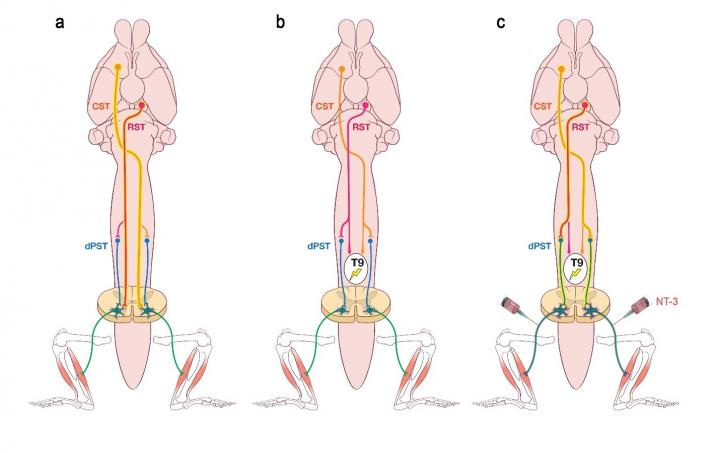
INDIANAPOLIS — Researchers at Indiana University School of Medicine have made several novel discoveries in the field of spinal cord injuries (SCI). Most recently, the team led by Xiao-Ming Xu, PhD, has been working to determine how to activate movement after a spinal cord injury at the ninth thoracic level, where nerve fibers from the brain down to the spinal cord are interrupted. Instead of focusing on the injury site, researcher Qi Han and his colleagues modulated the spared lumbar circuits below the injury to improve recovery from SCI, using animal models. The team revealed that neuromodulation of interrupted lumbar motor circuits by neurotrophic therapy improved locomotor performance. These findings are being published in the December 20 issue of Nature Communications.
“There are no definitive treatments yet for SCI patients,” said Han. “However, hope for restoring motor function continues to rise, for good reason. We find that, despite no direct damage from thoracic SCI, the lumbar circuit undergoes a profound neurodegeneration, which we have highlighted as a promising new therapeutic target for promoting neuroprotection.”

SCI disrupts pathways at the injury site and affects MNs by causing their dendrites to withdraw or atrophy below the injury, which can lead to diminished movement or locomotor function. Previously, the research team was able to improve locomotor recovery and reduce MN dendritic atrophy after a moderate, contusive SCI at the ninth thoracic level, by transporting Neurotrophin-3 (NT-3) to lumbar MNs. NT-3 is known as a trophic factor that contributes neuronal survival and growth. These latest research findings extend the role of NT-3 to modulating propriospinal-MN circuit reorganization, which accounts for improvement of locomotor function after SCI.

Researchers were also able to determine that a moderate injury at the ninth thoracic level stops the corticospinal tract and rubrospinal tract projections down to the spinal cord, but maintains some neural transmissions which can be reinforced by the NT-3 therapy. Additionally, they discovered the spared pathway, made up of a collection of nerve fibers, namely, the descending propriospinal pathway, connecting to the lumbar spinal cord, is functionally associated with NT-3-mediated locomotor recovery after SCI. Their research also suggests that NT-3 supports MN recovery by promoting dendritic regrowth.

Xu says he hopes their research findings in animal models will lay the groundwork for more NT-3 therapy research to help patients with SCI in the future.

“Modulating propriospinal-MN circuitry with NT-3 gene therapy could be an attractive strategy to enable functional recovery after SCI.” said Xu.

###

IU School of Medicine is the largest medical school in the U.S. and is annually ranked among the top medical schools in the nation by U.S. News & World Report. The school offers high-quality medical education, access to leading medical research and rich campus life in nine Indiana cities, including rural and urban locations consistently recognized for livability.

Media Contact
Anna Carrera
[email protected]
614-570-6503

Related Journal Article

http://dx.doi.org/10.1038/s41467-019-13854-3

Tags: BiotechnologyCell BiologyElectrical Engineering/ElectronicsMedicine/HealthNanotechnology/MicromachinesPhysiologyPublic HealthRehabilitation/Prosthetics/Plastic SurgeryTrauma/Injury
Share13Tweet8Share2ShareShareShare2

Related Posts

Miniature Sensor Uses Light to Detect Touch — Chemistry

Miniature Sensor Uses Light to Detect Touch

May 8, 2026
Iron Minerals Determine Whether Dissolved Organic Matter Fuels Microbes or Becomes Long-Term Carbon Storage — Chemistry

Iron Minerals Determine Whether Dissolved Organic Matter Fuels Microbes or Becomes Long-Term Carbon Storage

May 8, 2026

Kate Evans Appointed Associate Lab Director for Biological and Environmental Systems Science at ORNL

May 8, 2026

Advancing Multiscale Modeling and Overcoming Operational Challenges in Autothermal COâ‚‚-to-Methanol Reactors

May 8, 2026
Please login to join discussion

POPULAR NEWS

  • Research Indicates Potential Connection Between Prenatal Medication Exposure and Elevated Autism Risk

    840 shares
    Share 336 Tweet 210
  • New Study Reveals Plants Can Detect the Sound of Rain

    727 shares
    Share 290 Tweet 181
  • Salmonella Haem Blocks Macrophages, Boosts Infection

    61 shares
    Share 24 Tweet 15
  • Breastmilk Balances E. coli and Beneficial Bacteria in Infant Gut Microbiomes

    57 shares
    Share 23 Tweet 14

About

We bring you the latest biotechnology news from best research centers and universities around the world. Check our website.

Follow us

Recent News

New Post-Hoc Analysis Explores Daily Oral Orforglipron Use in Adults Over 65 with Obesity, Regardless of Diabetes Status

Evaluating Digoxin Use in Patients with Symptomatic Rheumatic Heart Disease

Evaluating the Effectiveness and Safety of Digitalis Glycosides in Treating Heart Failure

Subscribe to Blog via Email

Enter your email address to subscribe to this blog and receive notifications of new posts by email.

Join 82 other subscribers
  • Contact Us

Bioengineer.org © Copyright 2023 All Rights Reserved.

Welcome Back!

Login to your account below

Forgotten Password?

Retrieve your password

Please enter your username or email address to reset your password.

Log In
No Result
View All Result
  • Homepages
    • Home Page 1
    • Home Page 2
  • News
  • National
  • Business
  • Health
  • Lifestyle
  • Science

Bioengineer.org © Copyright 2023 All Rights Reserved.