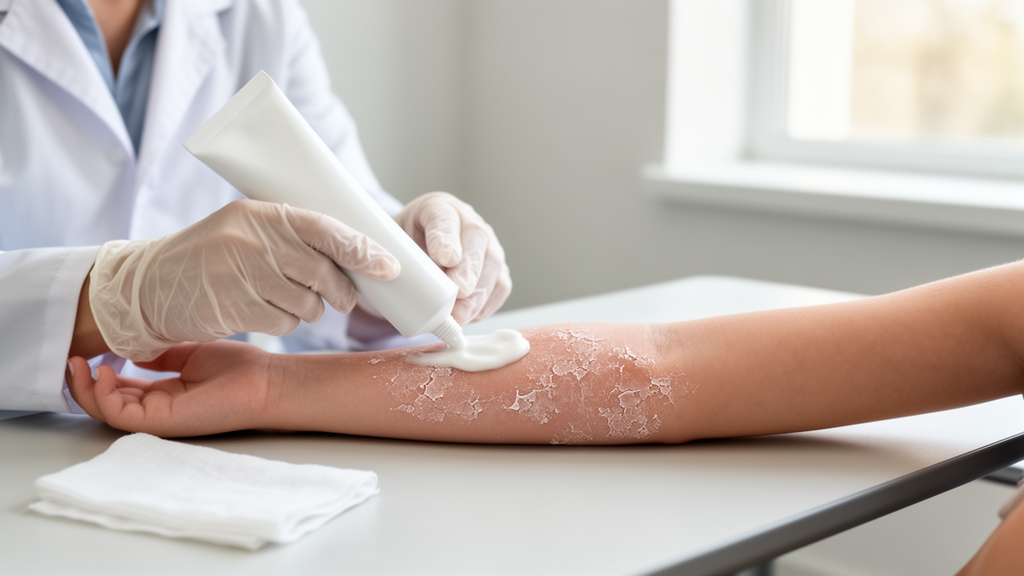
A rare and often devastating genetic skin disorder may have a new experimental option on the horizon, according to a report published in Dermatology and Therapy. Researchers describe the first use of QRX003, an investigational topical lotion, in a pediatric patient with Netherton syndrome, applied on a compassionate-use basis and followed for 21 months. Over that period, the child’s skin severity scores fell from severe to nearly clear, her chronic itch largely resolved, and she stopped needing antihistamines, glucocorticoids, and antivirals. The authors are careful, however, to frame these observations as exactly what they are: findings from a single, uncontrolled case that cannot establish causality, but that may point the way toward more rigorous trials.
Netherton syndrome is a rare autosomal recessive disorder caused by loss-of-function variants in both copies of the SPINK5 gene, which encodes LEKTI, a serine protease inhibitor crucial for regulating kallikrein enzymes in the skin. Without functional LEKTI, kallikreins—particularly KLK5, KLK7, and KLK14—become hyperactive, prematurely cleaving corneodesmosomes in the stratum corneum and accelerating desquamation, the process by which the skin sheds its outermost cells. The result is a thin, porous skin barrier that loses water easily and admits allergens, microbes, and irritants. Unchecked KLK5 activity can also activate protease-activated receptor 2 signaling and promote thymic stromal lymphopoietin-mediated inflammatory pathways, which are implicated in the atopic phenotype of the disease and intensify pruritus. The resulting inflammation creates a self-reinforcing feedback loop that further impairs barrier integrity and exacerbates kallikrein activity.
Clinically, the disease is defined by a hallmark triad: congenital ichthyosiform erythroderma, a distinctive hair shaft abnormality called trichorrhexis invaginata or bamboo hair, and immune dysregulation with elevated immunoglobulin E levels. The erythroderma typically appears as persistent, diffuse redness with variable scaling at birth or shortly thereafter. Infants often present with failure to thrive, hypoproteinemia, and recurrent infections, frequently leading to multiple hospitalizations per year. Because their compromised skin barrier impairs water retention, affected individuals are vulnerable to severe dehydration. Beyond the triad, Netherton syndrome is multisystemic: patients may suffer severe pruritus, chronic discomfort, growth delays, nutritional deficiencies, feeding challenges, and disrupted sleep, along with psychosocial burdens including social stigma, emotional distress, anxiety, and low self-esteem that can begin in early childhood and persist throughout life.
The condition is estimated to occur in roughly one in 200,000 live births and has been reported across all ethnic groups, though the true prevalence may be higher because of misdiagnosis, limited clinical awareness, and underreporting of neonatal fatalities. Diagnosis is complicated by phenotypic overlap with other forms of ichthyosis and by heterogeneous disease expression, making genetic testing essential to confirm the diagnosis and guide management. Presentation is highly variable, ranging from fatal cases in infancy to milder forms that may go undiagnosed into adulthood.
Today, there are no disease-specific therapies approved for Netherton syndrome. Management remains largely symptomatic and supportive, relying on topical emollients and moisturizers, topical glucocorticoids, calcineurin inhibitors, topical retinoids, and phototherapy such as narrowband UVB and PUVA. These approaches aim to reduce dryness, scaling, pruritus, and infection risk, but they carry notable drawbacks. Some moisturizers containing lanolin or petrolatum may exacerbate skin damage through friction on already fragile skin and can promote infection, and moisturizers typically must be applied five to six times daily, a burden for patients. Standard topical agents risk skin thinning and systemic absorption, which are especially concerning in Netherton syndrome because the compromised barrier increases susceptibility to percutaneous absorption and potential toxicity.
In recent years, case studies have reported the use of targeted biologic therapies, including anti-TNF-alpha, anti-IL-17, IL-12/IL-23 and IL-4Ralpha neutralizing antibodies, JAK inhibitors, and immunoglobulin therapy. Dupilumab, which blocks IL-4 and IL-13 signaling through IL-4Ralpha, has been reported to improve pruritus and inflammatory skin manifestations in some patients, though effects on other features such as hair growth have been variable. A placebo-controlled trial of the IL-36R antibody spesolimab enrolled 43 patients but was terminated early, and a Phase 1 study of topical ATR-12-351 enrolled six patients and has been completed, while a Phase 1 study of BCX17725 given intravenously and subcutaneously was ongoing at the time the report was prepared. Published clinical evidence for biologic and small-molecule therapies in Netherton syndrome remains limited largely to case reports and reviews.
QRX003 was designed to target the underlying molecular mechanism rather than the symptoms. The lotion contains 4% dipalmitoyl hydroxyproline, or DPHP, a synthetic hydroxyproline-derived lipoamino acid that acts as a competitive broad-spectrum serine protease inhibitor, delivered through a proprietary polymer-based technology. The development rationale rests on the known role of kallikrein dysregulation in the disease and on preclinical evidence supporting epidermal kallikrein inhibition as a disease-relevant strategy. By modulating elevated kallikrein activity associated with deficient LEKTI function, QRX003 is hypothesized to promote a more normalized skin-shedding process and support formation of a stronger, more effective epidermal barrier. DPHP has a long history of use in cosmetic formulations under the trade name SEPILIFT DPHP, marketed for moisturizing and skin-conditioning effects, and material-safety documentation reports no skin-irritation or skin-sensitization classification and negative findings in standard in vitro genotoxicity assays, though eye-irritation and aquatic-hazard considerations are noted. No prior independent peer-reviewed human clinical studies of QRX003 itself have been published.
The case report centers on a pediatric patient under 14 years of age, diagnosed with Netherton syndrome shortly after birth and confirmed by genetic testing showing compound heterozygosity for pathogenic SPINK5 variants. Before treatment, roughly 80% of her body area was affected, she experienced nightly sleep disturbances, and prior treatments—including intermittent topical glucocorticoids and calcineurin inhibitors, courses of oral antibiotics and antivirals for secondary infections, and ultimately dupilumab, which failed to help her other symptoms—had provided only partial or short-lived relief. Her medical history also included eosinophilic esophagitis and multiple food allergies. Compassionate use was requested by her physician and approved by the Children’s Health Ireland Drugs and Therapeutics Committee, with the lotion supplied by the manufacturer and dispensed through the hospital pharmacy.
At baseline, her Investigator’s Global Assessment score was 4, the top of the 0-to-4 scale, and her Worst Itch Numerical Rating Scale score was 5, indicating moderate itch. Treatment began once daily on the arms and legs for about five weeks, was briefly interrupted for unrelated gastrointestinal issues, and then resumed as once-daily whole-body application. After six weeks of whole-body use, her IGA score had fallen from 4, severe, to 1, almost clear, and her itch score had dropped from 5 to 1, mild itch. By eight months, both scores reached 0, indicating clear skin and no itch. Across the full 21 months of follow-up she remained mostly at IGA 0 with occasional episodes at IGA 1, and no scores of 2, 3, or 4 were recorded. She was able to discontinue all antihistamines, glucocorticoids, and antivirals, has required no antibiotics since whole-body application began, and for the first time sleeps through the night without sedating medications. Symptom worsening during treatment interruption and improvement after reinitiation were reported, which the authors describe as consistent with a possible treatment-associated effect.
Safety observations in this single patient were reassuring but preliminary. No adverse events considered treatment-related were reported by the family or the treating physician. The patient experienced peeling for one week after initial application, judged not clinically significant, and reported a brief cooling sensation for a few minutes after each application, with no pain. Clinical photographs taken during routine compassionate-use care were not acquired under a standardized photographic protocol, so visual comparisons should be interpreted descriptively. The authors emphasize that the report is limited by its single-patient, uncontrolled design, concomitant background therapy, reliance on clinical observation and investigator- and family-reported outcomes, and the absence of blinded assessment or biomarker confirmation of kallikrein modulation. Regulatory bodies have signaled the unmet need: the EMA granted Orphan Drug Designation in June 2025, the FDA granted Rare Pediatric Disease Designation in June 2025 and Orphan Drug designation in October 2025, and Fast Track Designation followed in March 2026. QRX003 is now being evaluated in open-label and controlled studies and an expanded-access protocol, as well as in peeling skin syndrome and other ichthyosis-related disorders, with ongoing trials intended to systematically characterize its safety, tolerability, dosing, pharmacodynamic effects, and clinical activity.
Subject of Research: An investigational topical serine protease inhibitor lotion, QRX003, evaluated in a pediatric compassionate-use case of Netherton syndrome.
Article Title: An Investigational Mechanism-Informed Therapy for Netherton Syndrome: Introduction to QRX003 and A Pediatric Compassionate-Use Case Report
Article References: Irvine, A. D., Hovnanian, A., Myers, M., & Carter, D. (2026). An Investigational Mechanism-Informed Therapy for Netherton Syndrome: Introduction to QRX003 and A Pediatric Compassionate-Use Case Report. Dermatology and Therapy. https://doi.org/10.1007/s13555-026-01948-y
Image Credits: AI Generated
DOI: 10.1007/s13555-026-01948-y
Keywords: Netherton syndrome, QRX003, DPHP, serine protease inhibitor, kallikrein, LEKTI, SPINK5, compassionate use, skin barrier, ichthyosis, orphan drug, pruritus
News Source: Ophelia Keating. (October 29, 2026). Investigational Lotion QRX003 Shows Early Promise in Netherton Syndrome Case. Scienmag.