• HOME
  • NEWS
  • EXPLORE
    • CAREER
      • Companies
      • Jobs
    • EVENTS
    • iGEM
      • News
      • Team
    • PHOTOS
    • VIDEO
    • WIKI
  • BLOG
  • COMMUNITY
    • FACEBOOK
    • INSTAGRAM
    • TWITTER
Wednesday, May 13, 2026
BIOENGINEER.ORG
No Result
View All Result
  • Login
  • HOME
  • NEWS
  • EXPLORE
    • CAREER
      • Companies
      • Jobs
        • Lecturer
        • PhD Studentship
        • Postdoc
        • Research Assistant
    • EVENTS
    • iGEM
      • News
      • Team
    • PHOTOS
    • VIDEO
    • WIKI
  • BLOG
  • COMMUNITY
    • FACEBOOK
    • INSTAGRAM
    • TWITTER
  • HOME
  • NEWS
  • EXPLORE
    • CAREER
      • Companies
      • Jobs
        • Lecturer
        • PhD Studentship
        • Postdoc
        • Research Assistant
    • EVENTS
    • iGEM
      • News
      • Team
    • PHOTOS
    • VIDEO
    • WIKI
  • BLOG
  • COMMUNITY
    • FACEBOOK
    • INSTAGRAM
    • TWITTER
No Result
View All Result
Bioengineer.org
No Result
View All Result
Home NEWS Science News Biology

International team discover new species of flying reptiles

Bioengineer by Bioengineer
March 26, 2020
in Biology
Reading Time: 2 mins read
0
IMAGE
Share on FacebookShare on TwitterShare on LinkedinShare on RedditShare on Telegram

IMAGE

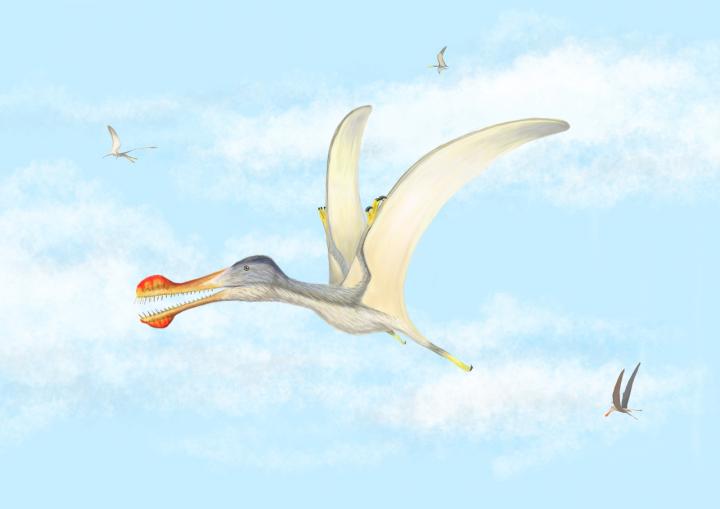
Credit: Nizar Ibrahim, University of Detroit Mercy


A community of flying reptiles that inhabited the Sahara 100 million years ago has been discovered by a University of Portsmouth palaeontologist and an international team of scientists.

Professor David Martill from Portsmouth and researchers from the United States and Morocco identified the three new species of toothed pterosaurs.

The pterosaurs were part of an ancient river ecosystem in Africa that was full of life, including fish, crocodiles, turtles and several predatory dinosaurs.

The research was led by Megan Jacobs from Baylor University, Texas, who worked alongside Professor Martill and Nizar Ibrahim from the University of Detroit Mercy.

The new fossils, published in the journal Cretaceous Research, are helping to uncover the very poorly known evolutionary history of Africa during the time of the dinosaurs. The new finds show that African pterosaurs were quite similar to those found on other continents.

These flying predators soared above a world dominated by predators, including crocodile-like hunters and carnivorous dinosaurs. Interestingly, herbivores such as sauropods and ornithischian dinosaurs are rare. Many of the predators, including the toothed pterosaurs, preyed on a superabundance of fish.

Professor Martill said: “We are in a golden age for discovering pterodactyles. This year alone we have discovered three new species and we are only into March.”

The new pterosaurs identified by the researchers from chunks of jaws and teeth, found in the middle Cretaceous Kem Kem beds of Morocco, had wingspans of around three to four metres. These aerial fishers snatched up their prey while on the wing, using a murderous looking set of large spike-like teeth that formed a highly effective tooth grab. Large pterosaurs such as these would have been able to forage over vast distances, similar to present day birds such as condors and albatrosses.

“These new finds provide an important window into the world of African pterosaurs,” said Ibrahim, assistant professor of Biology at Detroit Mercy. “We know so much more about pterosaurs from places like Europe and Asia, so describing new specimens from Africa is always very exciting.”

One of the species, Anhanguera, was previously only known from Brazil. Another, Ornithocheirus, had until now only been found in England and Middle Asia.

###

Media Contact
Sophie Wagstaff
[email protected]
07-966-314-727

Original Source

https://www.port.ac.uk/news-events-and-blogs/news/international-team-discover-new-species-of-flying-reptiles

Related Journal Article

http://dx.doi.org/10.1016/j.cretres.2020.104413

Tags: Earth SciencePaleontology
Share12Tweet8Share2ShareShareShare2

Related Posts

Using Real-Time Brain Signals to Forecast and Prevent Attention Lapses in Children — Biology

Using Real-Time Brain Signals to Forecast and Prevent Attention Lapses in Children

May 13, 2026
Cutting-Edge Genomic Techniques Reveal Unexpected Cellular Changes in the Aging Brain — Biology

Cutting-Edge Genomic Techniques Reveal Unexpected Cellular Changes in the Aging Brain

May 12, 2026

USC Researchers Initiate Study on the Most Advanced Lab-Grown Kidney Structures

May 12, 2026

Childbirth in Humans Is Not Uniquely Challenging Among Mammals, New Research Shows

May 12, 2026
Please login to join discussion

POPULAR NEWS

  • Research Indicates Potential Connection Between Prenatal Medication Exposure and Elevated Autism Risk

    842 shares
    Share 337 Tweet 211
  • New Study Reveals Plants Can Detect the Sound of Rain

    728 shares
    Share 290 Tweet 182
  • Salmonella Haem Blocks Macrophages, Boosts Infection

    62 shares
    Share 25 Tweet 16
  • Breastmilk Balances E. coli and Beneficial Bacteria in Infant Gut Microbiomes

    57 shares
    Share 23 Tweet 14

About

We bring you the latest biotechnology news from best research centers and universities around the world. Check our website.

Follow us

Recent News

Perimenopause Presents a Key Window for Heart Disease Prevention in Women

Penn Scientists Develop AI Tool to Accelerate Antibiotic Discovery

MIT-MGH Team Develops Novel Cancer Vaccine Strategy That Enhances T Cell Potency

Subscribe to Blog via Email

Enter your email address to subscribe to this blog and receive notifications of new posts by email.

Join 82 other subscribers
  • Contact Us

Bioengineer.org © Copyright 2023 All Rights Reserved.

Welcome Back!

Login to your account below

Forgotten Password?

Retrieve your password

Please enter your username or email address to reset your password.

Log In
No Result
View All Result
  • Homepages
    • Home Page 1
    • Home Page 2
  • News
  • National
  • Business
  • Health
  • Lifestyle
  • Science

Bioengineer.org © Copyright 2023 All Rights Reserved.