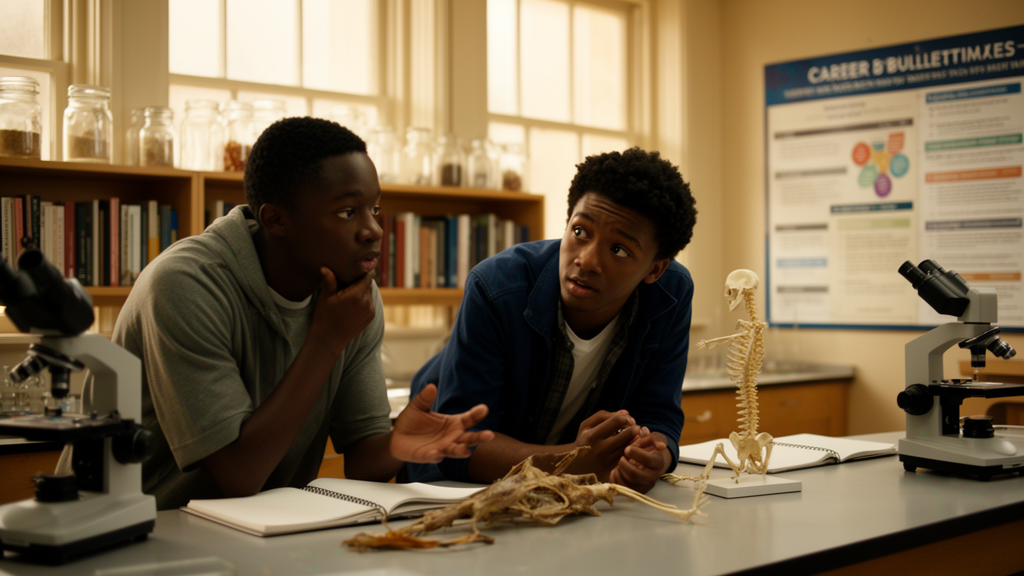
Most Black and African American undergraduates in a new qualitative study found evolution genuinely fascinating, yet very few could picture themselves working in the field. Researchers at a large public university in the northeastern United States interviewed 51 Black and African American undergraduates, roughly 26 percent of all self-identified Black or African American students taking introductory biology there between Fall 2019 and Spring 2022, to understand how they think about careers and what shapes those choices. The interviews, each lasting about an hour, revealed a tangled web of influences: religion, family expectations, thin knowledge of what evolution careers actually involve, and a keen awareness of the field’s racist history and persistent lack of racial diversity.
The study, published as an open access article in April 2026, used a constructivist qualitative design with semi-structured interviews conducted over Zoom during the summer of 2021 and spring of 2022. Interviews lasted 45 to 60 minutes and were conducted by two undergraduate researchers who shared socially defined racial or ethnic identities with participants, a choice the authors say built rapport while demanding careful reflexivity. Approximately 50 hours of recordings were transcribed and analyzed using the constant comparative method, with four independent coders reviewing transcripts line by line and resolving discrepancies by consensus until theoretical saturation was reached. Two biology education researchers then audited the coding.
Participants were enrolled in or had completed an introductory evolution-focused biology course. Their backgrounds varied widely: 42 percent had never taken a college-level biology course before, 52 percent were biology majors, 54 percent were freshmen or sophomores, and 73 percent identified as female. Alongside the interviews, validated instruments measured evolution knowledge, acceptance, perceived conflict, and religiosity. Participants spanned the full range of the religiosity scale, averaging 21.58 out of 36, and their evolution acceptance averaged 71.5 out of 95, showing substantial heterogeneity rather than a single profile.
Thematic analysis identified three broad factors shaping perceptions of evolutionary biology careers: career compatibility, career knowledge, and family influence. On compatibility, the sample split notably. Of the 51 participants, 22 identified low to very low compatibility between themselves and an evolution career, mostly citing limited interest, while 19 identified high to very high compatibility. Yet even interested students tended to see evolution as peripheral to their real goals. Many connected it to medicine, the most common career interest among biology majors at the institution, describing evolution as foundational for understanding disease but absent from day-to-day clinical practice.
Interest in evolution as a subject was strikingly broad: 41 of 51 participants called it an interesting topic, often crediting college coursework, particularly classes on human evolution, for transforming their engagement. Some described learning experiences as breathtaking or eye-opening. But intellectual curiosity rarely translated into vocational commitment. Several participants explicitly distinguished enjoying evolution as an academic subject from wanting to pursue it professionally, and even one participant majoring in evolutionary biology said they did not want a career in the field. One student who did want an evolution career worried they lacked the information to judge whether it was viable, noting they did not know whether it paid as well as dentistry or whether they would enjoy research.
Religion emerged as a powerful and double-edged influence. Twenty-four participants described religion as a very important source of support and 19 as somewhat important, citing comfort during academic stress and social connection. Fourteen of 48 respondents said faith played a large role in decision-making. For some, perceived conflict between religious beliefs and evolutionary principles, especially around human origins, made evolution-related careers untenable; 22 of 51 participants reported at least some conflict. One participant said simply that they would not want a career related to something they did not believe in. Importantly, however, the majority, 29 of 51, reported no conflict, describing compartmentalization, open-mindedness, or even compatibility between faith and evolution.
Race and representation weighed heavily on career compatibility. Twenty-four participants mentioned the visible lack of racial diversity in evolutionary biology, and several said they had never encountered a mentor or scientist in evolution who shared their racial background. Although no interview questions mentioned racism, seven participants directly linked underrepresentation to racial bias and anticipated microaggressions or doubts about whether they would be accepted by peers. Three participants pointed to the historical misuse of evolutionary ideas, including eugenics and pseudoscientific research on race and intelligence, as an additional deterrent. Others expressed cautious optimism, suggesting that increased representation could help counter the field’s racist legacy, though notably no participants identified support for diversification from the groups currently dominating these roles.
Career knowledge gaps compounded the problem. Nine participants who felt they knew about evolution careers held narrow views, imagining work focused on animals, dinosaurs, archaeology, or outdoor adventure. Ten of 51 participants expressed outright confusion, with several asking interviewers to clarify what an evolution career even meant. Some connected this ignorance to their environments, saying evolution careers were rarely presented to minority students. The authors note that real careers in evolutionary biology span genetics, medicine, environmental science, computational biology, and public health, options far broader than students imagined.
Family exerted perhaps the most intricate influence. Participants reported strong family support, most often emotional and financial, but also described family expectations steering them toward prestigious, financially secure careers like medicine or law. Twenty of 51 participants said their families were unfamiliar with evolution-related careers, and seven reported family concerns about financial instability in such paths. Discussing evolution at home was also fraught: 14 participants described conversations about evolution and religion with family as very difficult and 22 as slightly difficult, often because of strong religious beliefs, particularly around human evolution, while 15 described such discussions as relatively easy.
The authors emphasize remarkable heterogeneity across responses and caution that findings from a single flagship public R1 university in the Northeast may not generalize, especially given regional differences in religiosity and the geographic distribution of the U.S. Black population. Still, the findings motivate concrete recommendations: inclusive pedagogies that acknowledge the history of exclusion, career counseling that showcases diverse evolution-aligned professionals, curricula embedding career awareness in biology degrees, and resources students can share with families to demystify the field. The study’s core message is that interest in evolution is not the bottleneck; unclear pathways, racialized concerns about belonging, and family and religious contexts are what stand between curiosity and career.
Subject of Research: Career decision-making influences among Black and African American undergraduates in evolutionary biology
Article Title: Identifying the complex factors influencing evolutionary biology career interests among black and African American undergraduates
Article References: Montañez, G. N., Ozcan, K., Goodridge, J. A., Nehm, R. H., & Sbeglia, G. C. (2026). Identifying the complex factors influencing evolutionary biology career interests among black and African American undergraduates. Developmental Biology Advances, 17(1), Article 10. https://doi.org/10.1186/s13227-026-00266-w
Image Credits: AI Generated
DOI: 10.1186/s13227-026-00266-w
Keywords: evolutionary biology, career choice, underrepresentation, qualitative interviews, religion and science, family influence, STEM diversity, science education, Black undergraduates, career knowledge, belonging, Identifying
News Source: Gavin Prescott. (October 29, 2026). Interest in Evolution Runs High, but Black Undergraduates See Few Viable Career Paths. Scienmag.