First commercial pour of engineered graphene concrete takes place in UK using Manchester technology
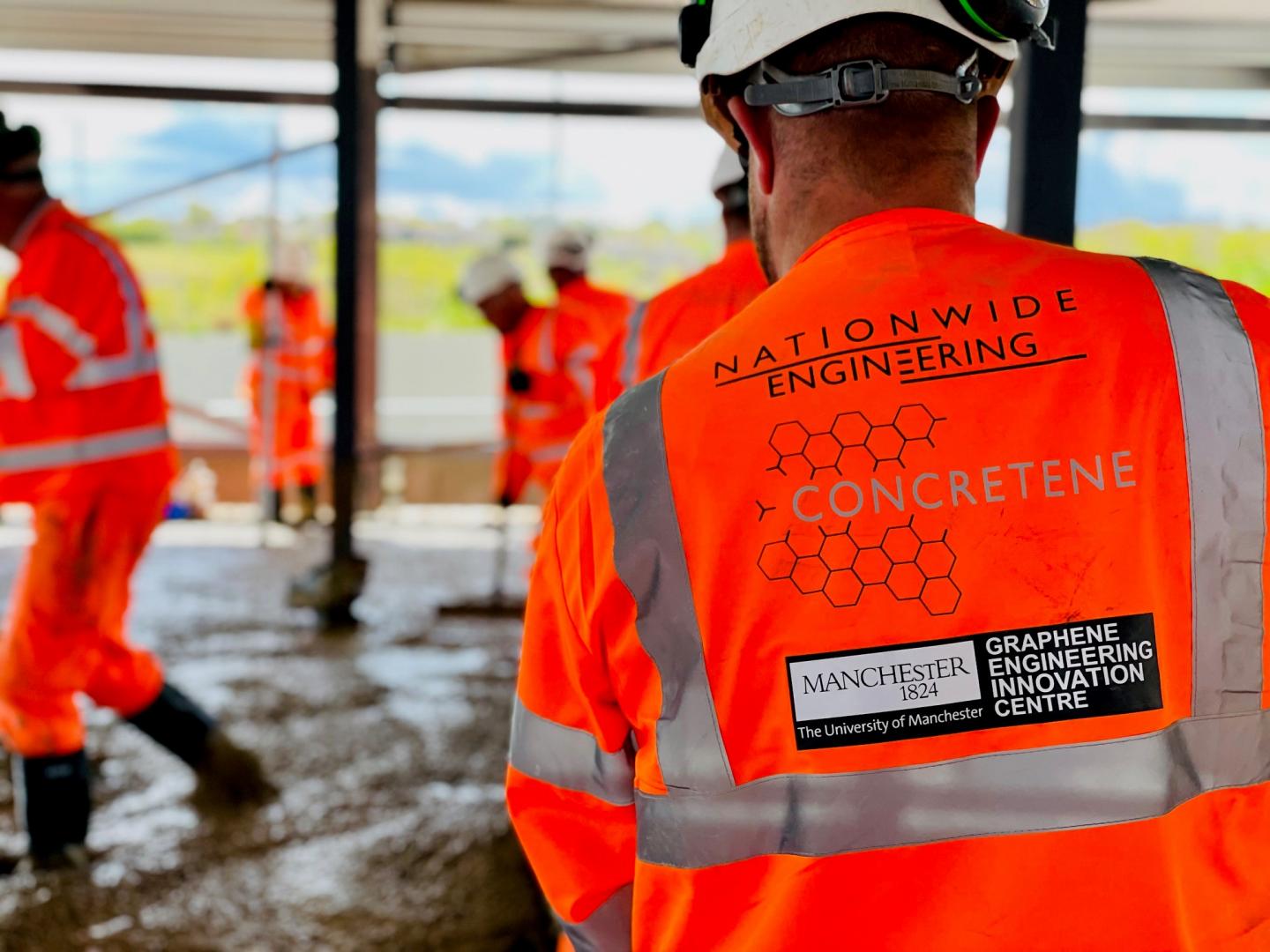
Credit: The University of Manchester/Nationwide Engineering
Manchester innovation pioneers score world first for sustainable construction with graphene concrete.
Construction firm Nationwide Engineering will make a piece of history on Tuesday 25 May, as it completes the laying of the world’s first graphene concrete slab engineered for sustainability in a commercial setting – the new material is strengthened by around 30% compared to standard concrete and so significantly cutting material use.
Just a couple of miles east of the ancient monument of Stonehenge, the new Southern Quarter gym in Amesbury’s Solstice Park – owned and run by military veterans and due to open in summer 2021 – is the venue for this innovation milestone, made possible by a joint venture between Nationwide Engineering and The University of Manchester.
The innovation team have pioneered this breakthrough material in to help significantly reduce CO2 emissions in construction. The production of cement – the ‘glue’ for concrete – is one of the leading causes of global carbon dioxide emissions, producing around 8% of global CO2 emissions.
The addition of tiny amounts of graphene – a 2D material made of a single layer of carbon atoms – strengthens Nationwide Engineering’s new product, Concretene, by around 30% compared to standard concrete, meaning significantly less material is needed to achieve the equivalent structural performance, reducing carbon footprint and costs.
The additional strength also reduces the need for steel reinforcement, saving material and time on site and further promoting the green credentials of this building method.
Nationwide Engineering estimates that an additional cost of 5% for Concretene will be offset by the reduction in material to deliver an overall saving of 10-20% over standard RC30 concrete.
“We are thrilled to have developed and constructed this game-changing, graphene-enhanced concrete on a real project,” said Alex McDermott, co-founder and managing director of Nationwide Engineering.
“Together with our partners at The University of Manchester’s Graphene Engineering Innovation Centre and structural engineers HBPW Consulting, we are rapidly evolving our knowledge and experience and are positioned for wider industry deployment through our construction frameworks, becoming the go-to company for graphene-enhanced concrete.”
Nationwide Engineering has three existing five-year construction frameworks with Network Rail and two seven-year Government Crown commercial building frameworks. With Network Rail committing to an 11% reduction in CO2 emissions over the next four years, graphene-enhanced concrete shows significant potential to help meet this target.
How does Concretene work? Liquid concrete sets into its solid form through chemical reactions known as hydration and gelation, where the water and cement in the mixture react to form a paste that dries and hardens over time.
Graphene makes a difference by acting as a mechanical support and as a catalyst surface for the initial hydration reaction, leading to better bonding at microscopic scale and giving the finished product improved strength, durability and corrosion resistance.
Crucially, Concretene can be used just like standard concrete, meaning no new equipment or training is needed in the batching or laying process, and cost-savings can be passed directly to the client.
Dr Craig Dawson, Application Manager at the Graphene Engineering Innovation Centre, explained further: “We have produced a graphene-based additive mixture that is non-disruptive at the point of use. That means we can dose our additive directly at the batching plant where the concrete is being produced as part of their existing system, so there’s no change to production or to the construction guys laying the floor.
“We have been able to do this via thorough investigation – alongside our University colleagues from the Department of Mechanical, Aerospace and Civil Engineering – of the materials we are using and we can tailor this approach to use any supplier’s graphene, so we are not beholden to a single supplier,” he added. “This makes Concretene a more viable proposition as there is increased security of supply.”
At Amesbury, an initial pour of 234m2 of Concretene was conducted on site on 6 May, with a further 495m2 to be laid on Tuesday 25 May to complete the concrete floor slab. The graphene used for the pour on 25 May is supplied by Versarien plc.
Nationwide Engineering will manage and monitor the site during its fit-out and onward operation, effectively creating a ‘living laboratory’ at Southern Quarter to measure and evaluate the performance of the material.
###
Media Contact
James Tallentire
[email protected]
Original Source
https:/