• HOME
  • NEWS
  • EXPLORE
    • CAREER
      • Companies
      • Jobs
    • EVENTS
    • iGEM
      • News
      • Team
    • PHOTOS
    • VIDEO
    • WIKI
  • BLOG
  • COMMUNITY
    • FACEBOOK
    • INSTAGRAM
    • TWITTER
Tuesday, July 7, 2026
BIOENGINEER.ORG
No Result
View All Result
  • Login
  • HOME
  • NEWS
  • EXPLORE
    • CAREER
      • Companies
      • Jobs
        • Lecturer
        • PhD Studentship
        • Postdoc
        • Research Assistant
    • EVENTS
    • iGEM
      • News
      • Team
    • PHOTOS
    • VIDEO
    • WIKI
  • BLOG
  • COMMUNITY
    • FACEBOOK
    • INSTAGRAM
    • TWITTER
  • HOME
  • NEWS
  • EXPLORE
    • CAREER
      • Companies
      • Jobs
        • Lecturer
        • PhD Studentship
        • Postdoc
        • Research Assistant
    • EVENTS
    • iGEM
      • News
      • Team
    • PHOTOS
    • VIDEO
    • WIKI
  • BLOG
  • COMMUNITY
    • FACEBOOK
    • INSTAGRAM
    • TWITTER
No Result
View All Result
Bioengineer.org
No Result
View All Result
Home NEWS Science News Biology

In vitro grafts increase blood flow in infarcted rat hearts

Bioengineer by Bioengineer
February 5, 2019
in Biology
Reading Time: 2 mins read
0
IMAGE
Share on FacebookShare on TwitterShare on LinkedinShare on RedditShare on Telegram

Stem-cell scientists show that petri dish-built matrices of vessels integrate well with existing heart tissue
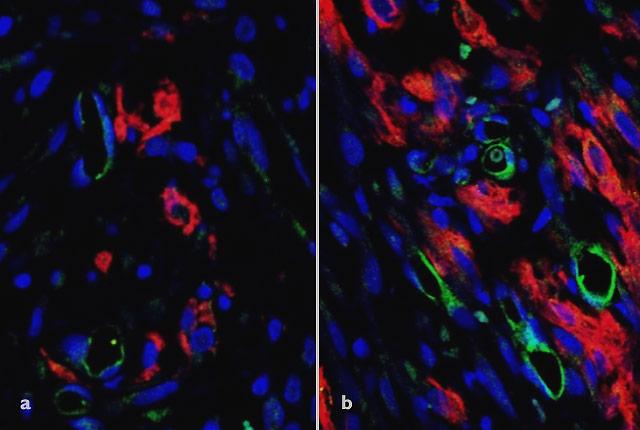
IMAGE

Credit: Nicole Zeinstra / University of Washington Bioengineering


Advances in stem cell research offer hope for treatments that could help patients regrow heart muscle tissue after heart attacks, a key to achieving more complete recovery.

Scientists today report success in creating functional blood vessels in vitro for hearts of rats that had sustained a heart attack. The journal Nature Communications published the paper, whose lead authors are Ying Zheng and Charles Murry of the UW Medicine Institute for Stem Cell and Regenerative Medicine in Seattle.

“To our knowledge, this is the first demonstration that building organized blood vessels with perfusion outside the body leads to improved integration with host blood vessels and better tissue blood flow,” said Zheng, a University of Washington associate professor of bioengineering.

The scientists set out to show that by growing stem cell-derived heart tissue in a petri dish, with attention to blood vessels’ construction, they could improve the tissue’s incorporation with existing heart vessels.

“I come from a mechanical background,” Zheng continued. “I love thinking about the dynamics of blood flow. Our whole bodies are vascularized. This network of vessels is dynamic and interconnected, like a transportation system that remodels itself all the time.”

Disruption to blood flow during a heart attack leads to significant loss of heart muscle and heart function. Heart muscle grown from stem cells must not only survive and integrate with the host tissue, but it must also restore adequate blood flow, explained Murry. He is a UW professor of pathology, bioengineering, and medicine/cardiology.

The research team used human stem cells to create a vascularized construct, or patch, with a functioning network of blood vessels that mimics the vasculature of a human heart.

“Being able to organize the vessels in the tissue outside the body was very important,” Zheng said. “When we implanted the patch, we saw that the stem cell-derived tissue integrated effectively with the host’s coronary circulation. This improved blood flow to the engineered tissue and gave it the nutrients it needed to survive.”

Optical microangiography imaging techniques developed by Ricky Wang, a UW professor of bioengineering, revealed that blood flow within the grafts was twentyfold higher than has been reported for any other such graft. This suggested that nurturing the tissue in the lab had a meaningful benefit for the heart cells before they were implanted into the rats’ hearts, the researchers said.

###

The work was funded by National Institutes of Health grant (R01HL141570).

Media Contact
Brian Donohue
[email protected]
206-543-7856

Original Source

https://newsroom.uw.edu/news/vitro-grafts-increase-blood-flow-infarcted-rat-hearts

Related Journal Article

http://dx.doi.org/10.1038/s41467-019-08388-7

Tags: Biomedical/Environmental/Chemical EngineeringCardiologyCell BiologyMedicine/Health
Share12Tweet8Share2ShareShareShare2

Related Posts

Here are a few rewritten headlines for a science magazine post, each with a slightly different tone: Intriguing & poetic: How do organs sculpt themselves? Sea stars hold the secret Direct & research-focused: Sea stars reveal the hidden rules of organ formation Metaphorical & inviting: Tiny architects beneath the waves: What sea stars teach us about building organs Short & punchy: Star-shaped clues to how our organs take shape Question-led: Could a sea star show us how organs form? Elegant & feature-style: The body’s blueprint, glimpsed in a sea star’s arm

July 6, 2026
Bacteria evolve faster with unconventional gene copies — Biology

Bacteria evolve faster with unconventional gene copies

July 6, 2026

Neighbours rewire soil feedback via root microbiome shifts

July 6, 2026

Evolution-Inspired Biosensors Revolutionize Lipid Tracking in Real Time

July 2, 2026
Please login to join discussion

POPULAR NEWS

  • Detection of EDCs in Breast Milk and Infant Urine Up to Six Months Highlights Early Exposure Risks

    77 shares
    Share 31 Tweet 19
  • New Drug Candidate Developed at McMaster Shows Potential for Treating Brain Cancer

    58 shares
    Share 23 Tweet 15
  • Saying Goodbye to PGY-6: Pediatric Fellowship Realities

    103 shares
    Share 41 Tweet 26
  • KTU Researchers Explore Ultrasound’s Role in Enhancing Blood Flow Beyond Diagnostics

    53 shares
    Share 21 Tweet 13

About

We bring you the latest biotechnology news from best research centers and universities around the world. Check our website.

Follow us

Recent News

Flame retardant BDE-209 targets molecularly linked to ulcerative colitis

Ultra-high frequency particle impacts mimic rockbursts to shatter hard rock

Kidney transplant outcomes in older adults studied by German researchers

Subscribe to Blog via Email

Enter your email address to subscribe to this blog and receive notifications of new posts by email.

Join 83 other subscribers
  • Contact Us

Bioengineer.org © Copyright 2023 All Rights Reserved.

Welcome Back!

Login to your account below

Forgotten Password?

Retrieve your password

Please enter your username or email address to reset your password.

Log In
No Result
View All Result
  • Homepages
    • Home Page 1
    • Home Page 2
  • News
  • National
  • Business
  • Health
  • Lifestyle
  • Science

Bioengineer.org © Copyright 2023 All Rights Reserved.